Commercial Real Estate Loan Requirements: What Lenders Look For & Essential Checklist
Understanding commercial real estate loan requirements before submitting an application is the most effective way to accelerate your approval timeline and avoid unexpected declines. Commercial underwriters evaluate a combination of property financial metrics, borrower creditworthiness, and market dynamics.
Whether acquiring owner-occupied retail space or expanding an industrial real estate portfolio, reviewing standard commercial real estate lending criteria ensures your business presents a financially compelling loan package.
What Do Lenders Look For in Commercial Real Estate Financing?
When underwriting commercial mortgages, lenders evaluate the property’s cash flow (Net Operating Income), Debt Service Coverage Ratio (DSCR, typically 1.20x–1.25x+), Loan-to-Value ratio (65%–80%), and tenant strength, along with the borrower’s credit score (680+), liquidity, net worth, and industry operational experience.
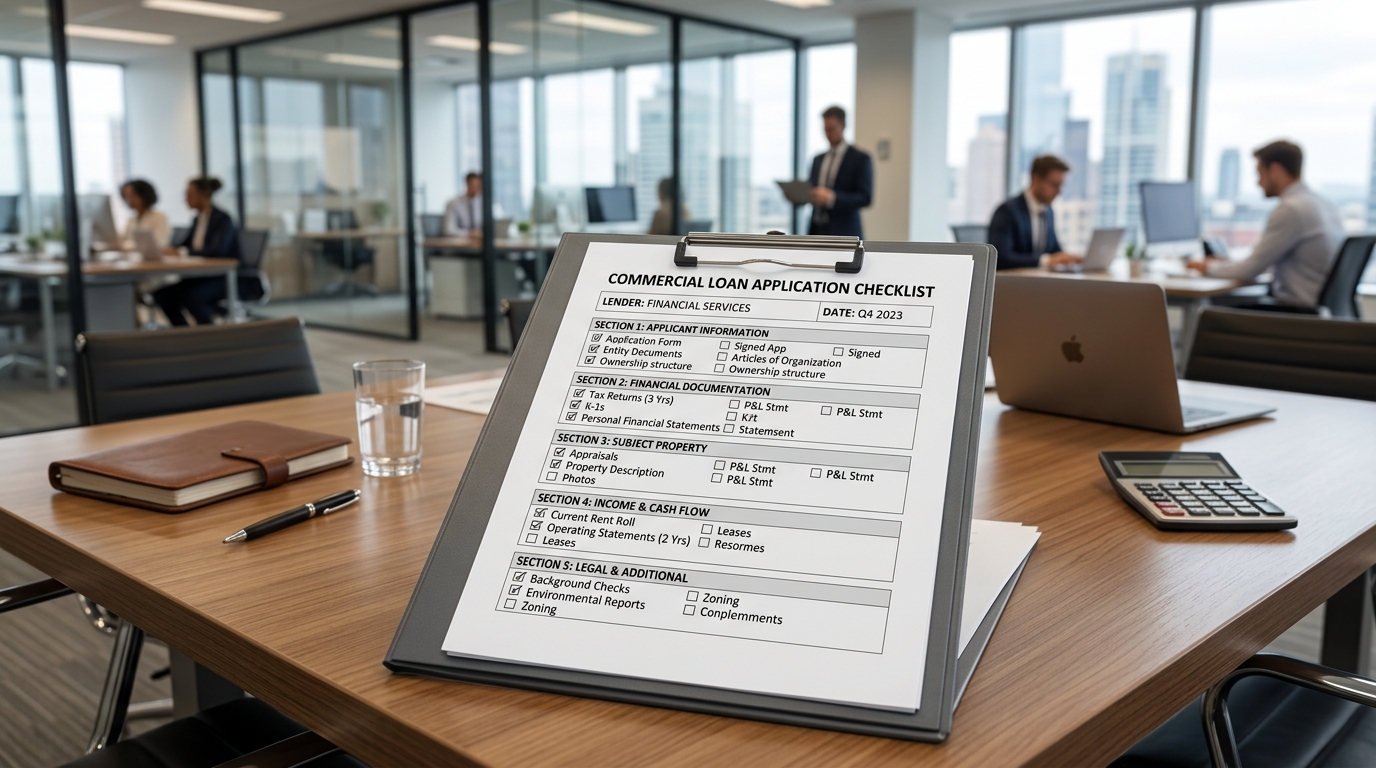
A comprehensive checklist outlining the key requirements lenders evaluate for commercial real estate financing.
Borrower Credit Score and Liquidity
Commercial lenders evaluate key equity principals holding 20% or more ownership in the borrowing entity:
- Credit Score Standards: Conventional lenders require personal credit scores of 680 or higher, with scores above 720 securing optimal interest rates.
- Post-Closing Liquidity: Lenders require borrowers to maintain liquid cash reserves (savings, money market, uncollected stocks) equal to 6 to 12 months of loan principal, interest, taxes, and insurance (PITI) payments post-closing.
- Net Worth Requirements: Many institutions expect the principal guarantors’ combined net worth to equal or exceed the total requested commercial loan amount.
Debt Service Coverage Ratio (DSCR) Requirements
The Debt Service Coverage Ratio (DSCR) measures a commercial property’s ability to cover its annual debt service payments from net operating cash flow:
$$\text{DSCR} = \frac{\text{Net Operating Income (NOI)}}{\text{Annual Debt Principal + Interest Payments}}$$
- Minimum Threshold: Standard commercial banks mandate a minimum DSCR of 1.25x.
- SBA Loan Programs: SBA 7(a) and 504 programs typically require a minimum historical or projected DSCR of 1.15x to 1.20x.
- Specialized Property Types: Riskier assets like hospitality, restaurants, or single-tenant retail may require a higher DSCR threshold of 1.35x to 1.40x.
To calculate potential loan coverage and monthly payments under different interest rates, utilize our interactive commercial loan calculator to test your cash flow scenarios.
Down Payment and Loan-to-Value (LTV) Ratios
Loan-to-Value (LTV) limits dictate the required borrower down payment:
- Conventional Commercial Loans: LTV ranges between 65% and 75%, requiring a 25% to 35% cash down payment.
- SBA 504 and 7(a) Loans: Permit LTVs up to 90%, requiring as little as a 10% equity down payment for owner-occupied business properties.
- Commercial Bridge Loans: Focus on Loan-to-Cost (LTC) or Loan-to-Value (LTV) up to 75%–80% based on stabilized post-renovation values.
Before finalizing purchase offers, make sure you review foundational commercial real estate loan basics to choose the right financing program for your capital budget.
Commercial Real Estate Loan Eligibility & Lending Criteria
To qualify for commercial real estate loans, borrowers and properties must satisfy core commercial real estate loan qualifications:
| Criterion | Conventional Bank Loans | SBA 504 & 7(a) Loans | Private / Bridge Loans |
|---|---|---|---|
| Min. Credit Score | 680–700 | 680+ | 620–650 |
| Min. DSCR | 1.25x | 1.15x–1.20x | 1.00x–1.15x |
| Max. LTV | 65%–75% | Up to 90% | 70%–80% |
| Property Occupancy | Investment or Owner-Occupied | 51%+ Owner-Occupied | Investment / Value-Add |
| Prepayment Penalty | Standard (Yield Maint. / Step-down) | Declining (First 3 years for 504) | Flexible / None |
Essential Commercial Loan Documents Needed
Incomplete paperwork is the single most common cause of commercial underwriting delays. Gathering all commercial loan documents needed in advance ensures a smooth approval process.

A collection of essential documents typically required for commercial loan application approval, neatly arranged on a desk.
Personal and Business Financial Statements
Borrowers must submit corporate and personal financial disclosures:
* Business Tax Returns: Full corporate federal returns for the past 3 consecutive years.
* Personal Tax Returns: Personal federal returns for all principals owning 20%+ of the business entity.
* Year-to-Date Financials: Interim P&L and Balance Sheet signed within the last 60 days.
* Personal Financial Statement (PFS): Standardized SBA Form 413 or bank equivalent listing personal assets, liabilities, and liquid reserves.
Property Tax Returns and Rent Rolls
For income-producing investment properties, lenders require asset-level documentation:
* Property Operating Statements: Year-end profit and loss statements for the past 3 years.
* Certified Rent Roll: Current tenant lease summaries detailing monthly rents, lease start/expiration dates, security deposits, and tenant renewal options.
* Lease Agreements: Executed copies of all existing commercial tenant contracts.
For a comprehensive step-by-step walkthrough of how these documents are evaluated during approval, read our guide on applying for a commercial real estate loan.
Commercial Real Estate Loan Checklist
Use this actionable checklist to assemble your commercial real estate loan application package:
1. Borrower & Corporate Documentation
- [ ] Articles of Incorporation, LLC Operating Agreement, or Partnership Agreement
- [ ] Certificate of Good Standing from State Secretary
- [ ] Driver’s License or Government ID copies for all major owners
- [ ] Business Plan and Executive Resume detailing industry experience
2. Financial & Tax Documentation
- [ ] 3 years of Corporate Tax Returns ( signed )
- [ ] 3 years of Personal Tax Returns for 20%+ owners ( signed )
- [ ] YTD Business Income Statement (P&L) and Balance Sheet
- [ ] Personal Financial Statement (PFS) for each guarantor
- [ ] 3 to 6 months of corporate bank statements proving liquidity reserves
3. Property Information & Contracts
- [ ] Fully executed Purchase and Sale Agreement (PSA) or Refinance Closing Statement
- [ ] Property Rent Roll with lease expiration dates and security deposits
- [ ] Historical property operating statements (3 years)
- [ ] Property tax bills and insurance declaration policies
- [ ] Environmental reports or previous property appraisals (if available)
FAQ: Commercial Real Estate Loan Requirements
What do lenders look for when approving a commercial real estate loan?
Lenders evaluate two main factors: the property’s financial performance and the borrower’s creditworthiness. Key property parameters include the Debt Service Coverage Ratio (DSCR, typically 1.25x+) and Loan-to-Value ratio (LTV, typically 65%–75%). Key borrower parameters include a personal credit score of 680+, 6–12 months of liquid reserves, and relevant management experience.
What documents are required for a commercial real estate loan application?
Applicants must provide 3 years of corporate and personal tax returns, interim year-to-date financial statements (P&L and balance sheet), personal financial statements (PFS), corporate organizational documents, purchase contracts, and property-level operating statements with current rent rolls.
What is the minimum down payment for a commercial property loan?
Minimum down payment requirements depend on the loan program. SBA 504 and 7(a) loans require as little as 10% down for owner-occupied properties. Conventional commercial real estate loans typically require a 20% to 35% down payment (65%–80% LTV).