How to Finance Commercial Property: 2026 Action Plan
Financing a commercial building or expansion project is a strategic process that requires financial preparation, asset analysis, and targeted lender outreach. Whether you are an investor building a real estate portfolio or a business owner securing space for your operations, navigating the commercial loan process efficiently can save you tens of thousands of dollars in interest and fees.
This actionable guide outlines exact steps on how to finance commercial property in 2026, breaking down financial requirements, application procedures, building-specific strategies, and execution tactics.
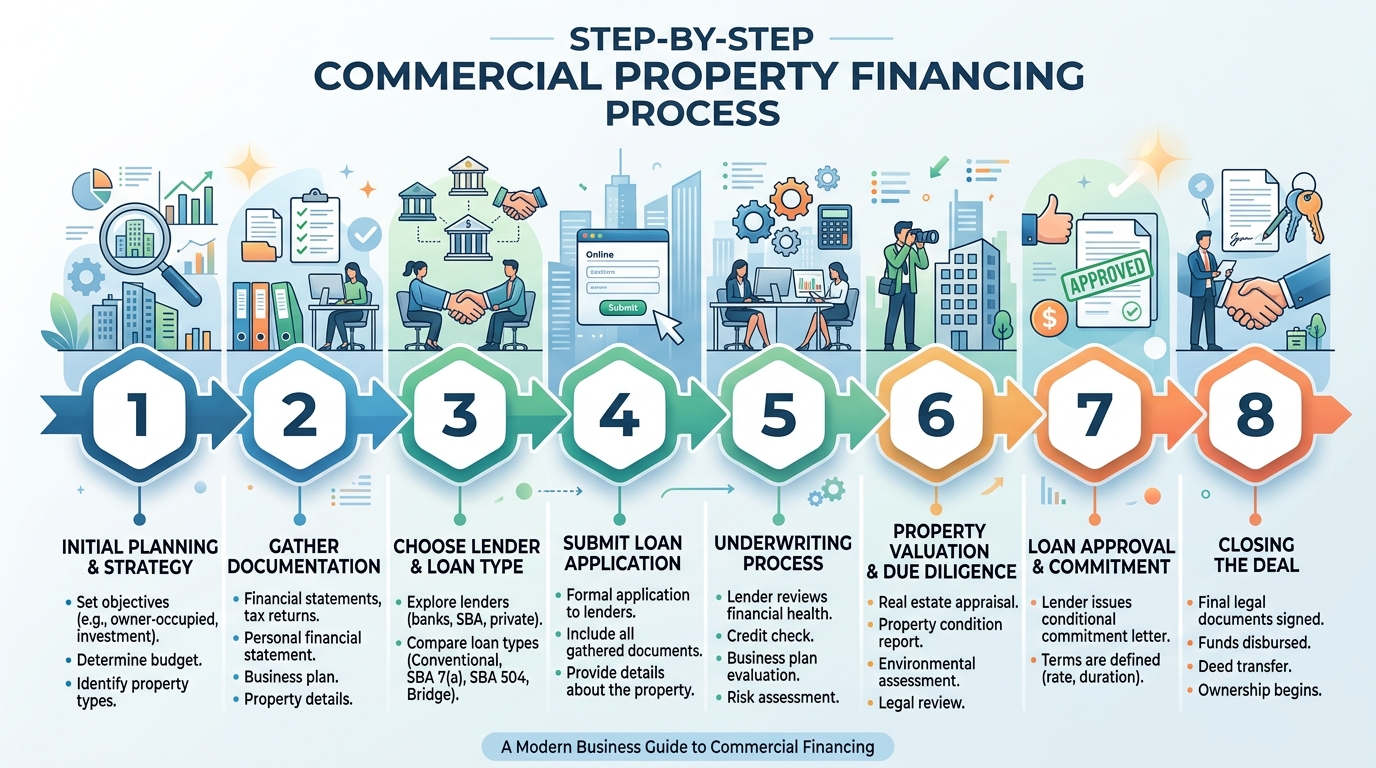
A visual guide to the commercial property financing process.
How to Get a Commercial Property Loan
To secure approval for a commercial property mortgage, borrowers must follow a structured approach. Here is the step-by-step summary process to qualify and win approval from lenders:
- Evaluate Borrower Credit & Capital Reserves: Ensure your personal and business credit scores meet minimum standards (typically 680+) and assemble required down payment equity (10% to 35%).
- Determine Property Net Operating Income (NOI): Calculate the asset’s annual gross revenues minus operating expenses to establish its debt service capacity.
- Select the Appropriate Commercial Loan Type: Choose between conventional bank financing, SBA government-backed programs, bridge loans, or private debt based on occupancy and strategy.
- Compile Underwriting Documentation: Gather 3 years of personal and business tax returns, profit & loss statements, rent rolls, lease agreements, and purchase contracts.
- Submit Loan Applications to Multiple Lenders: Issue formal funding proposals to commercial banks, credit unions, or specialized debt brokers to compare term sheets.
- Complete Appraisal & Environmental Assessments: Satisfy lender third-party due diligence, including property appraisals and Phase I Environmental Site Assessments (ESA).
- Finalize Underwriting & Close Loan: Satisfy outstanding lender conditions, execute final closing documents, wire equity down payments, and secure title transfer.
Step-by-Step Commercial Property Financing Process
Navigating the commercial real estate loan process requires progressing through distinct phases. Managing these stages methodically ensures faster approvals and reduces closing delays.
Step 1: Assess Your Financial Health & Down Payment
Before submitting a loan request, conduct a personal and organizational financial audit:
- Calculate Liquidity & Net Worth: Commercial lenders prefer borrowers whose aggregate net worth meets or exceeds the total loan amount requested. Furthermore, lenders expect post-closing liquidity (cash and liquid securities) equal to 6–12 months of mortgage payments.
- Determine Available Down Payment Equity: Commercial loans require higher down payments than residential mortgages. Conventional financing demands 20% to 35% cash down, whereas SBA programs require 10% to 15% for owner-occupied assets.
- Verify Debt Service Coverage Ratio (DSCR): Ensure the target property generates enough Net Operating Income to cover proposed loan debt service by a factor of at least 1.25x. If buying an empty or underperforming asset, prepare projections showing how occupancy will achieve target ratios.
Step 2: Choose the Right Loan Product
Selecting the appropriate loan product prevents costly financial mismatches:
- For small business owners acquiring a facility where their company occupies over 51% of usable area, explore SBA 504 or SBA 7(a) financing to minimize cash down payments.
- For experienced real estate investors purchasing stabilized, multi-tenant properties, compare institutional options among different commercial property financing options.
- For properties requiring immediate acquisition or extensive capital renovations, consider short-term bridge debt or hard money financing before securing long-term capital.
Step 3: Prepare Your Documentation & Underwriting
Underwriting delays are almost always caused by missing or incomplete documentation. Create a centralized loan application package containing:
- Tax Returns: Last 3 years of personal and business tax filings (all schedules).
- Financial Statements: Current Year-to-Date Profit & Loss (P&L) statement and Balance Sheet.
- Property Financials: Operating statements for the target asset covering the past 2–3 years.
- Rent Roll & Leases: Complete schedule of current tenants, suite square footages, rent amounts, lease start/expiration dates, and renewal options.
- Personal Financial Statement (PFS): Fully filled SBA Form 413 or standard bank PFS detailing assets and liabilities.
- Property Purchase Agreement: Fully executed purchase contract and legal property description.
Reviewing a comprehensive commercial real estate financing guide before submitting documents helps ensure your financial profile matches lender expectations.

An investor carefully considers financing options for a commercial building.
How to Finance a Commercial Building
Financing a commercial building requires adapting your capital strategy to the specific property asset class you are purchasing:
- Retail & Office Space: Lenders scrutinize tenant credit ratings, lease expiration schedules, and local vacancy rates. Multi-tenant properties with staggered lease expirations present lower underwriting risk than single-tenant facilities dependent on a single company.
- Industrial & Warehousing: Industrial assets enjoy strong lending demand in 2026 due to supply chain e-commerce trends. Underwriting focuses on clear ceiling heights, loading dock capabilities, power capacity, and location access to transit corridors.
- Multi-Family Residential (5+ Units): Multi-family financing benefits from robust commercial agency programs (Fannie Mae, Freddie Mac, HUD/FHA). Key metrics focus heavily on historical occupancy, physical property condition, unit mix, and regional rental rate growth.
- Specialized / Owner-Occupied Buildings: Buildings designed for single uses (e.g., auto repair, medical clinics, specialized manufacturing) require strong business operational revenue because secondary reuse is limited if the primary occupant vacates.
Commercial Property Financing Strategies That Work
Experienced commercial real estate buyers leverage advanced financing strategies to optimize investment performance and preserve liquid capital:
- Seller Financing / Owner Carryback: Negotiate with the seller to carry a secondary mortgage (e.g., 10% to 20% of the purchase price). This reduces the primary cash down payment required from the buyer and demonstrates seller confidence in the asset.
- Equity Syndication & Capital Partners: Rather than funding 100% of required equity out of pocket, structure joint ventures (JVs) or limited liability partnerships where passive equity investors supply down payment capital in exchange for property equity distributions.
- Value-Add Refinancing (BRRRR Method): Acquire distressed or under-managed commercial real estate using short-term debt, complete capital improvements, raise tenant occupancy, and refinance the asset into a permanent loan once higher cash flows justify a higher property appraisal.
- Mezzanine Debt and Preferred Equity: For larger commercial acquisitions ($5 million+), combine senior bank debt with mezzanine debt or preferred equity to reduce personal capital commitments while maintaining project control.
For active buyers seeking customized financial advisory and tailored debt placement, explore our dedicated commercial property investment financing programs.
Frequently Asked Questions (FAQ)
How long does it take to secure a commercial property loan?
The commercial property financing process generally takes 45 to 90 days from loan application to closing. Conventional bank loans and SBA options typically require 60 to 90 days due to third-party appraisals, environmental assessments, and legal review. Private bridge loans can close faster, often within 10 to 21 days.
What credit score do I need to finance a commercial property?
Most conventional banks and SBA lenders require a personal credit score of 680 or higher, with scores above 720 receiving preferred pricing. Private lenders and bridge funds may approve lower credit scores if the target commercial building offers strong equity margin and solid revenue.
How much money do I need to put down on a commercial building?
Down payments for commercial real estate usually range between 20% and 35% of the total purchase price. However, owner-occupants applying for government-backed SBA 504 or 7(a) loans can purchase buildings with down payments as low as 10%.
What is a Phase I Environmental Site Assessment (ESA)?
A Phase I ESA is a standard environmental investigation performed during commercial real estate underwriting. An environmental engineer reviews historical property usage, records, and site conditions to ensure no hazardous substances, underground storage tanks, or chemical contaminations exist that could create owner liability.
Disclaimer: Information provided in this guide is intended for informational and educational purposes only. Loan terms, underwriting standards, and process timelines vary based on lender policies, property types, and market conditions.