
Commercial Real Estate Cash to Close: Beyond the Down Payment
When acquiring commercial property, first-time investors and business owners often make the critical mistake of budgeting only for the mortgage down payment. While securing a 20% down payment is a major milestone, the actual commercial real estate cash to close required at the settlement table encompasses a far broader array of third-party reports, lender financing fees, escrow deposits, and post-closing liquidity reserves.
Failing to calculate your full capital stack and total out-of-pocket settlement costs can cause funding shortfalls, delay loan closing, or even jeopardize your earnest money deposit. Understanding how loan-to-value limits and third-party closing costs interact ensures you maintain total financial preparedness from LOI to closing.

A comprehensive breakdown of the typical cash required at closing for a commercial real estate transaction, beyond just the down payment.
How Much Total Cash to Close is Needed?
In standard commercial real estate transactions, your total commercial real estate cash to close equals your mortgage down payment PLUS 2% to 5% of the total purchase price in transaction closing costs, plus required post-closing liquidity reserves.
For example, on a $2,000,000 commercial building acquisition with a conventional 25% down payment ($500,000):
– Mortgage Down Payment (25%): $500,000
– Closing Costs & Third-Party Reports (3%): $60,000
– Upfront Escrow & Tax Reserves: $15,000
– Total Settlement Cash Required: $575,000
– Post-Closing Liquidity Reserves (Lender Requirement): $50,000 to $100,000 (retained in borrower accounts)
Total liquidity needed to buy commercial real estate on a $2,000,000 property is therefore $625,000 to $675,000—significantly higher than the baseline down payment alone.
To establish your initial down payment requirement, check our guide on securing a minimum down payment commercial loan.
What Closing Costs Are Added to the Down Payment?
Unlike residential home purchases, commercial real estate closing costs involve extensive legal due diligence, environmental testing, engineering inspections, and commercial title policy underwriting.
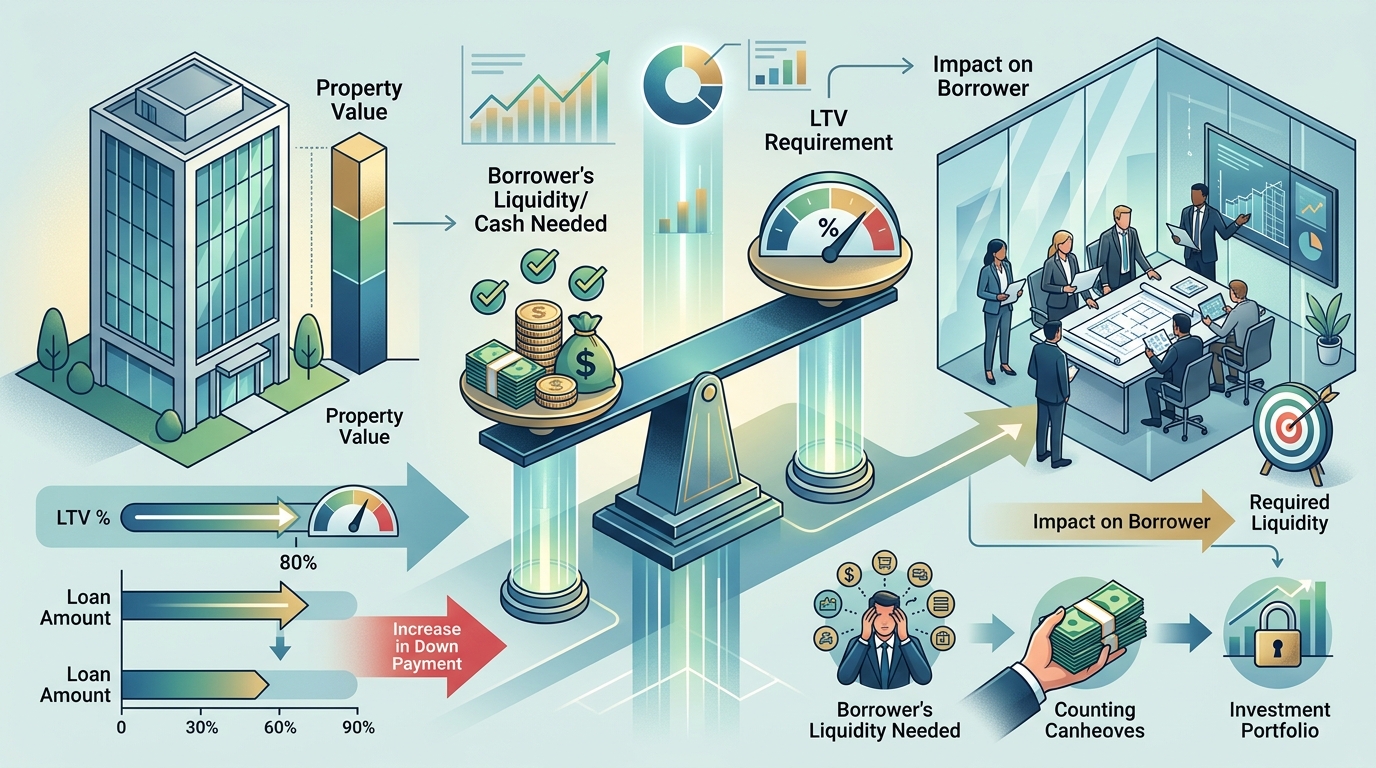
Understanding how commercial real estate LTV requirements directly impact the total liquidity needed for a property acquisition.
Essential Commercial Real Estate Settlement Checklist:
- Lender Origination & Processing Fees: Charged by the mortgage lender to originate and underwrite the loan. Typically ranges from 0.5% to 1.5% of the total loan amount.
- Commercial Real Estate Appraisal: Comprehensive independent property valuation required by the lender. Costs range from $3,000 to $8,000+ depending on property size and asset complexity.
- Phase I Environmental Site Assessment (ESA): Mandated by lenders to verify no hazardous materials or environmental liabilities exist on the property. Costs range from $2,500 to $5,000. If contamination issues are discovered, a Phase II ESA can add $10,000 to $35,000.
- Property Condition Assessment (PCA) / Building Engineering Report: Structural and mechanical inspection evaluating roof, HVAC, plumbing, and structural integrity. Costs range from $2,500 to $6,000.
- Commercial Title Insurance & Escrow Fees: Title search, owner’s and lender’s title insurance policies, and closing escrow fees. Typically accounts for 0.5% to 1.0% of purchase price.
- Legal & Attorney Fees: Borrower’s legal representation for purchase contract review, title review, entity formation, and loan document negotiation. Costs range from $5,000 to $15,000+.
- SBA Guaranty Fee (For SBA Loans Only): On SBA 7(a) and 504 loans, the federal government charges a guaranty fee ranging from 2% to 3.75% of the guaranteed loan portion (though this fee can usually be financed into the loan total).
- Property Tax & Insurance Escrow Reserves: Lenders collect 3 to 6 months of prepaid property taxes and hazard/flood insurance to fund the property escrow account at closing.
How Does Commercial Real Estate LTV Affect Down Payment?
Loan-to-Value (LTV) is the primary risk metric used by commercial lenders to dictate loan sizing. Commercial real estate LTV requirements directly establish your required down payment percentage.
$$\text{Required Down Payment Percentage} = 100\% – \text{Allowable Loan-to-Value (LTV) Percentage}$$
Max Allowable LTV vs. Effective LTV Reductions:
While a lender may advertise an “80% LTV maximum loan,” the actual dollar loan amount is constrained by two secondary factors during underwriting:
- Appraisal Shortfalls: If a buyer contracts to purchase a retail building for $1,500,000, but the appraisal establishes market value at $1,400,000, an 80% LTV lender will only lend 80% of $1,400,000 ($1,120,000). The buyer must fund $380,000 in cash equity (an effective down payment of 25.3% of the purchase price).
- Debt Service Coverage Ratio (DSCR) Sizing Limits: Lenders enforce minimum DSCR limits (typically 1.25x). If property Net Operating Income (NOI) cannot support debt payments at 80% LTV based on prevailing interest rates, the lender reduces the loan amount until the DSCR reaches 1.25x. This debt reduction forces the buyer to bring additional cash to closing to make up the difference.
To understand how baseline LTV limits vary across apartment, office, and retail property types, see our detailed review of down payment requirements by asset class.
Understanding Total Liquidity and Reserve Requirements
Beyond funding the commercial loan closing costs and down payment at the closing table, lenders mandate that borrowers demonstrate post-closing liquidity reserves. Lenders require this safety margin to guarantee the borrower can handle unexpected vacancy, tenant lease default, or emergency repairs without defaulting on debt service.
Post-Closing Liquidity Benchmarks:
- Standard Bank Reserve Requirement: Borrowers must show proof of unencumbered liquid assets (cash, money market funds, publicly traded stocks) equal to 6 to 12 months of principal, interest, taxes, and insurance (PITI) debt service AFTER closing costs and down payment are paid.
- Net Worth Rule: Many regional and national commercial lenders enforce a general rule that the borrower’s total net worth must equal or exceed 100% of the requested loan amount.
- Working Capital Reserves: For owner-occupied business purchases, lenders verify that the operating business retains adequate working capital to support day-to-day payroll and inventory needs post-closing.
If you are evaluating options to reduce upfront equity requirements or leverage secondary capital, explore our strategy guide covering zero down payment commercial loans.
Frequently Asked Questions (FAQ)
What is included in commercial real estate cash to close?
Commercial real estate cash to close includes your mortgage equity down payment, lender origination fees, appraisal fees, Phase I Environmental Site Assessments, building engineering reports, legal fees, title insurance, and prepaid property tax/insurance escrows.
How much are typical closing costs on a commercial loan?
Closing costs on a commercial real estate purchase typically range between 2% and 5% of the total purchase price, excluding the down payment. On a $1,000,000 property, closing costs generally range from $20,000 to $50,000.
What is post-closing liquidity and why do commercial lenders require it?
Post-closing liquidity refers to liquid cash reserves that remain in the borrower’s bank accounts after paying the down payment and closing costs. Lenders usually require 6 to 12 months of PITI debt service in reserve to protect against tenant defaults or unbudgeted capital expenses.
How does a low appraisal affect cash to close?
If a property appraises for less than the purchase contract price, the lender bases their loan-to-value (LTV) limit on the lower appraised value. The buyer must either renegotiate the purchase price down with the seller or bring additional cash to the closing table to cover the appraisal gap.
Can commercial closing costs be rolled into the mortgage loan?
On conventional bank loans, third-party closing costs (appraisals, legal fees, title) must usually be paid out of pocket at closing. However, under SBA 7(a) and SBA 504 loan programs, certain eligible closing costs, packaging fees, and SBA guaranty fees can be financed into the total loan amount.