

Negotiating Commercial Loan Fees: 5 Borrower Tactics & IRS Tax Rules
Introduction: Optimizing Terms and Maximizing Tax Deductions
In commercial real estate finance, term sheet negotiations often focus heavily on headline interest rates and leverage (LTV). However, experienced investors, real estate developers, and corporate CFOs recognize that upfront financing costs, legal retainers, and prepayment structures exert a profound impact on net project yields and internal rates of return (IRR).
Unchecked lender charges, uncapped legal bills, and non-refundable deposits can quickly inflate total cash-to-close requirements.
Equally important is understanding the IRS accounting standards governing loan fee write-offs. Knowing how to negotiate fee concessions before signing a commitment letter—and how to correctly amortize those expenses for tax purposes—provides a significant competitive advantage.
5 Proven Tactics to Negotiate Term Sheet Fees
Unlike standardized residential mortgages, commercial loan term sheets are fully negotiable instruments. Below are five actionable tactics borrowers can deploy during term sheet negotiations to lower upfront financing costs.

Master these five proven tactics to effectively negotiate commercial loan fees and reduce upfront financing costs.
Tactic 1: Leverage Competitive Term Sheets to Reduce Origination Points
The single most effective tool in fee negotiation is competing capital. Never negotiate exclusively with a single debt provider without market leverage.
- Execution Strategy: Run a parallel capital search to secure two or three formal term sheets simultaneously. Present competing loan quotes to your preferred lender, requesting a reduction in origination points (e.g., from 1.0% down to 0.50% or 0.75%). Lenders routinely trim origination fees to secure high-quality borrowers and premier property assets.
For a comprehensive breakdown of baseline point schedules across lender types, consult our guide on negotiating lender origination points.
Tactic 2: Request Contractual Caps on Lender Legal Counsel Retainers
Lender legal fees represent one of the most volatile line items on a commercial closing statement. Because borrowers pay 100% of the lender’s external attorney invoice, uncapped legal fees can easily escalate from $10,000 to over $25,000 during document negotiation.
- Execution Strategy: Insert a strict, binding legal fee cap into the term sheet language before signing:
> “Borrower shall reimburse Lender for actual, reasonable external legal counsel fees incurred in connection with loan document drafting, not to exceed $10,000 in the aggregate without prior written authorization from Borrower.”
Tactic 3: Re-use Existing Third-Party Reports (Reliance Letters)
Ordering brand-new commercial appraisals ($5,000–$10,000) and Phase I Environmental Site Assessments ($3,000–$6,000) adds substantial friction to closing budgets.
- Execution Strategy: If the seller or refinancing borrower has completed an appraisal or Phase I ESA within the past 6 to 12 months, request that the new lender accept a Reliance Letter or report recertification. Re-certifying an existing report typically costs $1,000 to $2,000, saving thousands in vendor fees and accelerating the closing timeline by weeks.
Tactic 4: Negotiate Open Prepayment Windows & Reduced Exit Fees
Short-term bridge debt and private fund capital frequently incorporate exit fees (0.50% to 1.0%) or restrictive prepayment lockout clauses.
- Execution Strategy: Request that the lender waive exit fees if the loan is refinanced using their own permanent lending desk. For permanent debt, negotiate to expand the final Open Prepayment Window from 30 days to 90 or 180 days prior to loan maturity, allowing penalty-free refinancing or asset sales.
Tactic 5: Bundle Application, Processing & Underwriting Charges
Lenders frequently include piecemeal administrative fees—such as processing fees ($1,500), underwriting fees ($2,500), document prep fees ($1,000), and application fees ($1,000).
- Execution Strategy: Request that the lender consolidate or eliminate piecemeal administrative charges into one flat, capped processing fee (e.g., $2,500 total administrative cap) or credit them entirely against final origination points at closing.
Are Commercial Real Estate Loan Fees Tax Deductible?
Under Internal Revenue Code (IRC) rules (specifically Sections 263 and 461), commercial real estate loan fees are NOT fully tax-deductible in the year they are paid.
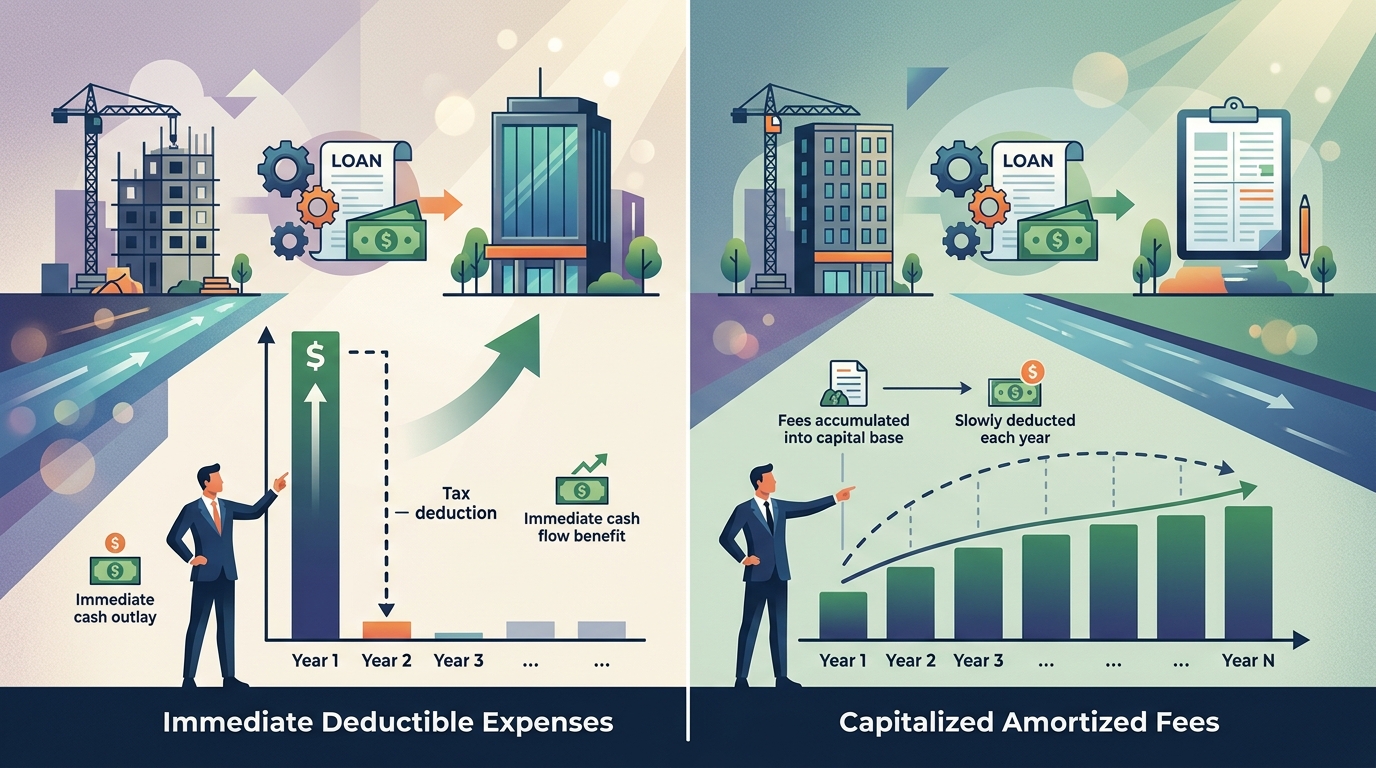
Understand the IRS tax treatment of commercial real estate loan fees, differentiating between immediate deductions and capitalized amortization.
Instead, the IRS treats loan origination fees, legal expenses, broker commissions, and third-party report costs as capitalized financing costs. These expenses must be amortized on a straight-line basis over the life of the loan term.
To review an itemized list of all eligible transaction costs, see our itemized list of commercial closing costs.
IRS Tax Treatment Summary Matrix for Commercial Loan Fees
The following matrix details the IRS tax treatment for primary commercial loan expenses under standard capitalization rules:
| Fee / Expense Category | Tax Accounting Method | Amortization Period | Conditions for Immediate Write-Off |
|---|---|---|---|
| Lender Origination Fees | Capitalized & Amortized | Life of Loan (Straight-Line) | Accelerate write-off upon loan payoff/refinance |
| Broker Placement Fees | Capitalized & Amortized | Life of Loan (Straight-Line) | Accelerate write-off upon loan payoff/refinance |
| Third-Party Reports (Appraisal/ESA) | Capitalized & Amortized | Life of Loan (Straight-Line) | Deductible in full if deal is abandoned pre-closing |
| Lender & Borrower Legal Fees | Capitalized & Amortized | Life of Loan (Straight-Line) | Accelerate write-off upon loan payoff/refinance |
| Operating Expenses / Mortgage Interest | Immediate Business Expense | Current Tax Year Incurred | Fully deductible in Year 1 |
Amortization Calculation Example ($10,000,000 Loan / 10-Year Term)
If a borrower incurs $100,000 in total capitalized financing costs (origination points + legal + appraisal + broker fees) on a 10-year commercial mortgage, the annual tax deduction equals:
$$\text{Annual Tax Deduction} = \frac{\$100,000 \text{ Total Loan Fees}}{10 \text{ Year Loan Term}} = \$10,000 \text{ per tax year}$$
Tax Treatment of Unamortized Loan Fees Upon Refinance or Payoff
A major tax advantage for commercial real estate investors occurs when a commercial loan is paid off early or refinanced prior to its scheduled maturity date.
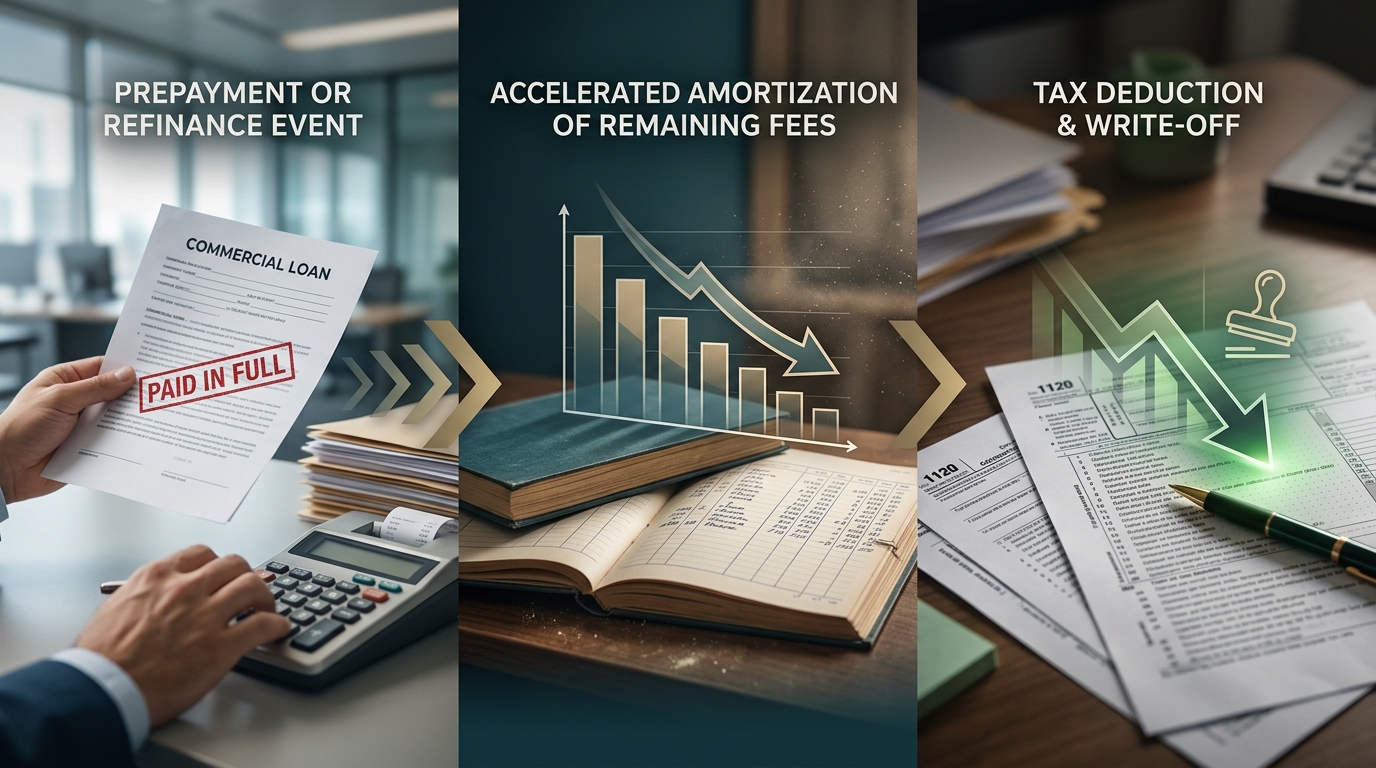
Learn how unamortized loan fees can be fully written off as a tax deduction upon early loan payoff or refinance.
The Accelerated Write-Off Rule
Under IRS rules, if a commercial mortgage is paid off before the end of its loan term—whether through a property sale, cash payoff, or debt refinance—any remaining unamortized loan fee balance can be written off in full as a tax deduction in the year of payoff.
- Payoff Amortization Example: Assume a borrower capitalized $100,000 in loan fees on a 10-year loan ($10,000/year deduction). In Year 5, the borrower refinances the property and pays off the loan in full.
- Tax Impact: The borrower has claimed $50,000 in cumulative deductions over Years 1–5. The remaining $50,000 unamortized balance is fully deductible as an immediate tax write-off in Year 5, providing a significant tax offset against capital gains or income.
Frequently Asked Questions
How do you negotiate commercial loan fees?
Negotiating commercial loan fees involves five key tactics:
1. Obtaining competitive term sheets to leverage origination point reductions.
2. Inserting contractual caps on lender legal counsel retainers.
3. Requesting reliance letters to re-use existing third-party appraisals and environmental reports.
4. Expanding open prepayment windows and capping exit fees.
5. Consolidating piecemeal administrative charges into one flat processing fee.
Are commercial real estate loan fees tax deductible?
Commercial real estate loan fees are generally not fully deductible in the year paid. IRS rules require loan origination fees, broker charges, legal fees, and third-party report costs to be capitalized and amortized straight-line over the life of the loan term.
Are commercial mortgage broker fees tax deductible?
Yes, commercial mortgage broker fees are tax-deductible, but they must be capitalized and amortized straight-line over the life of the mortgage facility rather than claimed as an immediate year-one expense.
What happens to unamortized loan fees when a loan is paid off early?
When a commercial loan is paid off early or refinanced before maturity, IRS rules permit the borrower to write off 100% of the remaining unamortized loan fee balance as an immediate tax deduction in the year the payoff occurs.
Conclusion: Final Checklist for Term Sheet Optimization
To maximize capital efficiency and protect deal yields, CRE investors and CFOs should execute the following checklist prior to signing any commercial loan term sheet:
Term Sheet Optimization Checklist
- [ ] Verify origination points are competitive with current market benchmarks.
- [ ] Require a binding contractual cap on lender external legal fees ($10,000–$15,000 max).
- [ ] Confirm initial expense deposits are classified as refundable retainers with required expense itemization.
- [ ] Request permission to re-use qualifying third-party appraisals and environmental reports.
- [ ] Confirm the amortization schedule with your CPA to track unamortized fee balances for future tax write-offs.
For a broader understanding of overall commercial real estate transaction costs, review our master commercial real estate loan fee guide.
To explore additional strategies for minimizing closing friction, read our article on closing cost optimization tactics.