
Key Factors Affecting Commercial Real Estate Rates
When applying for commercial property financing, borrowers quickly realize that interest rate quotes are highly individualized. Two investors purchasing commercial assets in the same metropolitan market can receive vastly different interest rate term sheets. Why? Because commercial lenders establish rates based on a holistic risk matrix evaluated during underwriting.
Understanding the specific underwriting metrics and asset characteristics that drive commercial mortgage pricing allows investors to structure acquisitions effectively and target lower borrowing costs. In this article, we analyze the primary factors affecting commercial real estate interest rates and outline how financial leverage, cash flow coverage, borrower credit, and property types influence final rate pricing.
What Factors Affect Commercial Real Estate Rates?
Commercial mortgage interest rates are calculated using a blend of macro-level capital market conditions and micro-level transaction risks.
- Loan-to-Value (LTV) Ratio: The proportion of debt financing relative to the property’s appraised value; lower leverage reduces lender default risk and lowers interest rates.
- Debt Service Coverage Ratio (DSCR): The property’s Net Operating Income (NOI) divided by annual debt service; higher cash flow buffers result in lower risk spreads.
- Borrower Credit & Financial Strength: Personal credit scores, corporate credit history, net worth, and post-closing liquidity reserves.
- Property Type & Asset Class: The specific asset sub-sector (multifamily, industrial, retail, office, hospitality), which determines revenue stability and market liquidity.
- Property Location & Market Tier: Primary metropolitan markets command tighter interest rate spreads than secondary or rural locations due to higher tenant demand and market depth.
- Loan Structure & Term Horizon: Fixed versus floating interest rate structures, amortization length, and loan duration.
To see how these underwriting elements feed directly into lender pricing equations, review our comprehensive commercial lender risk premium analysis.
How Does LTV Impact Commercial Loan Rates?
The Loan-to-Value (LTV) ratio is one of the most critical leverage metrics in commercial real estate underwriting. It measures the financial risk assumed by the lender relative to the underlying collateral value. When a borrower requests higher LTV financing, the lender’s exposure to capital loss during default increases, prompting the lender to widen the interest rate credit spread.

Lenders use tiered pricing grids to adjust interest rate spreads based on the Loan-to-Value (LTV) ratio, reflecting the level of financial risk.
LTV-to-Rate Tier Grid Breakdown
Lenders use risk-tiered pricing grids to automatically adjust credit spreads based on leverage levels. Below is an illustrative tier matrix demonstrating how LTV directly affects interest rate spreads:
| Leverage Tier | LTV Range | Relative Risk Profile | Typical Spread Adjustment (Basis Points) | Impact on Total Rate |
|---|---|---|---|---|
| Tier 1 (Low Leverage) | $\le 55\%$ | Minimal capital risk; heavy borrower equity buffer | $-25$ to $-50$ bps discount | Lowest Rate Available |
| Tier 2 (Moderate Leverage) | $56\% – 65\%$ | Standard institutional risk profile | Benchmark Baseline | Standard Market Rate |
| Tier 3 (High Leverage) | $66\% – 75\%$ | Elevated risk; reduced loss cushion | $+25$ to $+50$ bps surcharge | Moderately Elevated |
| Tier 4 (Maximum Leverage) | $76\% – 80\%$ | High risk; requires mezzanine or stretch capital | $+75$ to $+125+$ bps surcharge | Peak Rate Pricing |
Reducing your requested LTV by introducing additional equity is one of the quickest ways to optimize your borrower profile for the best rate and secure favorable loan terms.
What DSCR is Required for the Lowest Commercial Rates?
While LTV evaluates collateral protection, the Debt Service Coverage Ratio (DSCR) evaluates cash flow sustainability. DSCR measures a property’s ability to cover its annual debt payments from net operating income:
$$\text{DSCR} = \frac{\text{Net Operating Income (NOI)}}{\text{Annual Debt Service (Principal + Interest)}}$$
Lenders require minimum DSCR thresholds to ensure adequate cash cushion against tenant turnover or operating cost inflation:
- Minimum Qualification Threshold (1.20x to 1.25x): Most commercial lenders require a baseline DSCR of 1.20x to 1.25x. At a 1.20x DSCR, $1.00 of debt service is supported by $1.20 of net operating income.
- Tier-One Pricing Threshold (1.35x to 1.50x+): To unlock the lowest available interest rate spreads, lenders look for DSCR ratios of 1.35x or higher. High DSCR properties demonstrate robust income buffers, mitigating risk during market downturns.
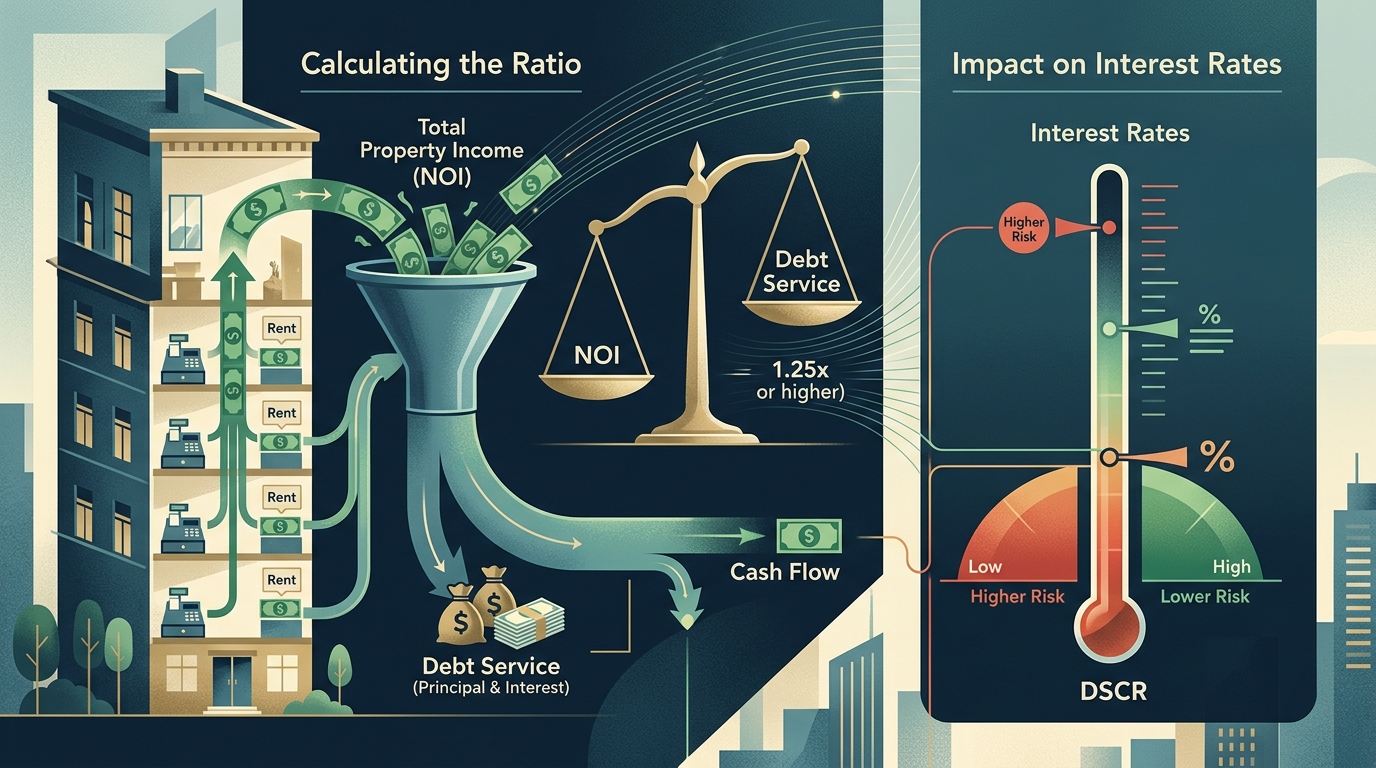
A higher Debt Service Coverage Ratio (DSCR) indicates robust income buffers, which can unlock lower interest rate spreads for commercial loans, especially for multifamily properties.
When evaluating DSCR, lenders conduct sensitivity stress tests, assessing whether cash flows can sustain debt service if interest rates increase or vacancy rises.
What Credit Score Do You Need for Competitive Commercial Loan Rates?
Although commercial underwriting prioritizes property performance, borrower creditworthiness remains a primary requirement—especially for non-recourse and bank debt structures. Lenders review FICO credit scores, borrowing history, liquidity reserves, and net worth.
Credit Score Ranges & Loan Rate Pricing Thresholds
- 720+ Credit Score (Tier 1): Qualifies borrowers for prime pricing, flexible loan structures, and maximum leverage limits. Demonstrates flawless debt management history.
- 680 – 719 Credit Score (Tier 2): Standard qualification tier. Borrowers receive competitive interest rate spreads but may face standard LTV and DSCR requirements.
- 620 – 679 Credit Score (Tier 3): Considered higher risk. Borrowers may experience spread surcharges of 50 to 100+ basis points, lower leverage caps (maximum 65% LTV), or recourse requirements.
- Below 620: Generally requires specialized hard money or private debt solutions with significantly higher interest rates and closing fees.
In addition to credit scores, commercial lenders typically expect the borrowing entity or guarantor to maintain a net worth equal to or exceeding the loan amount, along with post-closing liquid reserves equal to 6 to 12 months of principal and interest payments.
How Do Property Types Affect Commercial Loan Rates?
Lenders categorize real estate by asset class, assigning different baseline risk spreads to reflecting sector stability, tenant demand, and structural liquidity.
Property Asset Class Risk Spectrum
- Multifamily (Lowest Risk Tier): Multifamily properties benefit from diversified tenant bases and strong secondary market liquidity (supported by agencies like Fannie Mae and Freddie Mac). As a result, multifamily assets generally receive the lowest interest rates and tightest pricing spreads in commercial real estate finance.
- Industrial & Logistics (Low-to-Moderate Risk): Driven by e-commerce demand and low capital expenditure requirements, industrial assets command competitive rate spreads similar to multifamily debt.
- Anchored Retail (Moderate Risk): Grocer-anchored retail centers enjoy stable foot traffic and long-term lease structures, qualifying for favorable institutional pricing. Non-anchored strip centers incur moderate spread surcharges.
- Office Buildings (Elevated Risk): Hybrid work trends and elevated tenant improvement (TI) costs have increased perceived office sector risk. Office loans currently face stricter underwriting criteria, lower allowable LTVs, and higher interest rate spreads.
- Hospitality & Special-Purpose (Highest Risk Tier): Hotels, assisted living facilities, and single-use entertainment venues rely heavily on operational business performance rather than long-term real estate leases. Lenders compensate for this revenue volatility by charging higher interest rate spreads and requiring lower LTV limits.
Understanding these underwriting adjustments allows borrowers to accurately estimate total commercial real estate financing costs across different real estate investments.
Frequently Asked Questions (FAQ)
Which single underwriting factor has the biggest impact on commercial mortgage rates?
Loan-to-Value (LTV) and Debt Service Coverage Ratio (DSCR) jointly exert the largest influence on commercial loan pricing. High leverage paired with low cash flow coverage represents the highest default risk for commercial lenders.
Can strong personal liquidity offset a lower property DSCR?
Yes. Lenders may grant pricing or covenant flexibility on property DSCR if the borrowing sponsor maintains substantial liquid assets, strong net worth, or offers a personal guarantee (recourse).
Why do multifamily property loans receive lower interest rates than office loans?
Multifamily properties feature short-term lease granularity, high tenant diversification, and government-sponsored agency backing (Fannie Mae/Freddie Mac), which lowers lender risk compared to office properties that face lease rollover risks and high tenant build-out costs.
How does property location impact interest rate quotes?
Properties in Tier-1 primary metropolitan statistical areas (MSAs) feature higher tenant liquidity and stronger property resalability, allowing lenders to offer tighter interest rate spreads than on properties located in tertiary or rural markets.