Current Commercial Real Estate Interest Rates & Lending Data
Navigating the commercial real estate (CRE) debt market in 2026 requires continuous monitoring of macroeconomic conditions, benchmark indices, and lender spreads. Whether you are an institutional investor planning an acquisition, a property developer structuring debt, or an owner-occupier evaluating financing, understanding commercial real estate interest rates is fundamental to capital allocation and deal underwriting.
This benchmark hub delivers up-to-date analysis on current commercial mortgage rates, lender requirements, rate calculations, and fee structures across all primary property sectors.
What are current commercial real estate interest rates today?
In 2026, cre interest rates today vary significantly depending on loan structure, asset class, debt service coverage, and lender risk appetite. Commercial mortgage pricing is built on base benchmark indices—such as the 10-Year U.S. Treasury yield or the Secured Overnight Financing Rate (SOFR)—plus a risk premium margin assessed by the underwriting institution.
To evaluate commercial loan rates today, investors must categorize lenders into four primary capital sources:
- Life Insurance Companies: Offering the most competitive pricing for low-leverage (50%–65% LTV), prime assets. Typical rates range from
[CURRENT_RATE]%to[CURRENT_RATE]%on 5-to-10-year fixed terms. - Bank Lending (Regional & Community): Providing flexible balance sheet financing for owner-occupied and stabilized assets. Rates range between
[CURRENT_RATE]%and[CURRENT_RATE]%, generally structured with 5-year rate resets or variable spreads over SOFR. - CMBS (Commercial Mortgage-Backed Securities): Offering non-recourse capital for large institutional properties, with rates priced at
[CURRENT_RATE]%to[CURRENT_RATE]%over matching Treasury benchmarks. - Government-Sponsored Enterprises (Fannie Mae & Freddie Mac): Delivering premier pricing specifically for multifamily assets, with fixed rates from
[CURRENT_RATE]%to[CURRENT_RATE]%.
Understanding where current cre loan rates sit across these capital channels enables borrowers to select the appropriate lending institution for their portfolio strategy. To evaluate how capital structures compare, investors frequently compare fixed vs. variable commercial real estate rates when timing acquisition entries.
Average Interest Rate for a Commercial Mortgage
The average interest rate for a commercial mortgage currently ranges between [CURRENT_RATE]% and [CURRENT_RATE]%, depending on loan type, property asset class, borrower creditworthiness, and debt coverage ratios. Prime stabilized assets secure the lowest rates, while secondary markets or value-add properties carry higher interest rate margins.
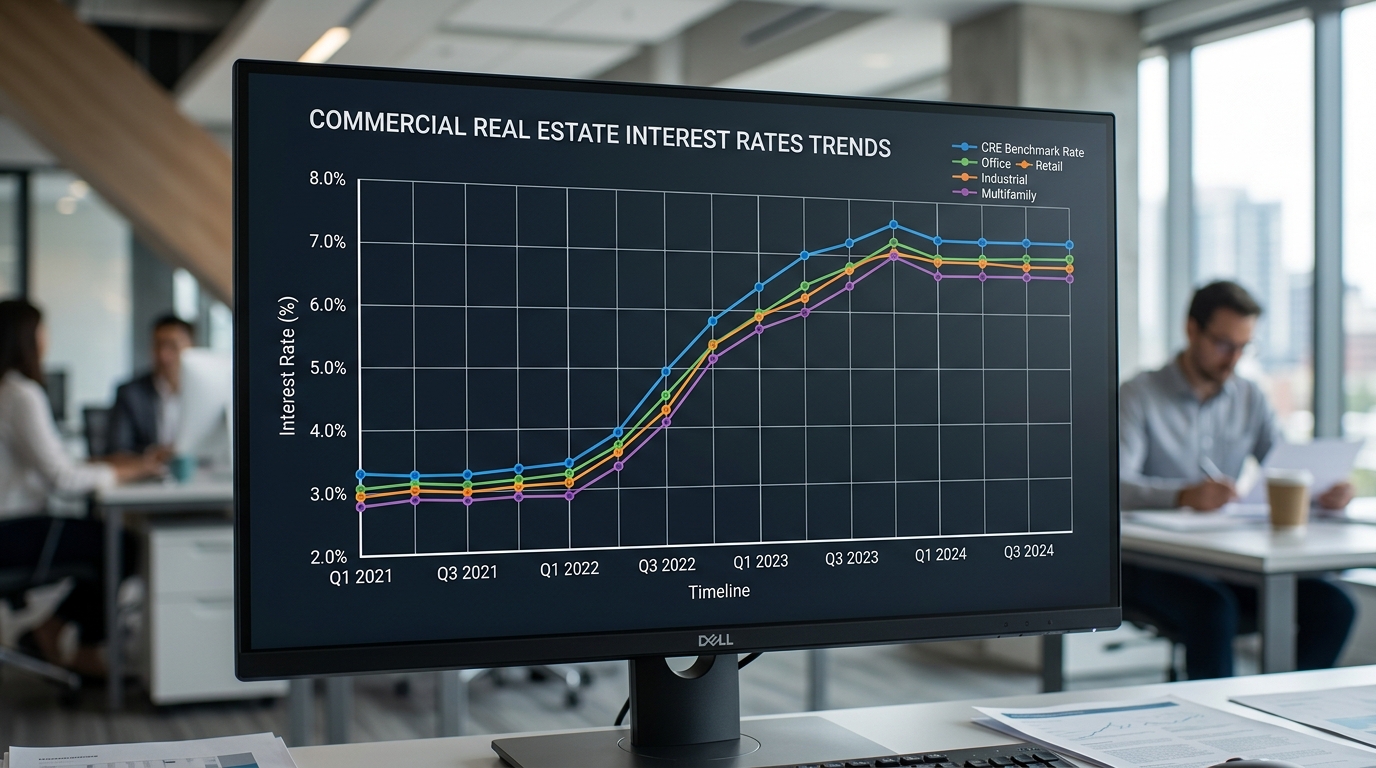
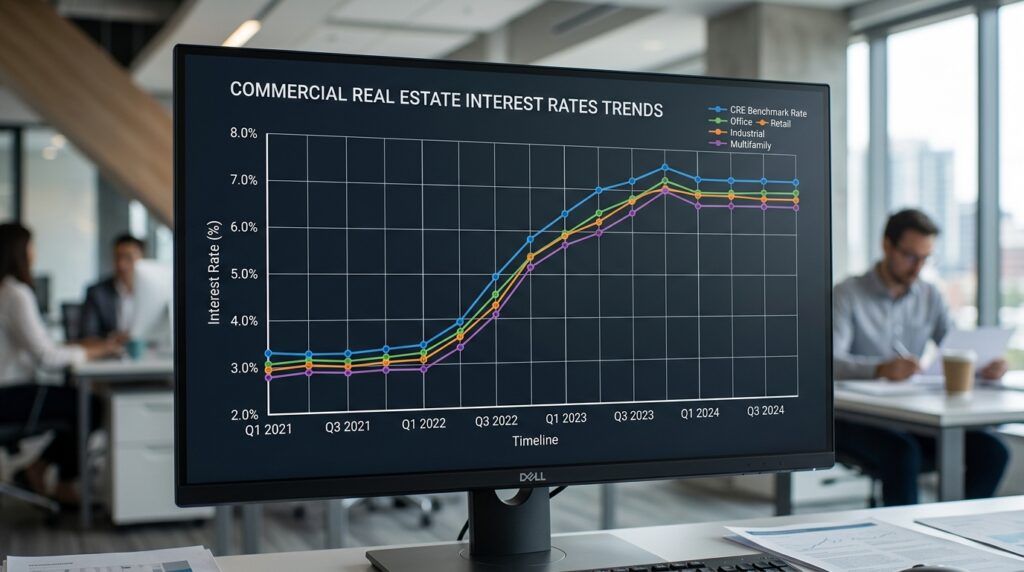
A visual representation of current commercial real estate interest rates, highlighting market trends.
To establish an accurate cost-of-capital baseline, investors must evaluate average rates by property type and debt instrument:
| Property / Loan Type | Average Rate Range | Typical LTV | Target DSCR | Loan Term |
|---|---|---|---|---|
| Multifamily (Agency) | [CURRENT_RATE]% – [CURRENT_RATE]% |
75% – 80% | 1.25x – 1.30x | 5 – 10 Years |
| Industrial / Logistics | [CURRENT_RATE]% – [CURRENT_RATE]% |
65% – 75% | 1.25x – 1.35x | 5 – 10 Years |
| Retail (Anchored) | [CURRENT_RATE]% – [CURRENT_RATE]% |
60% – 70% | 1.30x – 1.40x | 5 – 7 Years |
| Office (Class A) | [CURRENT_RATE]% – [CURRENT_RATE]% |
50% – 65% | 1.35x – 1.50x | 3 – 5 Years |
| SBA 504 / 7(a) | [CURRENT_RATE]% – [CURRENT_RATE]% |
85% – 90% | 1.15x – 1.25x | 10 – 25 Years |
| Bridge Loans (Short-Term) | [CURRENT_RATE]% – [CURRENT_RATE]% |
70% – 75% LTC | N/A (Interest Reserve) | 1 – 3 Years |
Tracking the average commercial real estate loan rates gives sponsors a reference point when negotiating loan commitments and evaluating property yield expectations.
How are Commercial Real Estate Interest Rates Calculated?
Understanding commercial real estate lending rates requires looking beneath headline numbers at the underlying pricing components. Unlike residential mortgages, which rely primarily on automated credit scoring and standardized agency guidelines, commercial property interest rates are custom-priced based on risk-adjusted spread mechanics.
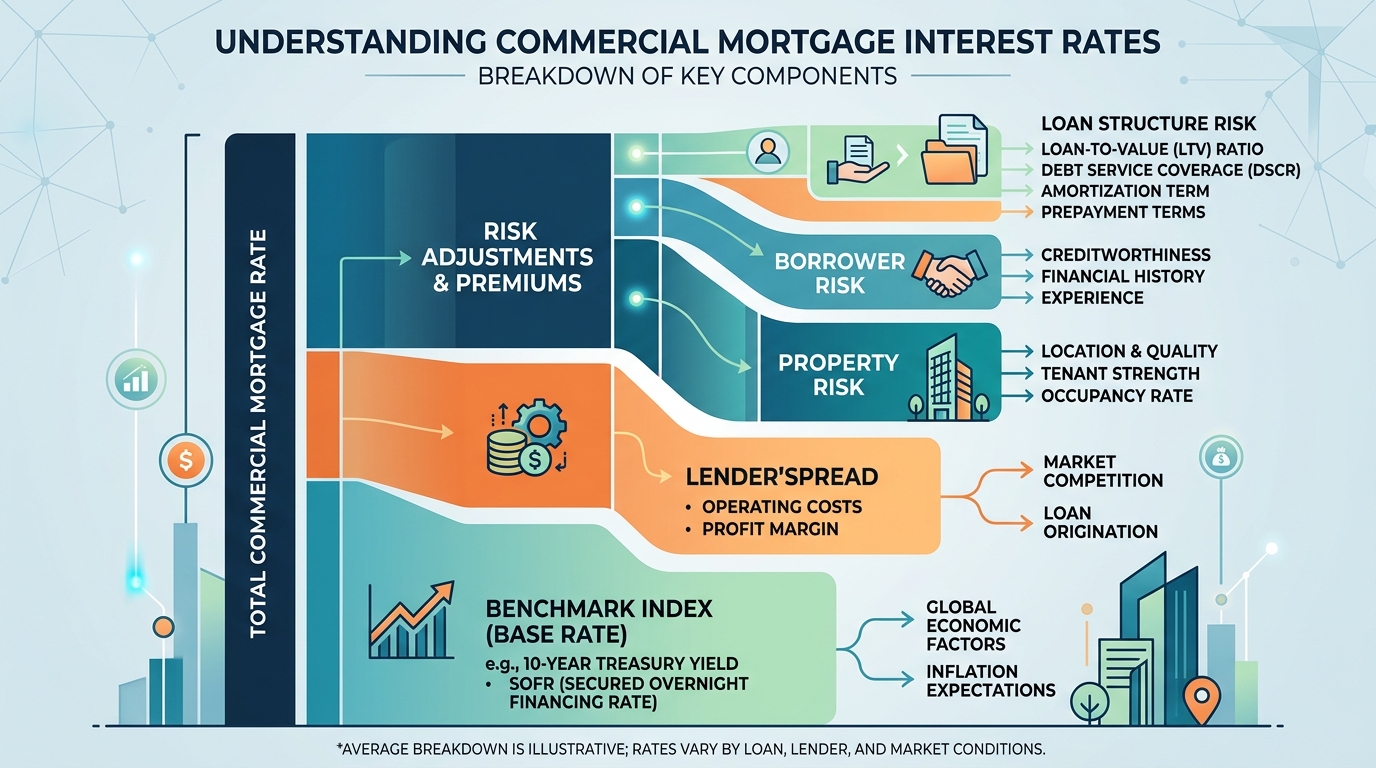
Understanding the calculation of commercial real estate interest rates, broken down by key components.
Lenders calculate the overall interest rate on a commercial property loan using the following core formula:
$$\text{Commercial Interest Rate} = \text{Benchmark Index} + \text{Lender Credit Spread} + \text{Risk Adjustments}$$
1. Benchmark Index
Commercial loans are tied to standard market benchmark indices:
– 10-Year U.S. Treasury Yield: Used primarily for fixed-rate, long-term commercial loans (CMBS, Life Co, Agency). (10-Year U.S. Treasury Yield)
– SOFR (Secured Overnight Financing Rate): The standard benchmark for floating-rate commercial real estate loans and bank debt. (SOFR (Secured Overnight Financing Rate))
– SBA Peg Rate or Prime Rate: Used for government-backed small business real estate loans.
2. Lender Credit Spread
The spread represents the lender’s profit margin and overhead allowance. Spreads typically range from 150 basis points (1.50%) for low-risk multifamily assets up to 350+ basis points (3.50%) for higher-risk asset classes or secondary markets.
3. Property & Borrower Risk Adjustments
Lenders adjust the spread upward or downward based on specific deal attributes:
– Tenant Credit Quality: Long-term leases with investment-grade tenants compress spreads.
– Lease Maturity Profile: WALT (Weighted Average Lease Term) exceeding loan maturity reduces risk.
– Location & Market Tier: Primary gateway cities command tighter spreads than tertiary markets.
– Sponsor Capital & Experience: Proven sponsors with strong liquidity secure preferred pricing.
Analyzing these variables allows borrowers to optimize deal parameters to lower their commercial mortgage interest rates. Property owners considering refinancing existing facilities should explore commercial mortgage refinancing options to capture lower credit spreads when market conditions shift.
Commercial Loan Qualification & Requirements
Securing competitive commercial property loan interest rates demands thorough underwriting documentation and meeting stringent balance sheet thresholds. Lenders evaluate both the financial standing of the guarantor and the cash-flow generating capacity of the real estate.
What credit score is required for prime commercial rates?
To qualify for prime commercial real estate financing rates, sponsors typically need a personal credit score of 680 or higher, with preferred tiers opening at 720+. While commercial debt underwriting centers on property cash flow, personal credit history serves as a proxy for financial stewardship—particularly for recourse bank financing and SBA loans. Sponsors with credit scores below 660 may still secure capital, but will face rate premiums of 100 to 250 basis points or be required to provide additional collateral.
What down payment is needed to secure the best rate?
Securing the lowest available interest rate usually requires a down payment or equity contribution of 25% to 35% (representing 65% to 75% Loan-to-Value). Higher equity positions mitigate lender risk, directly translating to narrower credit spreads. Owner-occupied transactions utilizing SBA programs can reduce down payment requirements to 10%, though rate structures differ due to federal guarantee fees and program-specific margins.
How does DSCR affect your interest rate?
The Debt Service Coverage Ratio (DSCR) measures a property’s net operating income (NOI) against its annual principal and interest obligations:
$$\text{DSCR} = \frac{\text{Net Operating Income (NOI)}}{\text{Annual Debt Service}}$$
Lenders set strict minimum DSCR thresholds (typically 1.20x to 1.35x). A higher DSCR demonstrates a stronger financial buffer against tenant vacancy or revenue contraction. Properties achieving a DSCR of 1.40x or higher often qualify for lower interest rates because the lender’s risk of default is substantially diminished.
Common Fees and Closing Costs
When calculating the total cost of capital, investors must look beyond nominal cre interest rates today to evaluate closing fees that increase the effective Annual Percentage Rate (APR).
Key closing costs and financing fees include:
- Loan Origination Fee: Typically 0.50% to 1.00% of the total loan amount, charged by the lender to cover processing and underwriting.
- Application & Commitment Fees: Non-refundable fees ranging from $2,500 to $10,000+ covering initial lender due diligence and credit committee presentation.
- Third-Party Reports:
- Commercial Appraisal: $3,500 to $10,000+ depending on property size and complexity.
- Phase I Environmental Site Assessment (ESA): $2,000 to $5,000.
- Property Condition Assessment (PCA): $2,500 to $6,000.
- Legal Fees: Lender legal counsel fees, typically billed to the borrower ($5,000 to $15,000+).
- Title & Escrow Charges: Title search, title insurance policies, and escrow closing fees (0.25% to 0.75% of loan size).
Factor these expenses into initial deal underwriting to ensure project returns account for the true cost of borrowing. For detailed macroeconomic insights on where rates are headed over the coming quarters, read our commercial real estate interest rate forecast.
Frequently Asked Questions (FAQ)
What is the current average commercial real estate interest rate?
In 2026, average commercial mortgage rates generally range between [CURRENT_RATE]% and [CURRENT_RATE]% for conventional stabilized loans, while government-backed programs (SBA, Agency) range from [CURRENT_RATE]% to [CURRENT_RATE]%.
How do lenders determine interest rates for commercial properties?
Lenders combine a benchmark index (such as SOFR or the 10-Year Treasury) with a credit spread based on property type, location, tenant quality, DSCR, LTV, and sponsor net worth.
What is a good DSCR for a commercial real estate loan?
A DSCR of 1.25x is standard for conventional financing, while ratios of 1.35x or higher unlock top-tier pricing and max leverage options.
Are commercial mortgage rates higher than residential rates?
Yes, commercial mortgage rates are typically 0.50% to 2.00% higher than residential rates due to property complexity, tenant vacancy risks, and non-standardized loan underwriting.