

Commercial Mortgage Rate Calculator
Underwriting commercial real estate (CRE) requires accurate financial modeling before committing capital to acquisitions or debt refinancing. A professional commercial mortgage rate calculator allows real estate investors, developers, and brokers to estimate monthly principal and interest payments, evaluate property Debt Service Coverage Ratios (DSCR), analyze amortization schedules, and evaluate balloon payment obligations.
Use this interactive commercial loan rate calculator tool and guide to structure your commercial real estate debt scenarios with confidence.

An interactive commercial mortgage rate calculator helps users estimate payments and analyze loan scenarios.
How do I use a commercial mortgage rate calculator?
Step-by-Step Guide: To accurately calculate commercial mortgage payments, gather your target purchase price or property value, down payment percentage, expected interest rate, amortization schedule length, and property Net Operating Income (NOI).
Step-by-Step Calculation Instructions
- Enter Total Purchase Price or Loan Amount: Input the commercial property purchase price or total requested mortgage debt balance.
- Select Your Down Payment or LTV Ratio: Input your equity contribution (typically 20% to 35% down) or specify your target Loan-to-Value (LTV) ratio.
- Input Expected Interest Rate: Enter current market interest rates for your property type. You can view current rates to use in your calculation based on bank, SBA, or agency benchmarks.
- Set Loan Term and Amortization Schedule: Select the loan term length (e.g., 5, 7, or 10 years) and the principal amortization schedule (typically 20, 25, or 30 years).
- Enter Property Net Operating Income (NOI): Provide annual property net operating income (effective gross income minus operating expenses) to run real-time DSCR stress tests.
- Review Payment Outputs: Review monthly principal and interest debt payments, total interest costs over the term, resulting DSCR, and projected balloon payment at loan maturity.
What is a Debt Service Coverage Ratio (DSCR) and how does it affect mortgage rates?
Definition: Debt Service Coverage Ratio (DSCR) is a fundamental financial underwriting metric measuring a property’s Net Operating Income (NOI) relative to its annual debt payment obligations (principal and interest). DSCR is calculated as:
DSCR = Net Operating Income (NOI) / Annual Debt Service
Why Lenders Focus on DSCR
Lenders utilize DSCR to assess property cash-flow solvency and default probability:
- Benchmark Standard (1.25x DSCR): Most commercial lenders require a minimum 1.25x DSCR, meaning the property generates 25% more net cash flow than necessary to meet annual mortgage payments.
- Impact on Rate Spreads: Properties with high DSCR levels (1.35x to 1.50x+) qualify for lower interest rates because the lender faces lower default risk.
- Impact on Loan Sizing: If property NOI is low relative to requested debt, lenders will constrain maximum loan sizing to meet target DSCR thresholds, requiring the borrower to contribute more equity capital.
Amortization and Balloon Payments Explained
Unlike residential mortgages that amortize fully over a 30-year fixed term, commercial real estate loans feature distinct structural differences between amortization periods and loan terms.
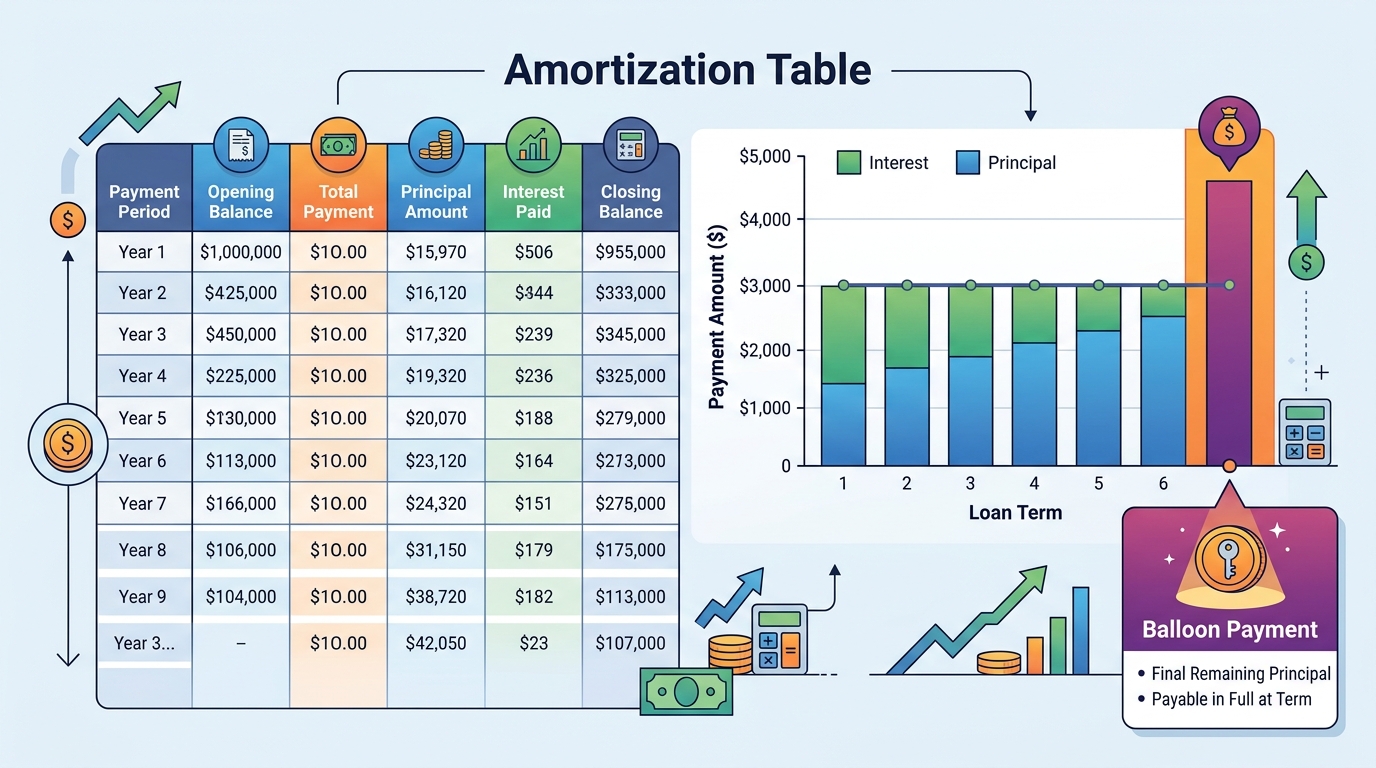
An amortization schedule details how principal and interest are paid over the loan term, often culminating in a balloon payment for commercial mortgages.
Amortization vs. Loan Term Structure
- Amortization Period (20–30 Years): The schedule used to calculate monthly principal and interest payments. A longer amortization schedule lowers monthly debt service but extends overall interest payout.
- Loan Term (5–10 Years): The actual lifespan of the commercial loan contract. At the end of the loan term, the remaining principal balance becomes due in full as a balloon payment.
Managing Balloon Payment Risk
When a commercial mortgage term reaches maturity, borrowers have three primary options:
- Refinance the Balance: Secure a new commercial mortgage to satisfy the maturing balloon payment. Property owners can check your refinance ROI to compare new rate terms.
- Pay Off Remaining Principal: Pay off the balloon balance using capital reserves or property equity.
- Sell the Property: Liquidate the commercial real estate asset to satisfy the mortgage balance and capture residual equity gains.
Next Steps: Get Prequalified for a Commercial Loan
Once you have run underwriting scenarios on the commercial mortgage rate calculator, follow these steps to advance your financing process:
- Calculate Total Transaction Costs: Interest payments are only one part of total capital requirements. Be sure to factor in total financing costs, including appraisal fees, legal costs, and origination points.
- Assemble Financial Documentation: Prepare three years of business tax returns, property operating statements (Schedule E / P&L), rent rolls, and borrower personal financial statements (PFS). (Schedule E)
- Request Lender Term Sheets: Submit your prequalification package to multiple commercial lenders—including commercial banks, credit unions, and SBA lenders—to negotiate optimal interest rates and LTV terms.