
Commercial Real Estate Refinance Rates & Lending Options
Securing optimal commercial refinance rates is one of the most effective strategies for commercial real estate (CRE) investors and property owners to optimize cash flow, reduce debt service costs, and unlock trapped equity. Whether you are holding a retail shopping center, an industrial warehouse, or an office complex, refinancing allows you to align your debt structure with your broader portfolio strategy in 2026.

A commercial property investor reviews current refinance rates to optimize their portfolio strategy.
Understanding how interest rates are priced across different commercial property types, lender tiers, and risk models is essential before submitting a loan application. This comprehensive guide breaks down current rate mechanics, Debt Service Coverage Ratio (DSCR) benchmarks, borrower credit guidelines, closing costs, and timeline expectations.
How Do Commercial Real Estate Refinance Rates Work?
Commercial mortgage refinance rates represent the annual cost of borrowing capital secured by income-producing commercial real estate. Unlike residential mortgages, which are heavily backed by government-sponsored entities and priced based on individual consumer credit profiles, commercial property refinance rates are fundamentally driven by property performance, cash flow stability, loan structure, and broader financial market benchmarks.
Lenders price commercial loans using a base rate index—such as the Secured Overnight Financing Rate (SOFR) or U.S. Treasury yields—and add a risk margin (spread) reflecting the property’s risk profile. (U.S. Treasury yields) (Secured Overnight Financing Rate (SOFR)) Commercial rates can be structured as fixed, variable, or hybrid products over terms ranging from 5 to 30 years.
Direct Answer Summary
How Do Commercial Refinance Rates Work?
Commercial refinance rates are calculated by adding a risk spread (typically 150 to 350 basis points) to a benchmark interest index like SOFR or 5-/10-Year U.S. Treasury yields. Lenders set the spread based on the property’s Debt Service Coverage Ratio (DSCR), Loan-to-Value (LTV) ratio, tenant creditworthiness, asset class, and overall borrower financial strength.
When evaluating commercial mortgage refinance rates, borrowers should monitor macro economic factors. For real-time updates on benchmark yields and market rate trends, review our comprehensive analysis of current commercial interest rates.
What DSCR is Required to Refinance a Commercial Property?
The Debt Service Coverage Ratio (DSCR) is the single most critical underwriting metric used by commercial lenders to assess loan safety. DSCR measures a property’s Net Operating Income (NOI) relative to its annual principal and interest debt payments:
$$\text{DSCR} = \frac{\text{Net Operating Income (NOI)}}{\text{Annual Debt Service}}$$
To qualify for competitive commercial real estate refinance rates, lenders generally require a minimum DSCR threshold based on asset quality and lender type:
- 1.20x to 1.25x DSCR: Standard benchmark for conventional bank loans, agency lenders, and life insurance companies on stabilized assets.
- 1.30x to 1.35x DSCR: Typical requirement for higher-risk commercial building refinance rates, such as office properties or single-tenant retail assets facing tenant roll risk.
- 1.15x to 1.20x DSCR: Specialized requirement for prime multifamily assets with strong, historical occupancy rates.
A higher DSCR indicates greater cash flow buffer, allowing lenders to offer tighter credit spreads and the best commercial refinance rates available in the market. If your property falls below 1.25x DSCR, lenders may lower the allowable maximum Loan-to-Value (LTV) or require cash injection at closing to right-size the loan balance.
Borrower Qualification & Credit Requirements
While property cash flow serves as the primary collateral anchor, lenders also evaluate borrower and sponsor creditworthiness. Institutional lenders, regional banks, and non-bank debt funds want assurance that the ownership team possesses the experience and liquidity necessary to handle unexpected capital expenditures or tenant vacancies.
Key borrower qualification standards include:
- Net Worth Requirement: Most lenders require key sponsors to maintain a total net worth equal to or greater than 100% of the loan amount requested.
- Post-Closing Liquidity: Borrowers typically must hold 6 to 12 months of principal, interest, tax, and insurance (PITI) debt service in liquid cash or marketable securities after closing.
- Sponsor Track Record: Demonstrated success managing similar asset classes in comparable markets for at least 3 to 5 years.
What credit score is needed for a commercial real estate refinance?
Direct Answer:
Most commercial real estate lenders require a minimum personal credit score of 680 to 700 for key guarantors. Premium pricing tiers and agency loan options generally require FICO scores of 720 or higher. For non-recourse loans, property financial strength and DSCR may take precedence over personal credit scores.
Timeline: How Long Does it Take to Close a Commercial Mortgage Refinance?
Closing a commercial investment property refinance takes significantly longer than residential financing due to third-party diligence requirements. On average, the process requires 45 to 75 calendar days from term sheet signing to funding.
+-----------------------------------------------------------------------+
|                       COMMERCIAL REFINANCE TIMELINE                   |
+-----------------------------------------------------------------------+
| Weeks 1 - 2  : Application, Underwriting & Term Sheet Execution       |
| Weeks 3 - 5  : Third-Party Reports (Appraisal, Environmental, PCA)    |
| Weeks 6 - 7  : Title Search, Legal Review & Insurance Verification     |
| Week 8       : Final Credit Approval & Closing / Loan Disbursement     |
+-----------------------------------------------------------------------+
Key milestones in the commercial refinance process include:
- Initial Underwriting (Days 1–10): Review of property operating statements, rent rolls, tax returns, and borrower financial statements.
- Third-Party Ordering (Days 11–35): Execution of property appraisals, Phase I Environmental Site Assessments (ESA), and Property Condition Assessments (PCA).
- Legal & Title Search (Days 35–50): Drafting loan documents, checking title commitments, and confirming zoning compliance.
- Closing & Disbursement (Days 50–60): Final loan document signing and payoff of existing debt.
Closing Costs and Fees for Refinancing Commercial Real Estate
Refinancing a commercial mortgage involves transactional friction costs that must be factored into your overall return on investment (ROI). On average, total closing costs range between 1.5% and 3.0% of the total loan amount.
| Fee Category | Estimated Cost Range | Description / Notes |
|---|---|---|
| Lender Origination Fee | 0.50% – 1.00% of loan | Covers lender processing, underwriting, and administrative overhead. |
| Appraisal Fee | $3,500 – $8,000+ | Full commercial valuation by a state-certified general appraiser. |
| Phase I Environmental (ESA) | $2,500 – $4,500 | Environmental assessment required by institutional lenders. |
| Property Condition Report (PCA) | $2,000 – $5,000 | Engineering inspection reviewing roof, HVAC, and structural integrity. |
| Legal & Closing Attorney Fees | $5,000 – $15,000+ | Representation for lender legal drafting and title settlement. |
| Title Insurance & Escrows | 0.25% – 0.50% of loan | Lender title policy, municipal searches, and escrow reserves. |
To evaluate whether extracting equity or refinancing into lower interest rates justifies these upfront closing costs, explore tailored cash-out loan terms to calculate net capital proceeds.
Commercial Refinance Rates by Property Type
Commercial real estate is not a monolith. Lenders price commercial property refinance rates based on risk factors unique to each asset class, including tenant leases, credit risk, occupancy volatility, and cap rate expansion trends.
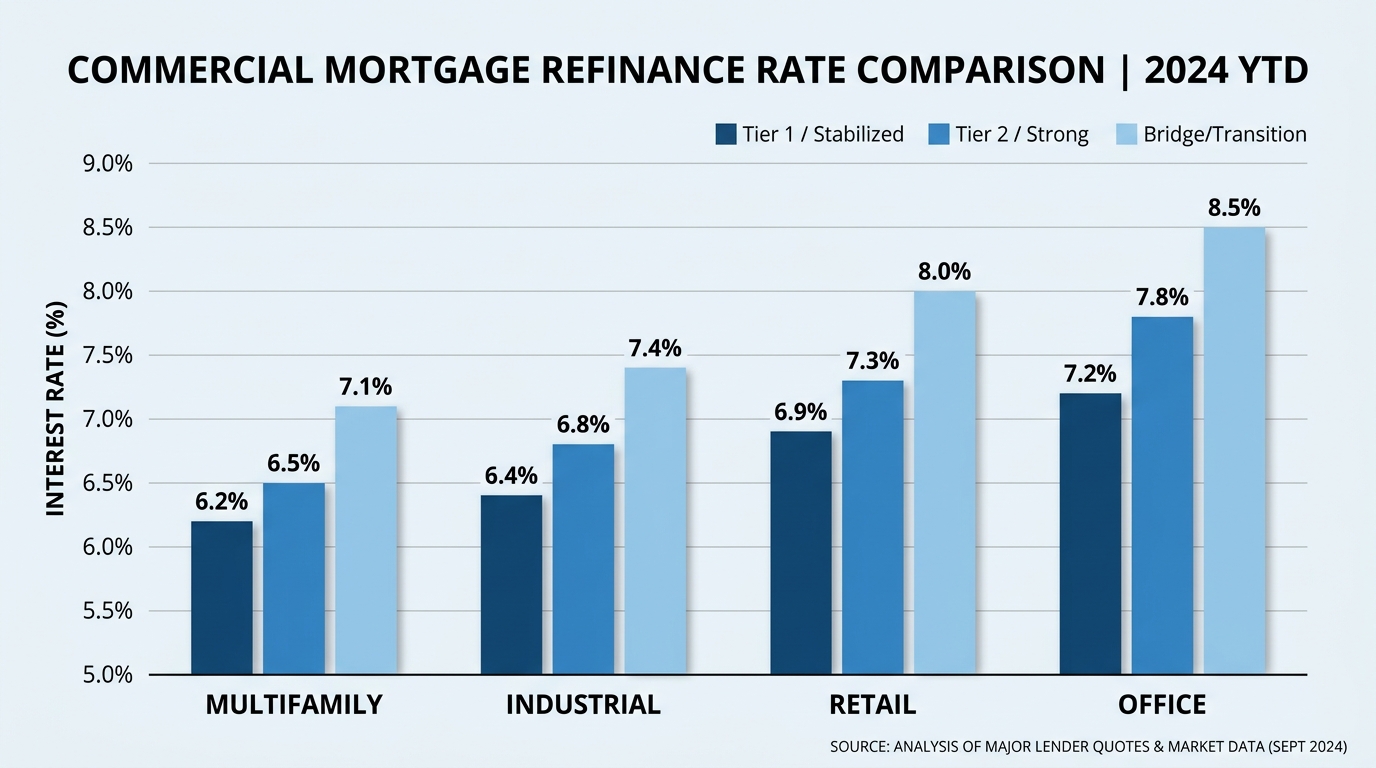
Commercial refinance rates vary significantly based on the property type and associated risk factors.
Multifamily vs. Office vs. Retail vs. Industrial Comparison
- Multifamily Properties: Multifamily assets command the lowest commercial refinance rates in the market today due to stable housing demand and government-backed agency programs. Investors seeking specific pricing for apartment assets can review current multifamily refinancing rates.
- Industrial Properties: Logistics facilities, flex space, and warehouses enjoy historically low interest rate spreads due to strong e-commerce tailwinds and high tenant retention rates.
- Retail Properties: Grocery-anchored centers and triple-net (NNN) single-tenant assets receive competitive pricing, whereas unanchored strip centers may carry higher spreads and lower allowable LTVs.
- Office Buildings: Office refinancing requires rigorous lease-term analysis. Institutional lenders favor Class-A assets with long weighted average lease terms (WALT), while secondary office properties face stricter DSCR requirements.
Frequently Asked Questions (FAQ)
What is the average commercial real estate refinance rate in 2026?
The average commercial real estate refinance rate ranges between 6.25% and 8.50%, depending on lender category, asset class, LTV, and borrower creditworthiness. Prime multifamily assets qualify for lower rates, while secondary office or bridge debt carries higher pricing.
Can I refinance a commercial loan with a prepayment penalty?
Yes, but you must evaluate penalty terms such as yield maintenance, defeasance, or step-down penalties. Calculating the cost-benefit of paying off existing debt versus interest savings over the new loan term is essential before proceeding.
What documents are required for a commercial loan refinance?
Lenders typically require 3 years of audited property financial statements (P&L), current year-to-date income statements, certified rent rolls, tax returns for guarantors, personal financial statements, and real estate schedule details.