
Commercial Refinancing Rates for SBA & Bridge Loans
Business owners and real estate developers often utilize specialized financing structures to achieve specific operational or repositioning objectives. Whether you are an owner-occupant looking for favorable government-backed terms or an investor transitioning an asset out of bridge financing, understanding SBA commercial refinance rates and short-term debt exit strategies is essential for lower long-term borrowing costs.

Business owner comparing SBA commercial refinance rates in a professional setting
This guide provides a detailed analysis of Small Business Administration (SBA) 504 and 7(a) refinancing programs, alongside tactical execution plans for converting high-cost bridge loans into permanent, long-term commercial mortgages in 2026.
How Do SBA 504 and 7(a) Commercial Refinance Rates Compare?
Direct Answer:
SBA 504 commercial refinance rates offer fixed long-term pricing (typically 6.25% to 7.15%) backed by federal guarantees, making them ideal for owner-occupied real estate. SBA 7(a) rates are typically variable, priced at Prime + 2.25% to 2.75% (currently 9.75% to 10.50%), but provide greater operational flexibility for working capital consolidation.
Program Comparison Matrix
The Small Business Administration offers two primary loan structures for refinancing commercial property:
| Loan Parameter | SBA 504 Refinance Program | SBA 7(a) Refinance Program |
|---|---|---|
| Interest Rate Structure | Fixed long-term rate (CDC debenture) | Prime-based floating rate (or fixed) |
| Current Rate Range | 6.25% – 7.15% | 9.75% – 10.50% |
| Maximum LTV | Up to 90% LTV | Up to 85% – 90% LTV |
| Maximum Loan Amount | $5.0M – $5.5M (CDC portion) | $5,000,000 total loan cap |
| Occupancy Requirement | Must occupy at least 51% of square footage | Must occupy at least 51% of square footage |
| Term & Amortization | 10, 20, or 25 years fully amortizing | Up to 25 years for real estate debt |
| Prepayment Penalty | 10-year declining penalty on CDC portion | 3-year declining penalty (5%-3%-1%) |
Borrowers evaluating owner-occupied loans alongside conventional non-recourse debt can benchmark terms against long-term commercial real estate rates.
When Should You Refinance a Commercial Bridge Loan into Long-Term Debt?
Commercial bridge loans provide rapid, short-term capital for property acquisition, value-add renovations, or lease-up execution. However, commercial bridge loan refinance rates range higher—typically 8.50% to 12.00% floating—making a timely exit into permanent financing critical for preserving investment margins.
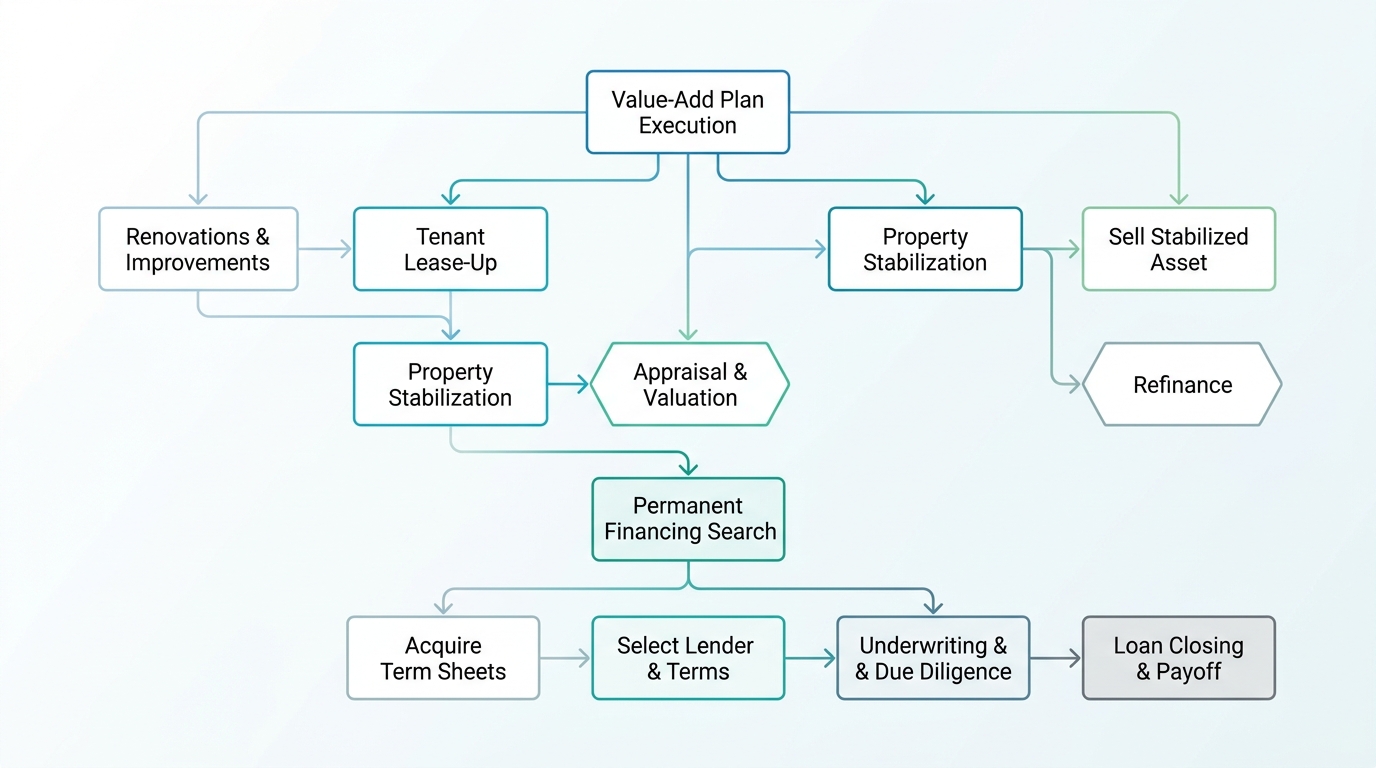
Step-by-step flowchart showing the process for exiting a commercial bridge loan
Bridge Loan Exit Strategy Guide
Direct Answer:
Investors should initiate bridge loan refinancing 3 to 6 months before achieving property stabilization (90%+ occupancy for 90 days) or 6 months prior to bridge maturity. Transitioning into permanent fixed debt eliminates interest rate risk and reduces monthly debt service costs by up to 300–400 basis points.
To execute a successful bridge loan exit:
+-----------------------------------------------------------------------+
|                    BRIDGE LOAN EXIT STRATEGY FLOWCHART                |
+-----------------------------------------------------------------------+
| Step 1: Execute Value-Add Plan (Renovations, Lease-Up, NOI Increase)   |
| Step 2: Attain Property Stabilization (90%+ Occupancy for 90 Days)    |
| Step 3: Order Appraisal to Confirm Higher Post-Renovation Value       |
| Step 4: Secure Term Sheet for Fixed Permanent Commercial Refinance     |
| Step 5: Close Permanent Loan & Pay Off Short-Term Bridge Debt          |
+-----------------------------------------------------------------------+
When locking in long-term debt post-stabilization, evaluate fixed rate options for short-term debt to insulate your asset against rate fluctuations.
Eligibility for Refinancing Owner-Occupied Real Estate
To qualify for government-backed SBA commercial refinancing, business owners must satisfy specific federal eligibility mandates:
- Owner-Occupancy Threshold: The operating business must occupy a minimum of 51% of the total rentable square footage of the commercial building (60% for newly constructed ground-up facilities).
- For-Profit Status: The business must operate as a organized for-profit entity (e.g., LLC, S-Corp, C-Corp).
- Substantial Debt Service Savings: SBA rules require that refinancing existing debt must result in a minimum 10% reduction in monthly principal and interest debt service payments, unless refinancing maturing balloon debt.
- Qualified Existing Debt: Refinanced debt must have been incurred for eligible business real estate expenditures and must be at least 6 months old.
Refinancing Out of High-Interest Short-Term Debt
Transitioning away from high-interest private lender financing, hard money loans, or expensive maturing bridge facilities allows real estate owners to stabilize property cash distributions.
Key benefits of transitioning to long-term permanent financing include:
- Debt Service Reduction: Lowering borrowing costs from 10%+ bridge rates down to 6.25%–7.00% permanent rates sharply increases property cash flow.
- Extended Amortization: Moving from short interest-only payment windows to 25- or 30-year principal and interest schedules builds equity while reducing debt service stress.
- Equity Release: If property valuation has appreciated significantly during the bridge period, investors can consider cashing out with permanent financing to extract capital for new projects.
Frequently Asked Questions (FAQ)
What is the difference between SBA 504 and SBA 7(a) for real estate?
SBA 504 loans feature a two-tiered lender structure offering low fixed interest rates ideal for long-term real estate holdings. SBA 7(a) loans are single-lender products with variable interest rates that offer greater flexibility for combined real estate and equipment debt.
Can I refinance debt that already has an SBA guarantee?
Yes, under current SBA rules, existing SBA debt can be refinanced using a new SBA loan provided the borrower demonstrates a material economic benefit, such as securing lower interest rates or extending loan term duration.
How quickly can I exit a commercial bridge loan?
Most commercial bridge loans feature a minimum interest covenant or lockout period of 6 to 12 months. Once the lockout expires, borrowers can refinance into permanent debt without prepayment penalties.