
Comparing Commercial Real Estate Financing Options
Commercial real estate represents one of the most effective asset classes for wealth creation, income generation, and portfolio diversification. However, selecting the wrong loan structure can severely erode cash flow, restrict operational flexibility, or trigger costly refinancing hurdles. As credit markets evolve in 2026, understanding the full spectrum of commercial real estate financing options is vital for real estate investors, developers, and owner-operators alike.

Explore the diverse range of commercial real estate financing options available to investors, from traditional bank loans to specialized short-term solutions.
Whether you are purchasing a stabilized neighborhood shopping center, acquiring an industrial warehouse for your expanding business, or executing a heavy value-add repositioning project, matching your capital structure to your business plan is critical. For a broad foundational understanding, start with our overview of commercial property loans, and read this detailed comparison guide to evaluate specific loan products.
What are the main types of commercial property loans?
Commercial real estate debt is not a one-size-fits-all market. Lenders evaluate loans based on borrower creditworthiness, property income stability, and intended hold periods. The primary types of commercial property loans available to borrowers include:
- Conventional Commercial Mortgages: Standard bank debt issued by national, regional, and community banks for stabilized, income-producing real estate.
- SBA Loans (SBA 7(a) & SBA 504): Government-backed loans designed specifically for small-to-midsize business owners purchasing owner-occupied commercial properties.
- CMBS (Conduit) Loans: Wall Street securitized loans packaged into bonds, offering high leverage and non-recourse debt for institutional and mid-market assets.
- Portfolio Lender Financing: Balance-sheet loans retained by commercial banks and credit unions that offer customized underwriting terms.
- Commercial Bridge Loans: Short-term, interim debt designed to fund property acquisitions, repositionings, or lease-up phases until long-term financing is secured.
- Commercial Hard Money Loans: Asset-based capital provided by private investors and private debt funds when execution speed and asset value outweigh credit requirements.
- Life Insurance Company Loans: Conservative, low-interest, long-term fixed loans reserved for premier Class A commercial properties with creditworthy tenants.
Conventional Commercial Mortgages vs. SBA Loans
When comparing commercial mortgage options, two of the most popular avenues for mid-market acquisitions are conventional bank mortgages and Small Business Administration (SBA) loan programs.
Conventional commercial mortgages are underwritten directly by commercial banks based on property cash flow (DSCR) and borrower liquidity. They typically require 20% to 30% down payments and feature 5-to-10-year term lengths with 20-to-25-year amortization schedules.
In contrast, SBA loans are partially backed by the federal government, encouraging lenders to offer higher Loan-to-Value (LTV) limits and longer repayment terms for business owners acquiring their own operational real estate.
How do SBA 7(a) and SBA 504 loans differ for commercial real estate?
The Small Business Administration offers two flagship financing solutions for real estate: the SBA 7(a) loan program and the SBA 504 loan program. The key differences between these options are summarized below:
| Loan Parameter | SBA 7(a) Loan Program | SBA 504 Loan Program |
|---|---|---|
| Primary Target Use | Real estate purchase, working capital, debt refinance | Land, major construction, facility purchase/modernization |
| Maximum Loan Amount | $5,000,000 total loan cap | Up to $5,000,000 ($5.5M for manufacturers/energy projects) |
| Maximum LTV / Down Payment | Up to 90% LTV (10% down) | Up to 90% LTV (10% owner, 50% bank, 40% CDC debenture) |
| Interest Rate Structure | Variable (tied to Prime) or Fixed options | Fixed long-term rate on CDC portion (10, 20, or 25 years) |
| Term Lengths | Up to 25 years for commercial real estate | 10, 20, or 25 years fully amortizing |
| Occupancy Requirement | Must occupy ≥ 51% (existing) or 60% (ground-up) | Must occupy ≥ 51% (existing) or 60% (ground-up) |
| Prepayment Penalties | Declining penalty for first 3 years (5%, 3%, 1%) | Declining penalty for first 10 years of CDC debenture |
If you are an investor looking to purchase multi-tenant rental property rather than operating your own company out of the building, SBA financing is not eligible. Instead, you should evaluate specialized investor loans for commercial property.
CMBS Loans vs. Portfolio Lender Financing
For larger commercial investments ($2,000,000 and above), investors frequently decide between CMBS (Conduit) loans and Portfolio Lender Financing.
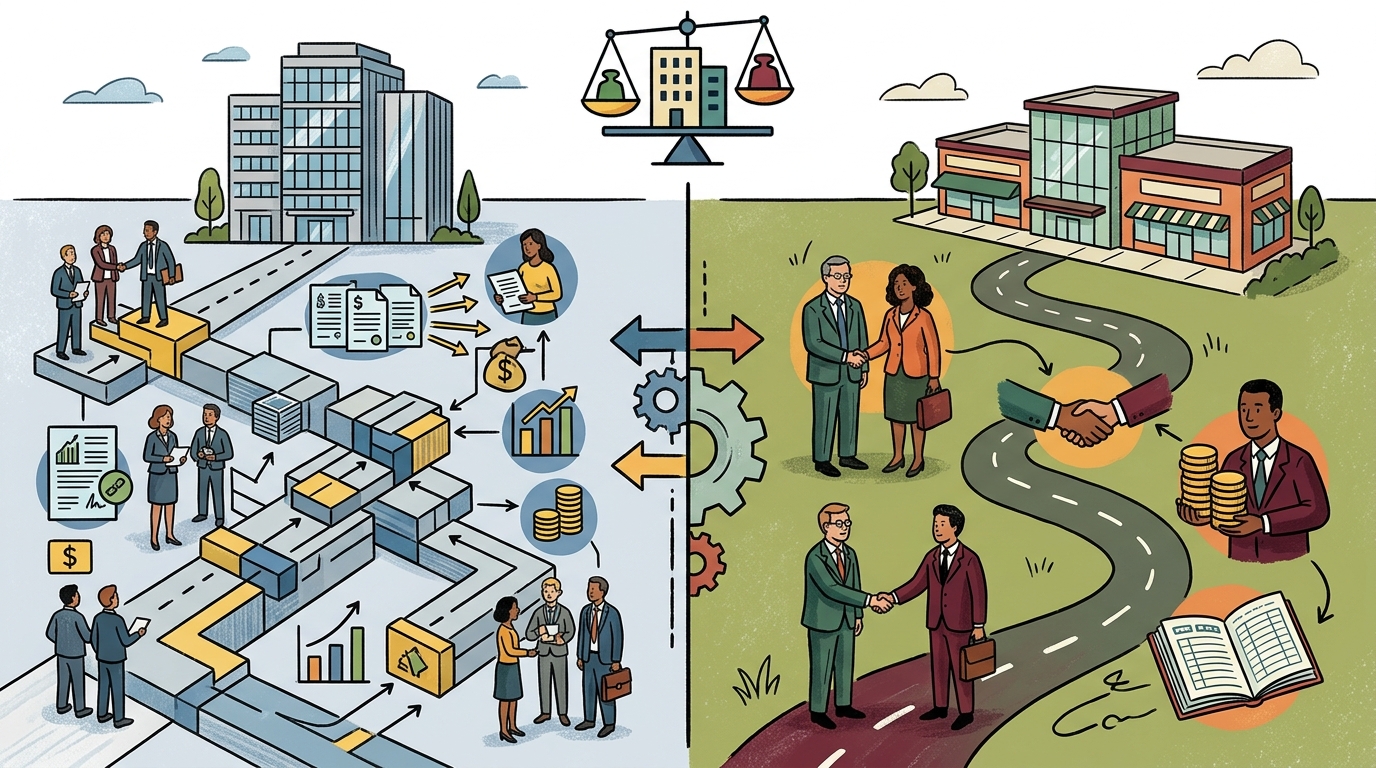
Understand the key distinctions between CMBS (Conduit) loans and Portfolio Lender Financing to choose the best option for your commercial investment.
CMBS (Conduit) Loans
Conduit loans are originated by commercial banks or investment firms and pooled into commercial mortgage-backed securities sold to secondary market bond investors.
* Key Advantages:
* Non-Recourse Protection: Lenders can only pursue the property collateral in default, protecting personal assets outside standard “bad-boy” fraud carve-outs.
* Higher LTV Limits: Often offers up to 75% LTV on cash-flowing commercial properties.
* Competitive Fixed Rates: Rates are pegged to swap spreads, providing low, fixed debt service for 5 or 10 years.
* Key Drawbacks:
* Prepayment Flexibility: Exiting early requires complex, costly defeasance or yield maintenance mechanisms.
* Rigid Servicing: Master and special servicers adhere strictly to bond documents, making lease modifications or loan restructuring difficult.
Portfolio Lender Financing
Portfolio lenders (local banks, credit unions, and mutual banks) hold loan assets directly on their balance sheets through maturity.
* Key Advantages:
* Relationship Flexibility: Portfolio lenders can adjust loan terms, accommodate lease changes, or grant short-term accommodations during market shifts.
* Easier Prepayment: Features lower step-down prepayment penalties (e.g., 3-2-1% structures) or no penalty at all.
* Key Drawbacks:
* Recourse Requirements: Typically requires full or limited personal guarantees from sponsors holding 20%+ ownership.
* Lower LTV Thresholds: Lenders may cap leverage at 65% to 70% LTV to mitigate balance sheet risk.
Short-Term Options: Bridge and Hard Money
When acquiring properties that require immediate physical repairs, lease stabilization, or rapid closing timelines, traditional bank debt is often unavailable. Underwriting short-term debt allows investors to execute value-add business plans before transitioning to permanent mortgages.
Commercial Bridge Loans
Bridge loans are short-term, floating-rate debt instruments (12 to 36 months) provided by private funds and specialty debt lenders. They bridge the gap between initial acquisition/repositioning and long-term stabilization. Lenders fund up to 75%–80% of total project costs (including construction budgets) and focus heavily on the property’s projected Post-Renovation Pro-Forma NOI.
Commercial Hard Money Loans
Hard money financing represents private capital provided primarily on the liquidation value of the real estate collateral rather than borrower credit or tax returns.
* Closing Speed: Can close in as little as 7 to 14 days.
* Pricing & Risk: Rates are higher (typically 9% to 13%+), with 1 to 3 origination points.
* Best Use: Distressed property auctions, opportunistic land acquisitions, or distressed note purchases where traditional lenders cannot meet closing deadlines.
To dive deeper into alternative capital solutions, learn about commercial hard money loans and evaluate pricing and exit strategy requirements.
Choosing the Right Financing Option for Your Property Strategy
Selecting among commercial real estate loan types depends on your property’s stabilization level, operational complexity, and target holding period.
+-------------------------------------------------------------------------+
|                  PROPERTY STRATEGY FINANCING DECISION MATRIX             |
|                                                                         |
|   Turnkey / Fully Leased Asset -----> Conventional / CMBS / Life Co     |
|   Owner-Occupied Facility     -----> SBA 504 or SBA 7(a) Loans          |
|   Value-Add / Low Occupancy   -----> Commercial Bridge Loan             |
|   Distressed / Fast Closing   -----> Commercial Hard Money Loan         |
+-------------------------------------------------------------------------+
Turnkey Properties vs. Value-Add Investments
-
Turnkey / Stabilized Properties:
* Definition: Properties with 90%+ occupancy, long-term credit tenants, and minimal immediate capital expenditure needs.
* Recommended Financing: Conventional bank mortgages, CMBS conduit loans, or Life Insurance company loans.
* Primary Goal: Secure lowest fixed interest rates and maximum debt service coverage to preserve monthly yield. -
Value-Add Investments:
* Definition: Properties suffering from high vacancy, deferred maintenance, below-market leases, or requiring adaptive reuse.
* Recommended Financing: Commercial bridge loans or flexible private lender debt with interest-only draw structures.
* Primary Goal: Obtain short-term flexible capital with non-prepayment penalties so the asset can be refinanced into permanent debt once stabilized.
Pros and Cons Summary Matrix for Commercial Loan Options
To streamline your selection process, the matrix below highlights the core tradeoffs across the leading commercial loan categories:
| Financing Category | Pros | Cons | Best Suited For |
|---|---|---|---|
| Conventional Bank Loan | Competitive rates; relationship terms; manageable fees | Personal recourse required; strict DSCR criteria | Stabilized assets with strong local bank ties |
| SBA 504 / 7(a) Loan | Low down payment (10%); long fixed terms | Owner-occupied restrictions; lengthy application | Small businesses buying operational real estate |
| CMBS (Conduit) Debt | Non-recourse debt; high LTVs; competitive fixed pricing | High defeasance fees; rigid bond servicer management | Large stabilized commercial properties ($2M+) |
| Bridge Financing | Fast execution; funds renovations; flexible underwriting | Higher floating rates; short terms; refinancing risks | Value-add turnarounds & un-stabilized property |
| Hard Money Loans | Asset-based underwriting; 7-14 day closings | High interest rates & points; strict equity requirements | Distressed asset acquisitions & quick flips |
Frequently Asked Questions
Which commercial real estate loan option requires the smallest down payment?
SBA 504 and SBA 7(a) loans offer the lowest down payment requirements, allowing qualifying small business owners to acquire commercial real estate with as little as 10% down (90% LTV).
Can I get a non-recourse loan for a commercial property?
Yes. Non-recourse commercial loans are widely available through CMBS conduit lenders, agency lenders (Fannie Mae/Freddie Mac for multi-family), life insurance companies, and select bridge funds, typically for loan amounts over $2,000,000.
What is the typical repayment term for a commercial bridge loan?
Commercial bridge loans generally feature terms ranging from 12 to 36 months, often with one or two 6-to-12-month extension options conditioned upon loan performance and extension fee payment.
How do lenders determine maximum loan amounts on commercial property?
Lenders evaluate maximum loan size using three main constraints: Loan-to-Value (LTV), Debt Service Coverage Ratio (DSCR), and Debt Yield thresholds. The loan amount is capped by whichever metric produces the lowest capital dollar amount.