
Current Commercial Real Estate Loan Rates & Financing Terms
Navigating the commercial real estate (CRE) debt capital markets requires up-to-date visibility into dynamic pricing, index movements, and lending criteria. In 2026, commercial real estate loan rates reflect a complex macroeconomic landscape shaped by benchmark yield movements, bank regulatory requirements, and property-level cash flow performance. Whether you are acquiring a single-tenant industrial asset, refinancing a stabilized multifamily property, or expanding an owner-occupied facility, securing competitive debt financing is central to optimizing your equity yield and internal rate of return (IRR).
This guide provides a comprehensive breakdown of today’s current commercial mortgage rates, comparing loan programs, explaining key underwriting parameters such as Debt Service Coverage Ratio (DSCR) and Loan-to-Value (LTV), and presenting actionable strategies to secure the most favorable commercial mortgage terms.

A dashboard view of current commercial real estate loan rates, illustrating various financing terms and market trends.
What Are Current Commercial Mortgage Rates Today?
Today’s commercial property interest rates vary substantially based on the loan structure, capital provider, underlying collateral class, and borrower risk profile. Commercial mortgage debt is generally priced as a spread over key benchmark index rates, primarily the Secured Overnight Financing Rate (SOFR) for short-term and floating-rate capital, or the 10-Year U.S. Treasury Yield for long-term fixed-rate financing. (10-Year U.S. Treasury Yield) (Secured Overnight Financing Rate (SOFR))
To evaluate where cre loan rates today stand across different capital sources, borrowers must look beyond the headline rate and evaluate the entire fee structure, recourse requirements, and prepayment flexibility.
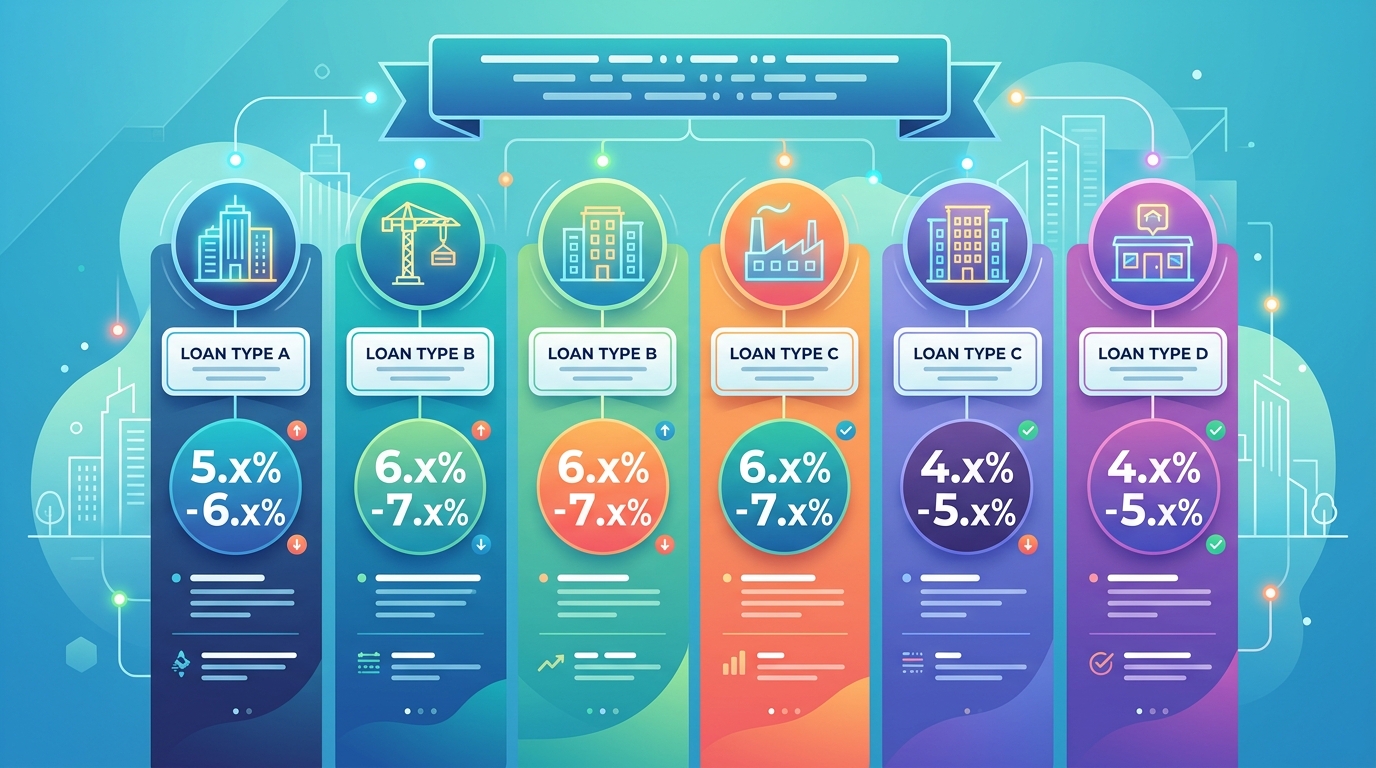
A detailed comparison chart highlighting the best commercial mortgage interest rates across different loan types and lenders.
SBA 504 and 7(a) Loan Rates
Small Business Administration (SBA) loan programs remain a primary vehicle for owner-occupied commercial properties, offering high leverage and competitive pricing backed by federal guarantees.
- SBA 504 Loans: Designed for real estate acquisition and long-term capital investments, SBA 504 loans utilize a two-tier structure. (SBA 504 Loans) The primary lender funds 50% of the purchase price, while a Certified Development Company (CDC) funds up to 40% backed by a 10-year or 25-year fixed-rate debenture. Currently, 25-year SBA 504 debenture interest rates average between 5.85% and 6.65%, providing long-term rate predictability.
- SBA 7(a) Loans: Offering multi-purpose business and real estate funding, SBA 7(a) interest rates are typically floating and pegged to the Prime Rate plus an lender margin ranging from 2.25% to 2.75%. In 2026, commercial property loan interest rates for SBA 7(a) real estate transactions range between 8.50% and 10.25%, depending on loan size and borrower creditworthiness.
CMBS and Bridge Loan Rates
For non-recourse, institutional, and transitional capital, Commercial Mortgage-Backed Securities (CMBS) and debt funds provide flexible structures across the risk spectrum:
- CMBS Conduit Loans: Fixed-rate, non-recourse CMBS loans are structured into Wall Street securitization pools. These 5-year to 10-year loans feature interest rates priced at a spread of 180 to 260 basis points over the 10-Year Treasury yield, placing typical CMBS rates between 6.25% and 7.15%. CMBS loans offer interest-only options and higher LTV limits, though they carry strict yield maintenance or defeasance prepayment penalties.
- Bridge and Transitional Loans: Private debt funds and balance-sheet lenders provide short-term bridge debt for non-stabilized assets, value-add acquisitions, and adaptive reuse projects. Priced over 30-day SOFR with spreads ranging from 350 to 600 basis points, current commercial real estate bridge loan rates range from 8.75% to 11.50%. While higher in cost, these loans offer flexible extension options and low prepayment friction.
Traditional Bank & Credit Union Rates
Regional banks, community institutions, and credit unions represent the largest originators of balance-sheet commercial mortgages:
- Commercial Banks: Local and national banks offer competitive fixed-rate and adjustable-rate products for stabilized assets. Typical 5-year and 10-year fixed bank loan rates range between 6.00% and 7.25%. Banks frequently prioritize full-relationship banking, often requiring operating deposit accounts to offer their premier rates.
- Credit Unions: Operating as non-profit institutions, credit unions frequently offer highly competitive commercial mortgage interest rates without requiring strict deposit relationship thresholds or charging heavy origination fees. Current credit union commercial rates range from 5.75% to 6.85% on 5-year fixed terms, making them a top choice for middle-market real estate investors.
How Can Borrowers Secure the Best Commercial Real Estate Loan Rates?
Securing the best commercial real estate rates requires strategic positioning long before formal loan application submission. Lenders price loans based on perceived risk; reducing risk indicators directly compresses the interest rate spread.
To secure competitive commercial real estate financing rates, consider the following strategic measures:
- Optimize Asset Cash Flow: Maximize Net Operating Income (NOI) by eliminating lease concessions, collecting delinquent rents, and auditing operating expenses. Higher, verified NOI directly strengthens coverage metrics.
- Present a Clean Credit & Liquidity Profile: Lenders evaluate borrower net worth and post-closing liquidity. Maintain liquidity equal to at least 6 to 12 months of principal and interest debt service payments.
- Engage Multiple Capital Providers: Rates and underwriting appetites vary significantly between regional banks, agency lenders, debt funds, and life insurance companies. Obtaining multiple competitive term sheets gives borrowers pricing leverage.
- Leverage Asset-Specific Programs: Review whether your asset qualifies for specialized agency programs or eco-friendly green financing discounts.
To better understand how market forces and macroeconomic policies influence underlying debt benchmarks, review historical commercial loan rate trends to strategically time your financing window.
Importance of DSCR and LTV
Underwriters prioritize two foundational debt metrics when setting interest rate spreads and maximum loan amounts:
- Debt Service Coverage Ratio (DSCR): Calculated as Net Operating Income divided by total annual debt service ($\text{DSCR} = \frac{\text{NOI}}{\text{Annual Debt Service}}$). A higher DSCR demonstrates stronger cash flow safety margins. Properties maintaining a DSCR of 1.35x or higher qualify for lower interest rate spreads compared to marginal assets at 1.20x.
- Loan-to-Value (LTV) Ratio: Representing the loan amount divided by the appraised property value ($\text{LTV} = \frac{\text{Loan Amount}}{\text{Appraised Value}}$). Lowering your requested LTV from 75% to 60% substantially de-risks the transaction for the lender, resulting in pricing discounts of 25 to 50 basis points.
What DSCR and LTV Are Required to Qualify for Lower Interest Rates?
To help borrowers target key underwriting benchmarks, the matrix below details typical DSCR and LTV criteria across primary commercial loan structures, alongside the impact on interest rate spreads:
| Loan Category | Minimum DSCR Requirement | Preferred LTV Range | Target Interest Rate Range | Primary Pricing Factors |
|---|---|---|---|---|
| Agency Multifamily (Fannie/Freddie) | 1.25x – 1.30x | 65% – 75% | 5.50% – 6.35% | Unit count, green certification, tenant affordability |
| Traditional Regional Bank | 1.25x – 1.35x | 65% – 70% | 6.00% – 7.25% | Borrower liquidity, deposit relationship, property location |
| CMBS Conduit Debt | 1.30x – 1.40x | 70% – 75% | 6.25% – 7.15% | Tenant credit quality, lease rollover schedule, market tier |
| SBA 504 Real Estate | 1.15x – 1.20x | 85% – 90% | 5.85% – 6.65% | Owner occupancy percentage (>51%), personal guarantee strength |
| Private Bridge Capital | 1.00x – 1.15x (As-Is) | 60% – 70% (LTC) | 8.75% – 11.50% | Execution track record, clear exit strategy, value-add potential |
Understanding how commercial loan rates are determined allows investors to model precise debt scenarios across different loan structures. Additionally, pricing varies according to asset type; borrowers should review commercial investment property rates by asset class to evaluate specific spreads for retail, industrial, office, and multifamily properties.
Frequently Asked Questions (FAQ)
What are current commercial mortgage rates today?
As of 2026, current commercial mortgage rates generally span from 5.50% to 7.25% for stabilized, institutional-quality properties financed through agency lenders or traditional commercial banks. SBA 504 fixed debentures range from 5.85% to 6.65%, while transitional bridge debt ranges between 8.75% and 11.50%, depending on asset risk and leverage.
How do commercial loan rates differ from residential mortgage rates?
Commercial loan rates are generally higher than residential rates by 50 to 150 basis points due to higher investment risk and shorter loan terms (typically 5, 7, or 10 years with 25-year amortization schedules). Furthermore, commercial underwriting focuses primarily on property cash flow (NOI and DSCR) rather than personal debt-to-income (DTI) ratios.
What is the minimum DSCR required for a commercial real estate loan?
Most conventional commercial lenders mandate a minimum Debt Service Coverage Ratio (DSCR) of 1.25x, meaning the net operating income must exceed the annual mortgage payment by 25%. Premium rates and terms are typically reserved for assets achieving a DSCR of 1.35x or higher.
How does LTV impact the commercial mortgage interest rate?
Lowering the Loan-to-Value (LTV) ratio reduces the capital provider’s exposure to loss in the event of default. A borrower requesting a 60% LTV loan will typically secure an interest rate that is 25 to 50 basis points lower than a borrower requesting 75% LTV on the same asset.