

DSCR Commercial Real Estate Loan Rates Explained
Navigating debt financing in commercial real estate requires a precise understanding of how property-level cash flow drives interest rate pricing. For commercial real estate investors, property owners, and syndicators scaling their portfolios in 2026, DSCR commercial real estate loan rates represent one of the most vital metrics in financial modeling.
Unlike residential mortgage underwriting, which relies heavily on personal debt-to-income (DTI) ratios and personal income tax returns, commercial debt underwriting centers on the asset’s capacity to service its debt burden. The Debt Service Coverage Ratio (DSCR) serves as the primary gauge of financial risk for commercial lenders. A higher DSCR signals robust cash flow cushion, mitigating default probability and unlocking institutional rate discounts. Conversely, a tight or marginal coverage ratio increases risk premiums, elevating borrowing costs across asset classes.
This guide breaks down current commercial debt market pricing, examines how lenders establish commercial loan interest rates based on DSCR thresholds, compares rates across asset classes, and explores strategic alternatives for low-DSCR properties.
How DSCR Directly Dictates Commercial Mortgage Interest Rates
Commercial debt pricing operates on a risk-adjusted return model. Lenders price loans by taking a benchmark index rate—such as the 5-Year or 10-Year U.S. Treasury yield or Secured Overnight Financing Rate (SOFR)—and adding a credit spread. The Debt Service Coverage Ratio is the single largest variable determining the width of that credit spread.
The mathematical formula for DSCR is expressed as:
$$\text{DSCR} = \frac{\text{Net Operating Income (NOI)}}{\text{Annual Debt Service}}$$
When a commercial property generates a higher Net Operating Income relative to its principal and interest obligations, the lender’s exposure to debt service default diminishes significantly.

A visual representation of how Debt Service Coverage Ratio (DSCR) directly influences commercial mortgage interest rates, with higher DSCR leading to lower rates.
Lenders translate this reduced risk into lower credit spreads. For instance, a commercial asset producing a 1.45x DSCR represents a low probability of cash flow distress even during localized economic downturns or temporary tenant vacancy. Lenders compete aggressively for these high-coverage assets, narrowing spreads over benchmark rates.
Conversely, when coverage drops toward 1.15x, even minor revenue fluctuations or unexpected capital expenditures can cause debt coverage default. Underwriters compensate for this added risk by expanding the interest rate spread, introducing debt yield minimums, or mandating structural protections such as cash sweeps or interest reserves.
Understanding the mechanics of how lenders use DSCR to set interest rates allows investors to model acquisition returns accurately and optimize their debt capital stack prior to issuing formal term sheet requests.
Current Commercial Loan Rate Ranges by DSCR Threshold
Commercial mortgage pricing is categorized into distinct coverage tiers. While macroeconomic factors and base benchmark rates fluctuate, the relative rate spread differentials across DSCR tiers remain consistent throughout market cycles.
Below is an overview of representative debt pricing structures across financial institutions, agency lenders, and private commercial credit markets:
| DSCR Tier Level | DSCR Coverage Range | Typical Interest Rate Spread | Risk Level & Underwriting Focus | Primary Capital Sources |
|---|---|---|---|---|
| Tier 1 (Prime) | 1.40x and above | Base Index + 150 to 220 bps | Preferred institutional quality; high cash flow safety cushion | Fannie Mae, Freddie Mac, Life Insurance Cos, Regional Banks |
| Tier 2 (Standard) | 1.25x to 1.39x | Base Index + 225 to 300 bps | Standard commercial underwriting benchmark; moderate leverage | Regional Banks, Debt Funds, CMBS Conduits |
| Tier 3 (Elevated Risk) | 1.15x to 1.24x | Base Index + 325 to 450 bps | Tight coverage cushion; capped Loan-to-Value (LTV) limits | Bridge Lenders, Private Credit, Specialized Credit Unions |
| Tier 4 (High Risk / Low DSCR) | Below 1.15x | Base Index + 475+ bps (or Fixed 9.50%–12.00%+) | High risk of default; requires IO periods or cross-collateral | Private Money, Opportunistic Debt Funds, Hard Money |
Note: Spread figures represent baseline credit adjustments over prevailing benchmarks like 5-Year Treasuries or SOFR 5-Year Treasuries or SOFR. Actual quotes depend on location, sponsor liquidity, and property condition.
Moving between these debt tiers produces a direct financial impact on debt service payments. For example, moving an asset from Tier 3 to Tier 1 by expanding property NOI can reduce borrowing costs by 100 to 200 basis points, driving thousands of dollars in annual interest savings.
Multifamily vs. Other Commercial Asset Class DSCR Rates
Commercial real estate is not a monolith. Lenders apply asset-class specific adjustments when calculating commercial investment property DSCR rates, as tenant durability, lease terms, and capital expenditure demands vary significantly between property types.
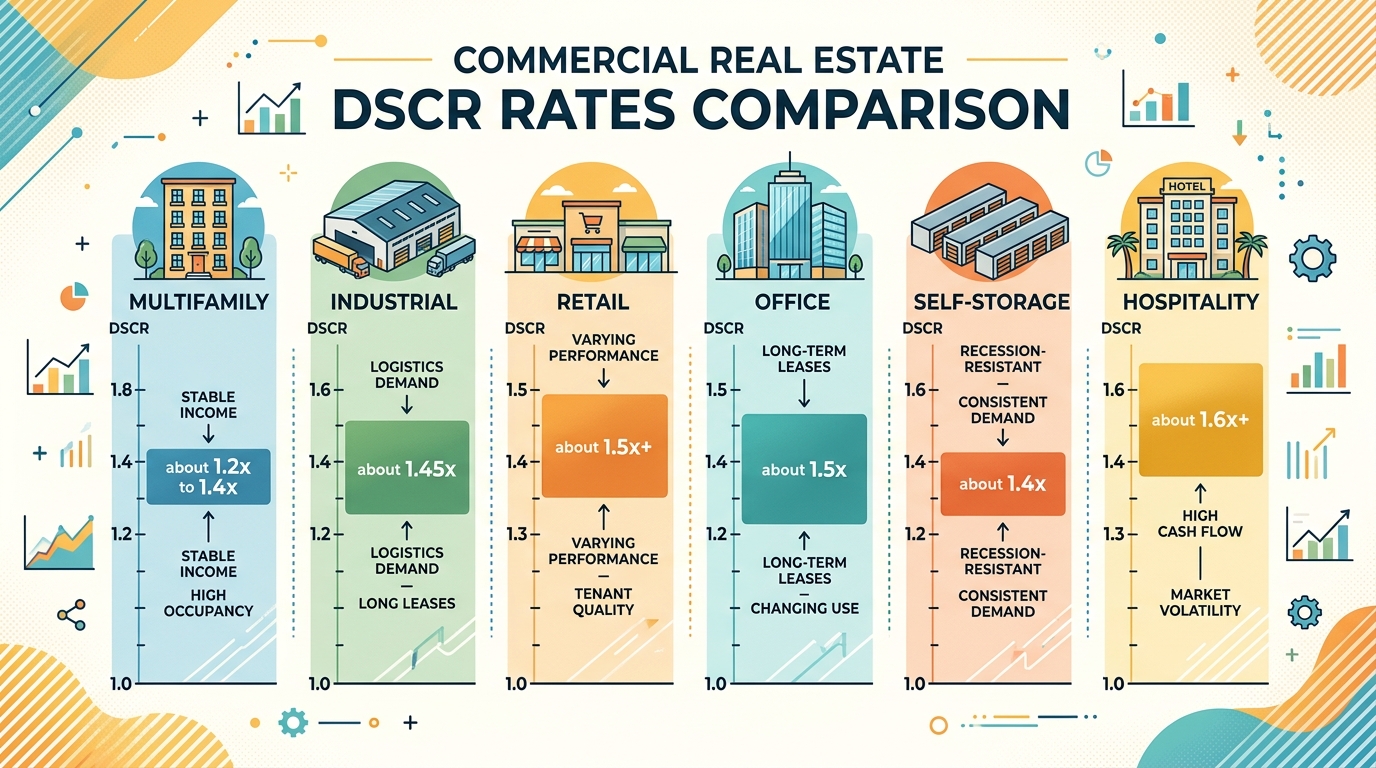
Comparison of Debt Service Coverage Ratio (DSCR) rates across various commercial investment property asset classes, highlighting differences in risk perception and lending standards.
What rates can multifamily properties achieve with a high DSCR?
Multifamily assets consistently achieve the lowest borrowing rates in the commercial debt markets. Due to government-sponsored agency programs (Fannie Mae and Freddie Mac), housing market liquidity, and diversified multi-tenant lease structures, lenders view residential rental properties as lower risk compared to single-tenant commercial assets.
When evaluating multifamily DSCR loan rates, properties maintaining a high DSCR (1.35x to 1.50x+) unlock access to prime agency execution, long-term fixed rates (up to 10 or 30 years), and non-recourse debt terms. Rate spreads for Tier 1 multifamily assets routinely price 30 to 75 basis points below non-residential commercial assets with identical coverage ratios.
How do commercial investment property DSCR rates compare across asset classes?
Non-multifamily commercial property sectors face distinct underwriting metrics and rate spreads:
- Industrial & Logistics: High tenant stability and triple-net (NNN) lease structures allow industrial assets with strong coverage (1.30x+) to price near multifamily benchmarks. However, single-tenant concentration risk may trigger lender requirements for higher baseline DSCR targets.
- Retail Properties: Multi-tenant neighborhood shopping centers anchored by grocers command competitive pricing at 1.25x–1.35x DSCR. Conversely, unanchored strip centers or big-box retail face higher coverage requirements (1.35x–1.45x) and elevated interest rate spreads due to tenant transition risks.
- Office Buildings: Given ongoing post-pandemic market adjustments, office underwriting remains stringent. Lenders often require minimum DSCR targets of 1.35x to 1.50x alongside conservative debt yield thresholds before quoting competitive fixed rates.
- Self-Storage & Hospitality: Self-storage assets benefit from diversified income streams and enjoy favorable DSCR pricing tiers similar to multifamily. Hospitality properties, facing volatile daily operational cash flow, face stringent DSCR requirements (1.40x–1.50x) and premium rate spreads.
To explore specific threshold standards by asset class, review our detailed guide on commercial real estate DSCR tiers.
Options for Borrowers with Low DSCR (<1.15x–1.20x)
Securing conventional commercial financing becomes challenging when a property’s coverage falls below standard bank guidelines of 1.20x–1.25x. Value-add acquisitions, recent tenant roll-offs, or properties located in rapidly adjusting rental markets frequently present coverage challenges.
What loan options exist for low DSCR commercial real estate?
Borrowers evaluating low DSCR commercial real estate loans have access to specialized capital structures designed to accommodate transition assets:
- Interest-Only (IO) Periods: Converting full principal and interest amortizing payments into Interest-Only structures lowers immediate annual debt service obligations. This artificial reduction in debt service inflates the calculated DSCR back into an acceptable underwriting tier, securing lower base rates during the initial loan term.
- Commercial Bridge Debt: Private debt funds and bridge lenders provide short-term (1 to 3 year) flexible financing for low-coverage properties. While bridge rates carry higher interest spreads, these loans provide capital for property stabilization without penalizing long-term yield.
- Seller Financing & Master Leases: Negotiating secondary seller financing or master lease agreements allows primary lenders to underwrite lower senior debt service, maintaining overall property coverage requirements.
- Mezzanine Capital or Preferred Equity: Inserting mezzanine financing above senior debt reduces the primary loan size, boosting the senior DSCR ratio to qualify for competitive institutional interest rates.
Investors focused on repositioning assets to reduce capital costs can learn more about improving DSCR for lower commercial mortgage rates through strategic revenue enhancement and capital stack adjustments.
Frequently Asked Questions (FAQ)
What is a typical interest rate spread for a commercial DSCR loan?
Standard commercial DSCR loan spreads range from 150 to 350 basis points over prevailing benchmark indices like 5-Year U.S. Treasuries or SOFR, depending on property tier, LTV, sponsor experience, and asset condition.
Can I secure a commercial real estate loan with a DSCR below 1.0x?
Yes, loans for properties with a DSCR below 1.0x (where property cash flow does not fully cover debt service) are available through private bridge debt, hard money, or short-term value-add loan structures, provided the borrower demonstrates a clear path to lease-up or stabilization.
How does property type impact DSCR interest rate requirements?
Property type dictates tenant stability risk. Multifamily and industrial properties receive lower rate spreads at lower coverage thresholds (e.g., 1.20x–1.25x) compared to office or hospitality properties, which require higher coverage buffers (1.35x–1.50x) for equivalent pricing tiers.
Conclusion & Next Steps
Understanding how commercial real estate DSCR rates are calculated and priced empowers real estate investors to structure debt effectively, negotiate better terms, and maximize investment returns. By monitoring coverage tiers and optimizing net operating income prior to application, borrowers can unlock substantial interest cost savings across their portfolios.
For custom rate analysis or assistance structuring commercial debt options tailored to your specific commercial asset, contact the underwriting team at Hunter Fisher LLC today.