Exploring Your Options: Types of Commercial Real Estate Loans
Choosing the ideal financing structure for commercial real estate requires matching your business goals, risk tolerance, and investment horizon with the appropriate lending vehicle. The commercial debt market offers a wide spectrum of credit facilities—ranging from long-term, low-cost conventional mortgages to rapid, short-term bridge capital.
Whether you are purchasing your first owner-occupied retail space, acquiring a stabilized industrial park, or repositioning an underperforming multi-family asset, evaluating the primary types of commercial real estate loans is the first step toward securing capital.
This guide details the major commercial loan structures, comparing loan terms, down payments, qualification standards, and ideal use cases for each option.
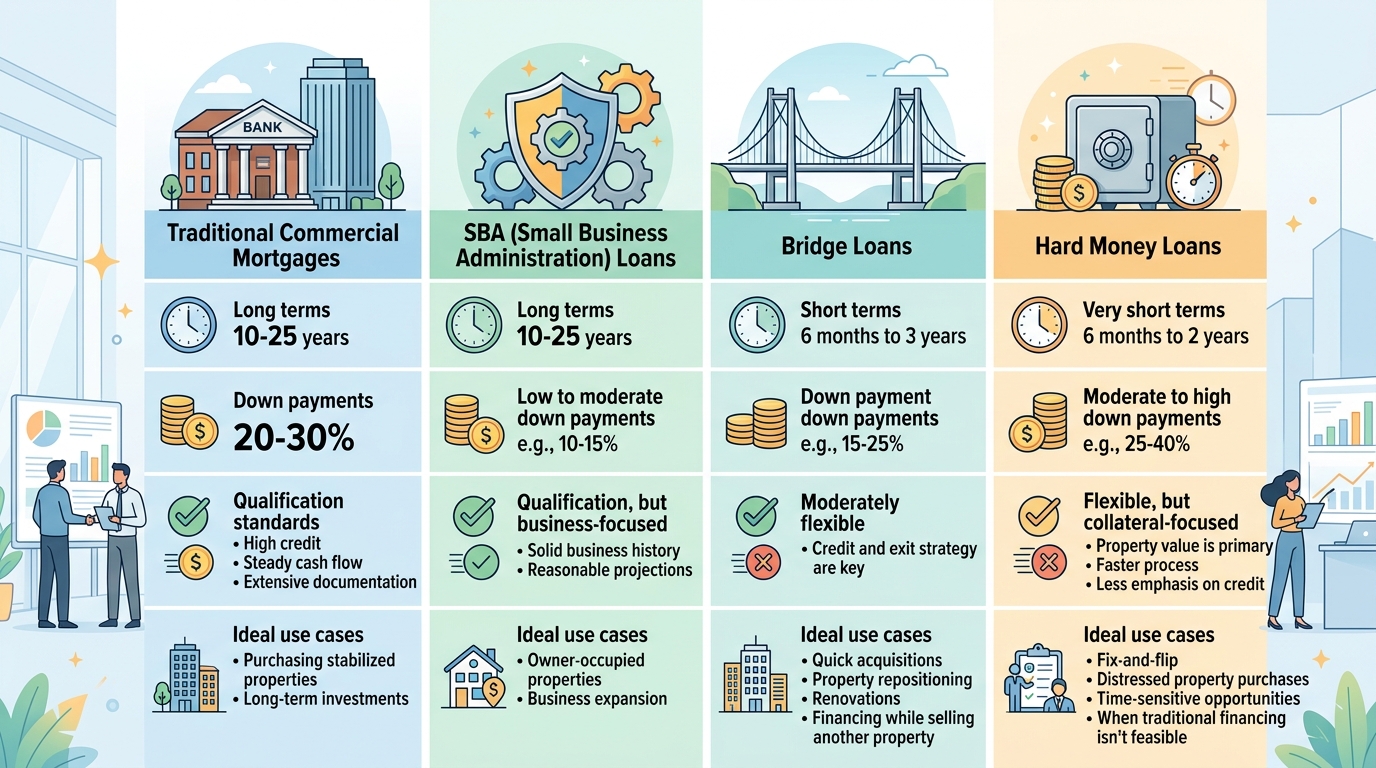
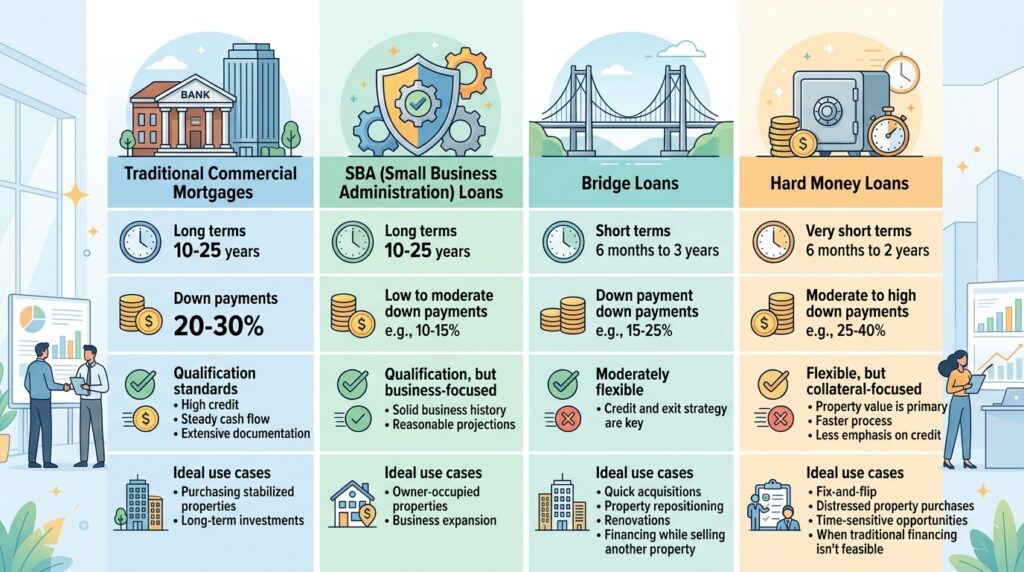
A visual comparison of commercial real estate loan options, detailing their terms, down payments, and suitable applications.
Overview of Commercial Real Estate Loan Options
Commercial property financing is not a one-size-fits-all market. Lenders structure debt facilities around key project parameters, including property stabilization, occupancy rates, borrower equity contribution, and expected holding duration.
The main categories of commercial real estate loan options include:
- Traditional Commercial Mortgages: Best for stabilized, cash-flowing properties and experienced borrowers seeking long-term debt.
- SBA Government-Backed Financing: Designed for small-to-medium business owners occupying at least 51% of the property.
- Commercial Bridge Loans: Short-term, interim funding for value-add acquisitions, repositioning, or fast closings.
- Hard Money Commercial Loans: Asset-based, short-term private capital prioritizing property value over borrower financials.
Traditional Commercial Mortgages
Traditional commercial mortgages—issued by regional banks, national institutions, insurance companies, and credit unions—are the standard financing method for stabilized commercial assets.
Key Features and Terms
- Loan-to-Value (LTV): Up to 65% – 75% LTV.
- Interest Rates: Fixed or variable pricing tied to SOFR or U.S. Treasury benchmarks.
- Loan Terms: 5 to 10 years, typically amortized over 20 to 25 years.
- Recourse Requirements: Usually full-recourse or partial-recourse guarantees required from major equity principals.
Best Used For
Traditional commercial mortgages are best suited for cash-flowing office buildings, retail centers, industrial facilities, and multi-family properties where Net Operating Income (NOI) cleanly supports debt service (DSCR >= 1.25x).
For a complete look at underlying lending criteria, consult our primary portal on commercial real estate loans.
SBA 7(a) and 504 Loans
The U.S. Small Business Administration (SBA) offers government-guaranteed loan programs to help small business owners purchase, build, or renovate commercial real estate.
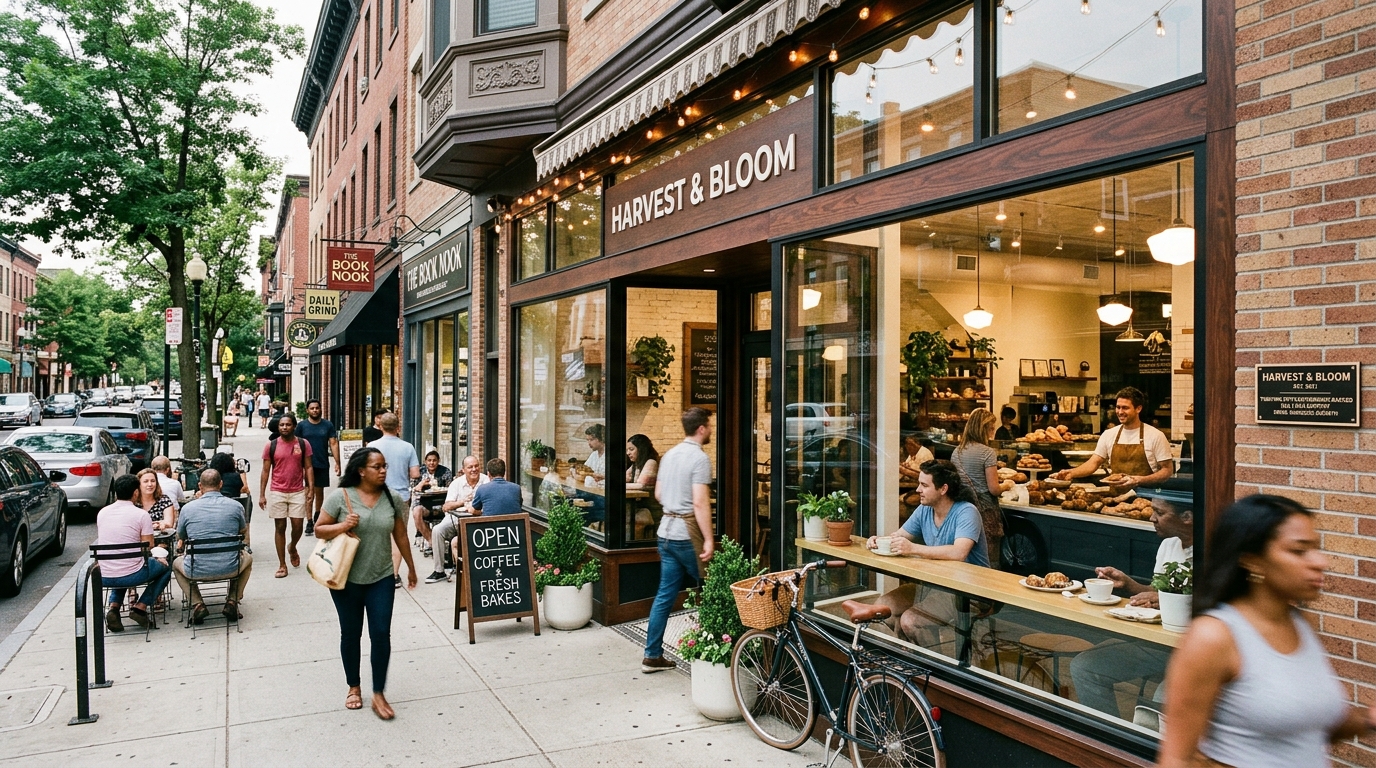
SBA 7(a) and 504 loans empower small businesses to acquire or improve commercial real estate, like this thriving retail storefront.
SBA 7(a) Loan Program
The SBA 7(a) program provides multi-purpose business financing up to $5 million, which can be applied to real estate acquisition, debt refinancing, working capital, or equipment upgrades.
- Max Real Estate LTV: Up to 85% – 90% LTV.
- Repayment Terms: Up to 25 years fully amortizing (no balloon payments).
- Occupancy Rule: The borrowing business must occupy at least 51% of an existing building (or 60% of a ground-up construction project).
SBA 504 Loan Program
The SBA 504 program is tailored specifically for major fixed-asset financing, such as real estate acquisition, development, or long-term machinery. The debt is split into a multi-tiered structure:
* 50% First Mortgage: Provided by a conventional commercial bank.
* 40% Second Mortgage (Debenture): Provided by a Certified Development Company (CDC) and guaranteed 100% by the SBA.
* 10% Equity Contribution: Provided by the business owner borrower.
Because SBA 504 loans offer fixed interest rates locked for 10, 20, or 25 years with only 10% down, they remain one of the most attractive options for owner-occupied business properties.
Commercial Bridge Loans
When acquiring non-stabilized real estate or competing against cash buyers in tight timelines, conventional long-term loans may not fit. Commercial bridge loans provide temporary capital to “bridge” the gap until long-term financing or asset sale occurs.
Key Characteristics
- Loan Duration: 12 to 36 months (often with 1-year extension options).
- Leverage: 70% to 80% Loan-to-Cost (LTC) or Loan-to-Value (LTV).
- Repayment: Interest-only monthly payments with full principal payoff at maturity.
- Speed to Close: Closes in 14 to 30 days.
Common Use Cases
- Property Repositioning: Purchasing a partially vacant office or retail property to complete capital improvements and lease up to full capacity.
- Distressed Asset Acquisitions: Buying distressed assets quickly from motivated sellers before conventional underwriting can be finalized.
- Time-Sensitive Refinancing: Paying off maturing debt while securing new long-term commercial leases.
Hard Money Commercial Loans
Hard money financing is short-term capital supplied by private investors or private lending funds rather than regulated banks.
Primary Characteristics
- Underwriting Emphasis: Focuses heavily on the underlying property’s liquidation value and loan-to-value ratio, rather than strict borrower tax returns or business revenue.
- Speed: Funds can disburse in as few as 7 to 10 days.
- Pricing: Higher interest rates and origination fees (typically 2 to 4 points) reflecting higher risk.
- Term Duration: 6 to 24 months.
When to Consider Hard Money
Hard money is ideal when credit issues prevent traditional bank approval, or when immediate funding is required to win a competitive property bid. Once the asset is stabilized or renovated, borrowers typically transition to standard long-term debt using competitive commercial real estate loan rates.
Which Type of Commercial Loan is Right for You?
Selecting the correct commercial property loan structure requires matching your asset status with your long-term operational timeline:
                  ┌─────────────────────────────────────────┐
                  │ Is property owner-occupied (51%+ space)?│
                  └────────────────────┬────────────────────┘
                                       │
                       ┌───────────────┴───────────────┐
                      YES                              NO
                       │                               │
             ┌───────────────────┐           ┌───────────────────┐
             │ SBA 504 or 7(a)   │           │ Is property fully │
             │  (Up to 90% LTV)  │           │   stabilized?     │
             └───────────────────┘           └─────────┬─────────┘
                                                       │
                                       ┌───────────────┴───────────────┐
                                      YES                              NO
                                       │                               │
                             ┌───────────────────┐           ┌───────────────────┐
                             │ Conventional Bank │           │ Bridge or Hard    │
                             │  or CMBS Mortgage │           │ Money Capital     │
                             └───────────────────┘           └───────────────────┘
For a comprehensive foundation on how underwriting benchmarks impact each option, read our foundational guide to commercial real estate loans.
Frequently Asked Questions
What is the difference between SBA 7(a) and SBA 504 loans for real estate?
SBA 7(a) loans are versatile, multi-purpose loans up to $5 million with variable or fixed rates, suitable for real estate, working capital, and business acquisitions. SBA 504 loans are dedicated exclusively to major real estate and equipment purchases, offering 25-year fixed interest rates with a 50/40/10 bank-CDC-borrower debt structure.
What is a commercial bridge loan used for?
Commercial bridge loans provide short-term funding (1 to 3 years) to acquire or renovate non-stabilized real estate, complete capital improvements, or secure fast financing before transitioning to permanent conventional debt.
Can I get a commercial real estate loan for an un-tenanted property?
Yes. Non-stabilized or vacant properties can be financed using commercial bridge loans, hard money capital, or construction loans. Conventional banks typically require 80%+ occupancy with established lease income before issuing permanent long-term mortgages.
What down payment is required for non-owner occupied commercial loans?
Non-owner occupied commercial properties (such as multi-tenant retail, office, or industrial investments) generally require a down payment between 25% and 35% of the property purchase price.