Multifamily Interest Rate & Payment Underwriting Calculator
Accurate debt underwriting is essential when acquiring or refinancing commercial real estate. Our Multifamily Interest Rate & Payment Calculator allows investors, brokers, and syndicators to model monthly principal and interest payments, evaluate annual debt service burdens, and calculate key underwriting constraints like Debt Service Coverage Ratio (DSCR) and Loan-to-Value (LTV).
Before underwriting a specific transaction, borrowers can view benchmark interest rates across major capital providers to ensure rate inputs reflect current market conditions.
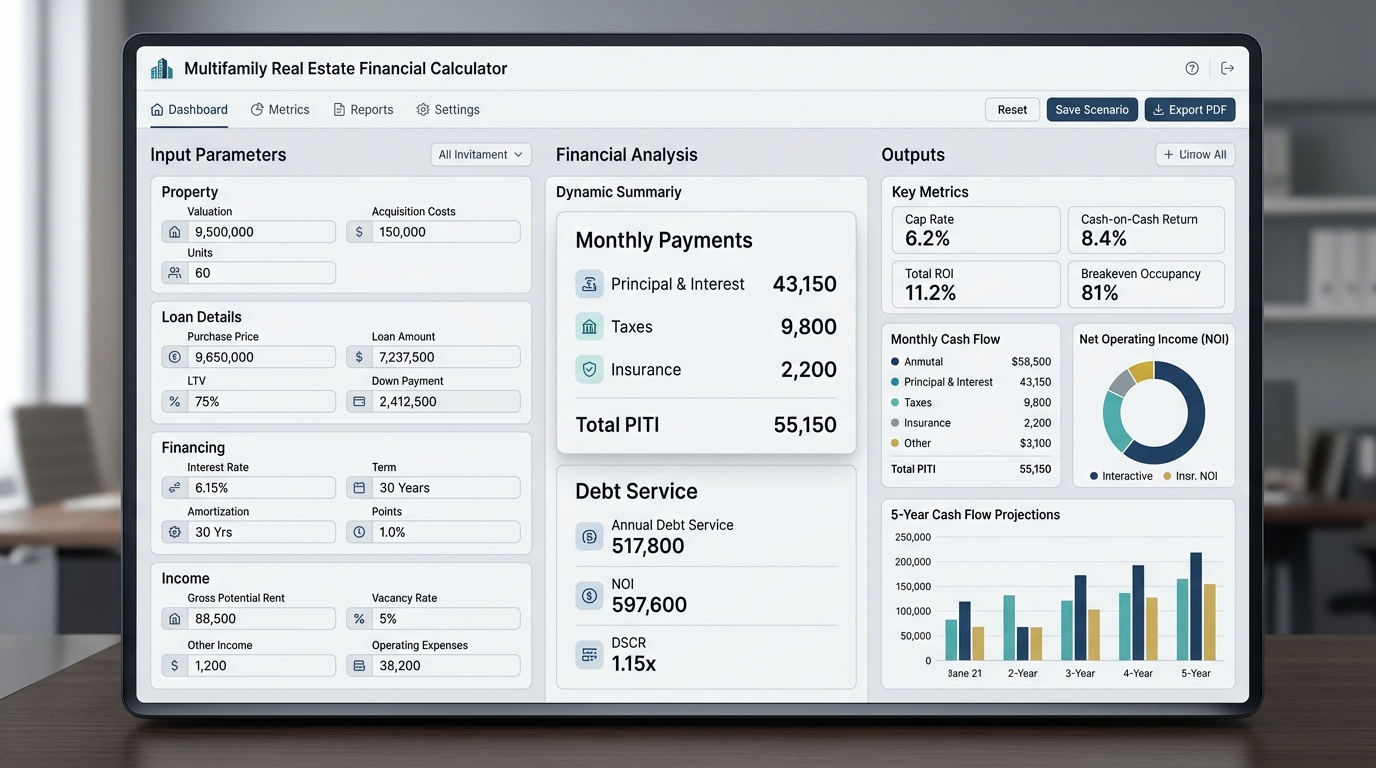
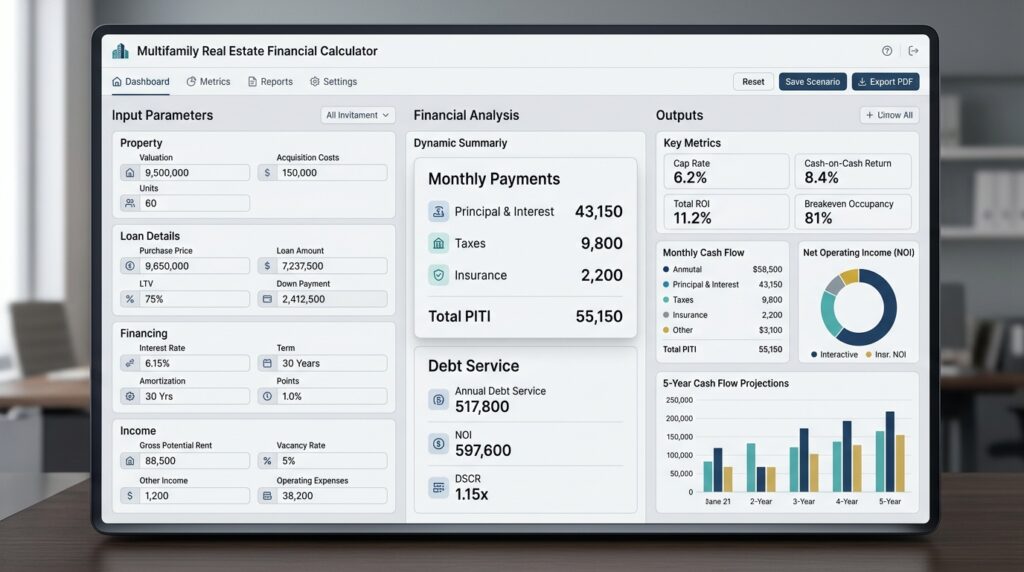
An intuitive interface for calculating multifamily loan payments and underwriting key financial metrics.
How to Use the Multifamily Interest Rate Calculator
Our commercial underwriting tool evaluates primary property financial inputs to deliver instant debt service outputs:
- Purchase Price / Appraised Value: Enter the total asset valuation.
- Loan Amount / Target LTV: Input the requested loan amount or desired Loan-to-Value percentage (e.g., 75% LTV).
- Interest Rate (%): Enter the quoted benchmark interest rate.
- Amortization Period (Years): Select standard commercial amortization (typically 25 or 30 years).
- Interest-Only Period (Months): Specify any interest-only (I/O) payment window (e.g., 12, 24, or 36 months).
- Net Operating Income (NOI): Input projected or historical trailing 12-month Net Operating Income.
How do I calculate monthly payments using a multifamily interest rate calculator?
The calculator computes monthly payments using the standard commercial amortization formula:
$$\text{Monthly Payment (P\&I)} = P \times \frac{r(1+r)^n}{(1+r)^n – 1}$$
Where:
* $P$ = Principal Loan Amount
* $r$ = Monthly Interest Rate ($\text{Annual Rate} / 12$)
* $n$ = Total Number of Amortization Months ($\text{Years} \times 12$)
During interest-only periods, the calculation simplifies to:
$$\text{Monthly Payment (I/O)} = \frac{P \times \text{Annual Interest Rate}}{12}$$
How Lenders Underwrite Multifamily Cash Flows
Commercial lenders do not base loan approvals solely on borrower personal income. Instead, commercial debt sizing centers on property cash flow capabilities.
Lenders analyze historical income and expenses through a standardized process:
* Gross Potential Rent (GPR): Total potential rent if all units are 100% occupied at market rates.
* Effective Gross Income (EGI): GPR minus physical vacancy loss, concessions, bad debt, plus utility reimbursements and laundry/parking income.
* Net Operating Income (NOI): EGI minus operating expenses (property taxes, insurance, management fees, repairs, maintenance, utilities).
Lenders apply standard expense floors during underwriting—such as minimum management fee assumptions (3% to 5%) and replacement reserve allocations ($250 to $350 per unit per year)—to arrive at Underwritten Net Operating Income.
Understanding Debt Service Coverage Ratio (DSCR)
Debt Service Coverage Ratio (DSCR) measures an asset’s cash-flow cushion relative to its annual debt obligations.
$$\text{DSCR} = \frac{\text{Net Operating Income (NOI)}}{\text{Annual Debt Service}}$$

Visualizing the calculation of Debt Service Coverage Ratio (DSCR) to assess a property’s ability to cover its debt obligations.
How does debt service coverage ratio (DSCR) affect maximum loan size?
Lenders set strict minimum DSCR floors to insulate debt from property performance declines:
- Standard Agency Target: Agency programs (such as Fannie Mae DUS loan underwriting) mandate a minimum 1.25x DSCR for fixed-rate debt in primary markets.
- Commercial Bank Target: Banks typically require 1.20x to 1.30x DSCR.
- Bridge Lender Target: Short-term bridge debt may underwrite to 1.10x to 1.15x DSCR on initial cash flow, requiring stabilization to 1.25x+ by loan maturity.
If a property’s NOI cannot support a 1.25x DSCR at the requested loan amount, the lender will constraint-size the maximum loan amount downwards, requiring the buyer to bring additional equity to close.
How Interest Rates Impact Debt Service Coverage Ratio (DSCR)
As interest rates increase, annual debt service costs rise. Consequently, for a property with a fixed NOI, higher interest rates depress the DSCR:
- Lower Rate Environment: Lower debt service yields a higher DSCR, allowing maximum LTV borrowing (e.g., 75% to 80%).
- Higher Rate Environment: Increased debt service lowers the DSCR below required lender thresholds (e.g., dropping to 1.10x), forcing maximum loan sizing down to 65% LTV or lower.
Investors testing leverage options can model a refinancing scenario to assess how rate resets affect cash flow distributions.
Frequently Asked Questions (FAQ)
What is the difference between DSCR and Debt Yield?
DSCR measures NOI relative to total annual debt service (principal and interest). Debt Yield measures NOI relative to total loan principal ($\text{NOI} / \text{Loan Amount} \times 100\%$), independent of interest rates or amortization terms.
How does an interest-only period affect DSCR during underwriting?
While an interest-only period reduces short-term monthly debt service, agency and conservative bank lenders typically size maximum loan limits based on full principal and interest amortizing payments to ensure long-term debt sustainability.
Disclaimer: Calculator results are for preliminary planning and educational purposes only. Actual commercial loan sizing, terms, and final approvals depend on formal lender credit underwriting.