SBA 504 Loan Down Payment vs. SBA 7(a) & Conventional Loans
When acquiring business property, choosing the right financing structure is one of the most critical decisions facing business owners and real estate investors. The choice between Small Business Administration (SBA) guaranteed loans and traditional institutional financing often comes down to upfront equity requirements.
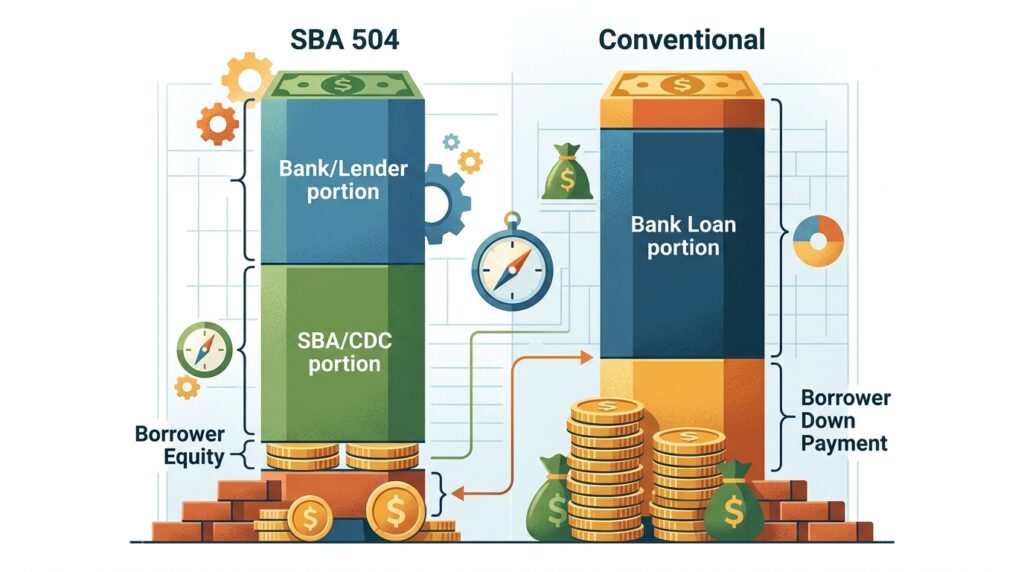
While a conventional commercial loan down payment typically requires 20% to 30% in equity, SBA government-backed loan programs allow eligible business owners to acquire property with a significantly lower equity injection. Understanding how the SBA 504 loan down payment compares to the SBA 7a commercial real estate down payment and conventional options allows business buyers to optimize liquidity while securing long-term real estate assets.
SBA 504 loans typically require a significantly lower down payment than conventional commercial loans, preserving borrower capital.
How Much Down Payment is Required for an SBA 504 Loan?
The SBA 504 loan program is designed specifically for long-term fixed-asset financing, such as purchasing existing commercial real estate, constructing new facilities, or modernizing heavy equipment. The flagship advantage of the SBA 504 loan structure is its low equity requirement.
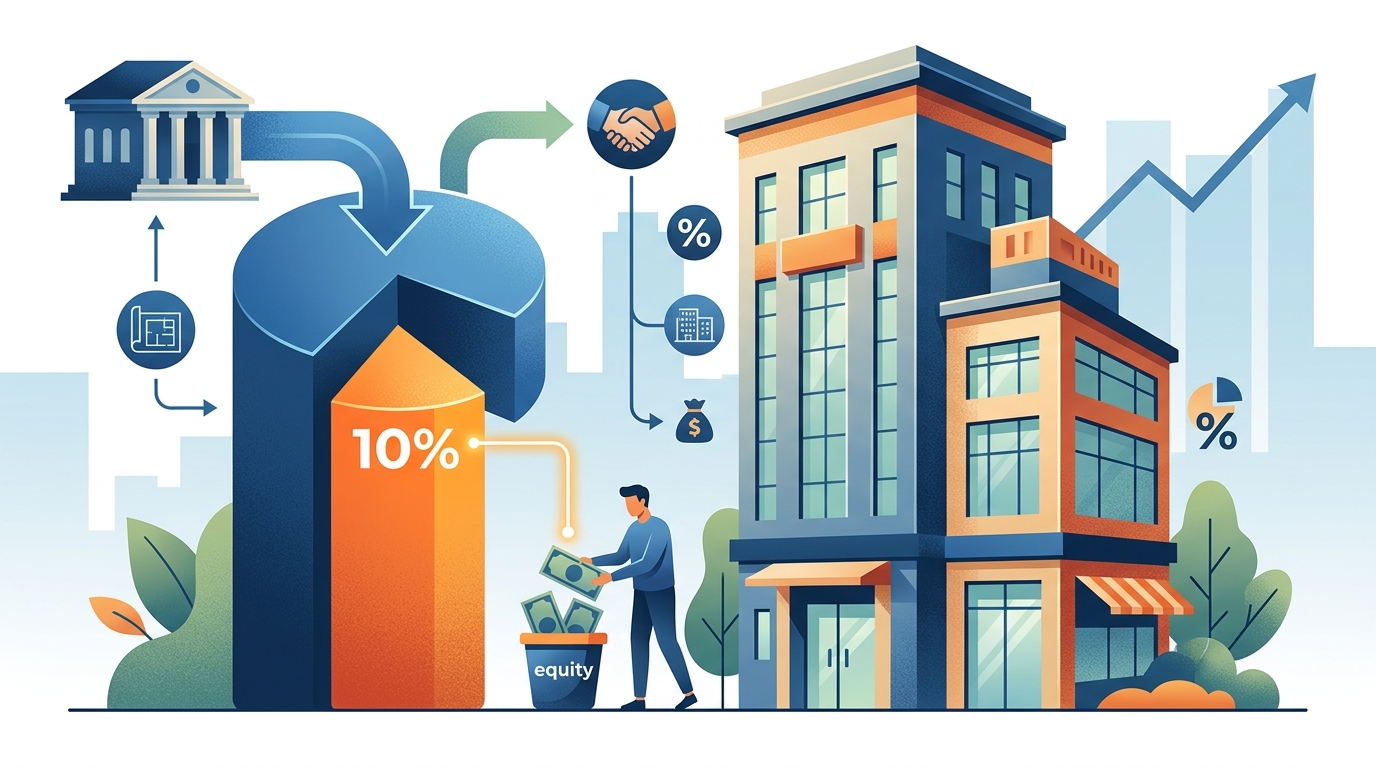
For standard owner-occupied commercial properties, the SBA 504 loan down payment is just 10%.
The Structure of an SBA 504 Loan Capital Stack
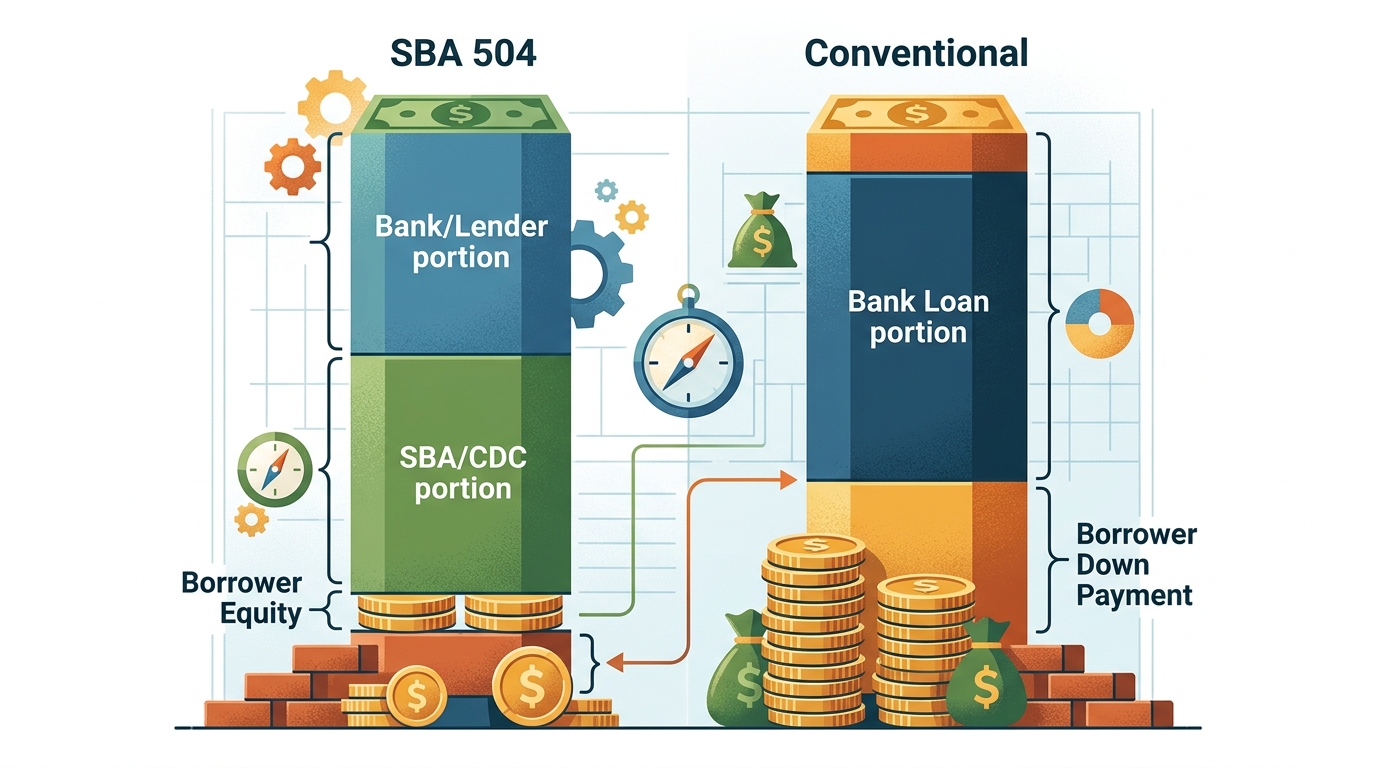
The SBA 504 program utilizes a unique three-tier capital stack:
1. Third-Party Senior Lender (Bank or Credit Union): Provides 50% of the total project cost. The senior lender holds the first mortgage lien position.
2. Certified Development Company (CDC): Provides up to 40% of the project cost through an SBA-backed debenture with a 10-, 20-, or 25-year fixed interest rate.
3. Borrower Equity Injection: The borrower contributes the remaining 10% cash down payment.
By leveraging CDC participation, senior lenders face lower risk exposure (50% Loan-to-Value), allowing them to offer attractive long-term fixed rates while keeping the borrower’s upfront cash requirement to a minimum.
What is the SBA 7(a) Commercial Real Estate Down Payment?
The SBA 7(a) program is the SBA’s primary general-purpose loan program. Unlike the 504 program, which focuses strictly on fixed assets, an SBA 7(a) loan can combine commercial real estate acquisition with working capital, equipment purchase, and debt refinancing into a single financing facility.
The minimum SBA 7a commercial real estate down payment requirement is 10% for standard multi-purpose properties.
Key characteristics of the SBA 7(a) program for commercial real estate include:
– Maximum Loan Amount: Up to $5,000,000.
– Term Length: Fully amortizing up to 25 years for real estate purchases (with no balloon payment).
– Flexibility: Allows borrowers to bundle closing costs, working capital, and leasehold improvements into the loan amount, further reducing total out-of-pocket cash required at closing.
If a buyer is acquiring both an existing operating business and its underlying real estate simultaneously, the SBA 7(a) lender may adjust the equity requirement to 15% depending on goodwill valuation and overall cash flow coverage.
SBA vs. Conventional Commercial Loan Down Payments
To determine which loan program best fits your financial strategy, compare the key parameters of SBA 504, SBA 7(a), and conventional loans side-by-side:
| Feature / Metric | SBA 504 Loan | SBA 7(a) Loan | Conventional Commercial Loan |
|---|---|---|---|
| Typical Down Payment | 10% (15% – 20% for special purpose or startups) | 10% (10% – 15% depending on business mix) | 20% to 30% |
| Occupancy Requirement | Owner-occupied ($\ge 51\%$ existing, $\ge 60\%$ new) | Owner-occupied ($\ge 51\%$ required) | Investment or owner-occupied |
| Maximum Loan Size | Up to $5.5M (CDC portion); project total $12M+ | Up to $5,000,000 maximum total loan | No federal limit; set by lender balance sheet |
| Repayment Terms | 10, 20, or 25-year fixed debenture | Up to 25 years fully amortizing | 5 to 10-year term with 20-25 year amortization |
| Prepayment Penalties | Declining penalty for first 10 years | Prepayment penalty for first 3 years only | Step-down prepayment or yield maintenance |
| Best Used For | Large real estate acquisition & construction | Real estate combined with business acquisition | Commercial investment property & non-owner occupied |
While traditional lenders demand higher equity upfront, borrowers evaluating non-owner-occupied properties must look to conventional bank financing because SBA programs strictly prohibit passive investment properties. To explore standard equity requirements across apartment buildings, retail centers, and office space, consult our overview of typical down payment by property type.
The SBA 7(a) program offers flexible financing for commercial real estate with a minimum 10% down payment.
Does SBA 504 Require 10% or 15% for Special Purpose Properties?
While the baseline SBA 504 loan down payment is 10%, SBA guidelines mandate higher borrower equity contributions under two specific scenarios: special purpose properties and start-up businesses.
Special Purpose Property Rule (+5% Equity)
The SBA designates certain real estate assets as “special purpose” due to their limited alternative utility or high conversion costs if repossessed. Examples of special purpose properties include:
– Hotels, motels, and bed-and-breakfast inns
– Gas stations and convenience stores
– Car washes
– Bowling alleys, sports arenas, and golf courses
– Funeral homes and medical surgery centers
If a transaction involves a special purpose commercial property, the standard 10% down payment increases to 15%. In this structure, the senior lender funds 50%, the CDC funds 35%, and the borrower contributes 15%.
New Business / Start-Up Rule (+5% Equity)
If the borrowing business has been operating for less than two years, the SBA considers it a start-up, adding an additional 5% equity requirement.
Combined Special Purpose + Start-Up Rule (20% Total Equity)
If a project involves both a special purpose building AND a start-up business (for example, building a brand new car wash facility for a new business entity), the SBA requires a 20% down payment. The senior lender provides 50%, the CDC provides 30%, and the borrower must inject 20% cash equity.
SBA Loan Down Payment Rules & Borrower Equity Injection
Navigating SBA loan down payment rules requires adherence to strict SBA guidelines governing acceptable sources of borrower equity.
Eligible Sources of SBA Equity Injection
Under SBA regulations, borrower down payment funds may originate from:
1. Cash on Hand or Liquid Reserves: Verified via 60 to 90 days of personal or corporate bank statements.
2. Borrowed Funds (Under Specific Terms): Debt incurred by the individual borrower (such as a HELOC or personal loan) is allowed ONLY if the borrower can prove independent cash flow from another income source capable of servicing the loan outside of business earnings.
3. Seller Carryback Notes: A note from the seller can count toward the required 10% equity injection, provided the seller note is placed on full standby (no principal or interest payments allowed) for a minimum of 2 to 5 years (or the life of the loan for 504 projects).
4. Gifts: Unconditional gift funds from immediate family members are permitted with an executed gift letter and proof of transfer.
Ineligible Sources of Down Payment
- Borrowed money paid back by the business: Operating income from the target business cannot be pledged to repay a personal loan used for the down payment.
- Unverified Cash: Cash without clear electronic bank trails or tax documentation is excluded.
Understanding these commercial real estate financing down payment guidelines ensures small business buyers present clean, fully compliant loan packages that clear SBA underwriting without unnecessary delays. For a baseline overview of general commercial real estate financing equity standards, review our standard commercial property down payment guide.
Frequently Asked Questions (FAQ)
Can I get an SBA 504 loan with only 10% down?
Yes. For existing businesses purchasing standard multi-purpose commercial real estate (such as an industrial warehouse, office building, or retail storefront) for owner-occupancy, the required SBA 504 loan down payment is exactly 10%.
Why does an SBA loan require a 15% or 20% down payment sometimes?
The SBA mandates higher equity injections if the property is categorized as a special purpose building (such as a hotel or gas station) or if the operating business is a start-up (under 2 years old). If both conditions apply, the total required down payment is 20%.
Does conventional commercial real estate financing allow 10% down?
Generally, no. Traditional banks, credit unions, and life insurance companies typically enforce a minimum 20% to 30% down payment requirement for commercial mortgages because they lack government guarantees.
Can seller financing be used for an SBA loan down payment?
Yes. Seller financing can cover a portion of the SBA down payment as long as the seller note is placed on full standby (meaning no debt service payments are made on the seller note) for an agreed standby period under SBA guidelines.
What is the minimum owner-occupancy percentage for SBA financing?
For existing buildings, the borrower’s operating business must occupy at least 51% of the total square footage. For ground-up new construction, the business must occupy at least 60% immediately, rising to 80% over ten years.