
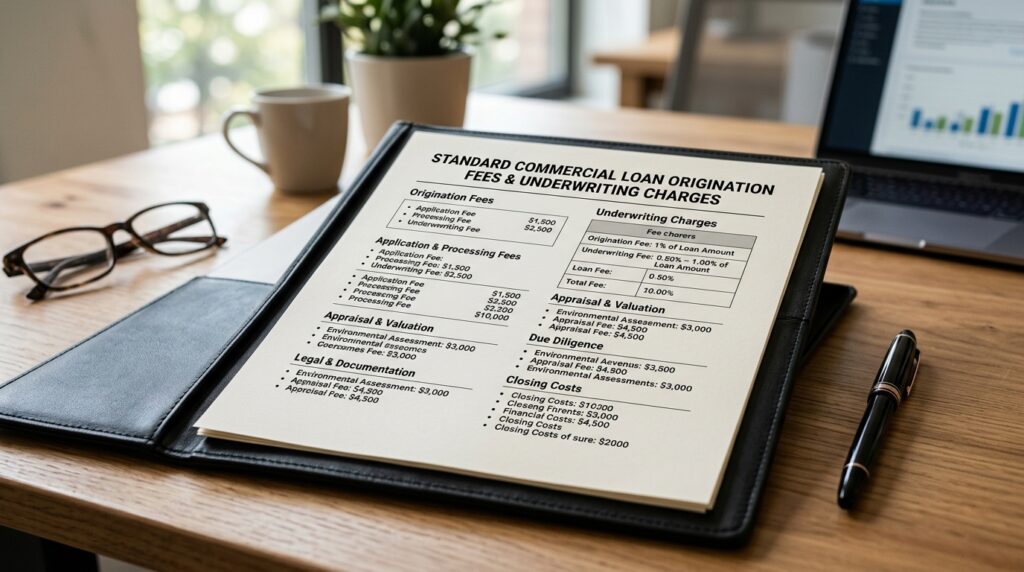
Understanding Commercial Loan Origination and Lender Fees
When evaluating commercial real estate financing options, borrowers often focus primarily on the interest rate, loan-to-value (LTV) ratio, and loan term. However, the true cost of debt capital depends heavily on lender-imposed fees assessed during origination and closing.
Lender fees can add tens of thousands of dollars to your upfront capital requirements. Understanding commercial loan origination fees, processing charges, broker commissions, and administrative fees is crucial for comparing competing term sheets and protecting your deal margins.
In this guide, we provide a complete breakdown of lender-side expenses, highlight potential hidden charges in commercial loan term sheets, and outline strategies to negotiate these fees prior to execution. For a broader overview of costs across all closing categories, explore our flagship pillar resource.
What are Commercial Loan Origination Fees?
A commercial loan origination fee is an upfront charge levied by a lender to compensate for the administration, structuring, risk evaluation, and capital placement of a commercial mortgage. Unlike residential mortgage origination fees—which are frequently capped or flat—commercial origination fees are calculated as a percentage of the total loan amount (referred to as “points”).
In commercial lending, standard origination fees typically range from 0.5% to 1.5% of the total loan amount (or 50 to 150 basis points).
| Loan Type | Typical Origination Fee Range | Primary Cost Drivers |
|---|---|---|
| Conventional Bank / Credit Union | 0.50% – 1.00% | Low-risk assets, conservative LTV, strong borrower credit |
| SBA 7(a) & 504 Loans | 0.50% – 1.50% | Government guarantee fee structures and administrative setup |
| CMBS (Conduit) Loans | 0.50% – 1.00% | Capital markets distribution and securitization requirements |
| Bridge / Debt Fund Loans | 1.00% – 2.00% | Short-term capital, non-stabilized assets, rapid execution |
| Hard Money Loans | 2.00% – 4.00%+ | High-risk real estate, speculative repositioning, asset-based |
For example, on a $3,000,000 commercial acquisition financed through a regional bank charging a 1.0% origination fee, the borrower will owe $30,000 at closing for origination alone.
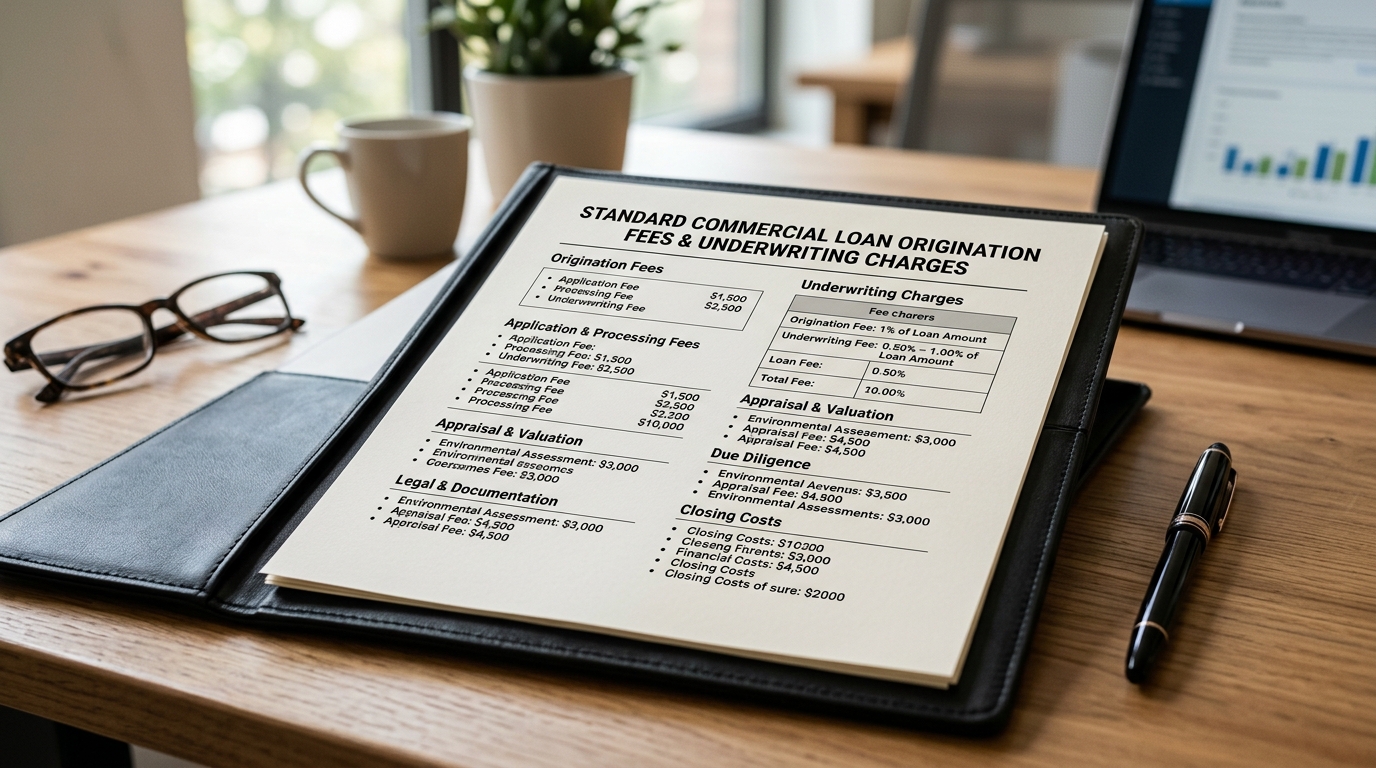
A detailed document illustrating the various fees associated with commercial loan origination and underwriting processes.
Breakdown of Underwriting and Processing Charges
In addition to percentage-based origination points, lenders bill separate line items for background processing and risk evaluation. These expenses are frequently grouped under administrative charges on the preliminary settlement statement.
- Underwriting Fee: Covers the financial analysis performed by internal risk officers. Underwriters evaluate borrower creditworthiness, historical property financial statements, rent rolls, lease agreements, and debt service coverage ratios (DSCR). Typical fee: $1,500 to $3,500.
- Processing Fee: Covers file setup, document collection, verification of deposits, title order management, and administrative tracking throughout the underwriting pipeline. Typical fee: $750 to $1,500.
- Document Preparation Fee: Billed for generating loan commitments, promissory notes, mortgages, and personal guarantees. Typical fee: $500 to $1,250.
What is the difference between commercial underwriting and processing fees?
FAQ / Technical Breakdown:
While processing and underwriting are often conflated, they serve distinct operational functions:
Processing fees cover administrative file setup, vendor coordination (ordering title and appraisals), and verifying borrower documentation.
Underwriting fees compensate internal credit officers who analyze financial risk, calculate DSCR and debt yield, stress-test interest rates, and make final credit committee lending decisions.
Commercial Mortgage Broker Fees: Structures & Typical Percentages
Many commercial investors utilize a commercial mortgage broker to source competitive debt packages across banks, life insurance companies, debt funds, and private lenders.
Commercial mortgage broker fees generally mirror origination fees, ranging from 0.50% to 1.00% of the loan amount for conventional deals, and up to 2.0% for complex bridge or distressed transactions.
How do commercial mortgage broker fees work?
Commercial mortgage broker fees are structured in one of three primary ways:
- Borrower-Paid Commission (Direct Fee): The broker negotiates a fee agreement directly with the borrower (e.g., 1.0% of loan amount) paid upon successful closing from loan proceeds.
- Lender-Paid Yield Spread / Referral: In certain loan channels, the lender pays the broker directly out of the loan’s origination points or spread.
- Split Commission: The broker and lender split a total fee pool (e.g., 1.0% total, split 0.50% to broker and 0.50% to lender) as outlined in the initial broker mandate.
Important Note: Always ensure broker representation agreements explicitly define fee expectations and prohibit double-dipping where a broker collects full fees from both borrower and lender without disclosure.
Uncovering Hidden Fees in Commercial Loan Term Sheets
One of the greatest pain points for commercial real estate borrowers is discovering surprise expenses late in the loan process. Because commercial term sheets are non-binding operational outlines, lenders sometimes omit or obscure fee structures until final loan documents are drafted.
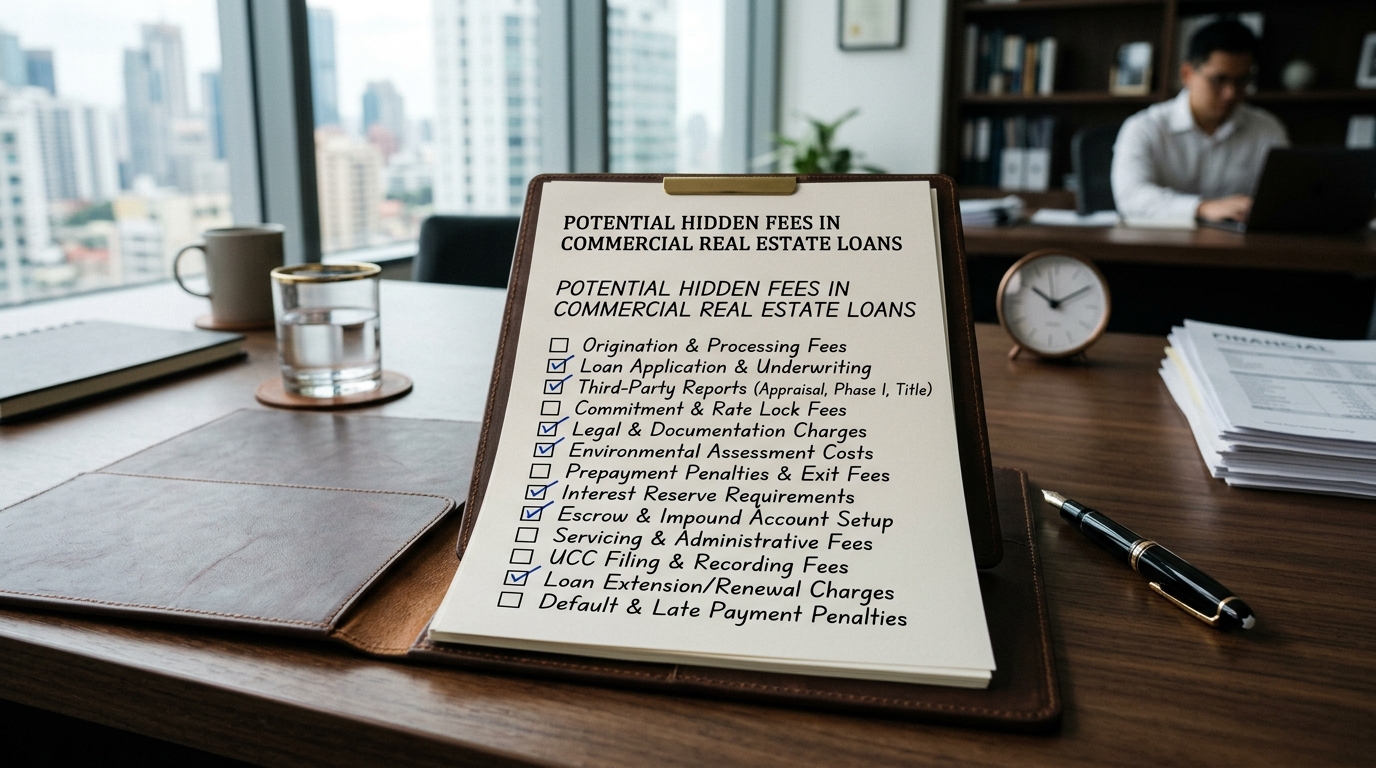
A visual checklist detailing common hidden fees that borrowers should be aware of in commercial real estate loan term sheets.
What hidden fees exist in commercial real estate loans?
Featured Answer / PAA Target:
Common hidden or unexpected fees in commercial real estate loans include:
Lender Legal Fee Recoupment: Lenders retain external law firms to draft loan documents, passing billable hours directly to the borrower ($3,000 to $10,000+).
Rate Lock & Extension Fees: Charges (typically 0.25%–0.50% of the loan amount) levied if loan closing extends beyond the initial rate lock commitment window.
Site Visit / In-House Environmental Review Fees: Internal charges ($1,000–$2,500) billed when lender credit officers inspect the property independent of third-party appraisers.
Re-Appraisal / Appraisal Review Fees: Secondary fees ($750–$1,500) assessed if the lender requires an independent appraisal review or updated valuation.
Exit & Prepayment Penalties:* Hidden fees charged when refinancing or paying off the loan early (e.g., yield maintenance, defeasance, or step-down prepayment structures).
Which Lender Fees Are Negotiable?
Unlike retail consumer loans, commercial mortgage terms are negotiable agreements between commercial entities. While certain third-party and government expenses cannot be reduced, most lender-side fees can be negotiated prior to signing the term sheet.
Highly Negotiable Lender Fees:
- Origination Fee Points: On larger loan balances ($5 million+), borrowers can frequently negotiate origination fees down from 1.0% to 0.50% or request a capped flat fee.
- Administrative Processing & Underwriting Charges: Lenders will often waive or consolidate $1,500 processing/underwriting fees if competitive term sheets are presented.
- Lender Legal Counsel Fee Caps: Always request a binding cap on lender legal fees in the initial term sheet (e.g., “Lender legal counsel fees billed to borrower shall not exceed $5,000 without prior written consent”).
- Application & Commitment Deposits: Ensure unused portions of underwriting deposits are contractually refundable if the lender declines the loan.
For concrete strategies on how to leverage these terms during discussions, visit our dedicated negotiation section.
Next Steps for Borrowers
Before executing a commercial term sheet, demand an itemized pre-closing fee schedule from your lender. To compare competing loan offers and model your complete cash-to-close requirements, run your transaction numbers through our free commercial closing cost tools or consult our comprehensive planning guides.