
5 Ways to Get Low & No Down Payment Commercial Real Estate Loans
For commercial real estate investors and small business owners, equity is often the primary bottleneck limiting expansion. Traditional institutional banks routinely demand 20% to 30% cash down payments before issuing a commercial mortgage. On a $3,000,000 industrial building or retail strip center, a standard 25% down payment represents $750,000 in liquid capital—money that could otherwise fund operations, hire key staff, or finance business acquisitions.
Fortunately, capital markets offer structured alternatives. By leveraging government guarantees, seller participation, secondary debt, equity capital, or asset cross-collateralization, savvy buyers can secure low down payment commercial loans or structure no down payment commercial real estate deals without exhausting liquid capital reserves.

Exploring financing options for a new retail space, an investor seeks low down payment commercial loans to minimize upfront capital.
Can You Buy Commercial Property with No Down Payment?
Yes, you can buy commercial real estate with no down payment out of your own pocket, but institutional lenders almost never offer 100% Loan-to-Value (LTV) single-source financing. Instead, achieving zero down payment commercial loans requires combining primary lender debt with secondary capital sources—a strategy known as building a multi-tiered capital stack.
When lenders state that a commercial deal requires 20% equity, they are requiring 20% value contribution relative to the purchase price, not necessarily 20% cash from the borrower’s personal checking account.
By utilizing creative financing models, borrowers fulfill the lender’s loan-to-value safety parameters while minimizing or eliminating their personal cash out of pocket at closing.
5 Low Down Payment Options for Commercial Real Estate
To minimize upfront capital outlays, real estate investors and business operators utilize five primary financing models:
- SBA Loan Programs (10% Down Payment): Government-backed 504 and 7(a) financing for owner-occupied business properties.
- Seller Carryback Financing (0% to 10% Out-of-Pocket): Combining a primary bank mortgage with seller second-position financing.
- Mezzanine Debt & Preferred Equity (5% to 10% Out-of-Pocket): Inserting secondary debt between senior debt and borrower equity.
- Equity Partnerships & Joint Ventures (0% Personal Down Payment): Bringing in equity partners or LP investors who supply required capital.
- Cross-Collateralization (0% Cash Out-of-Pocket): Pledging equity in existing real estate holdings in lieu of cash.
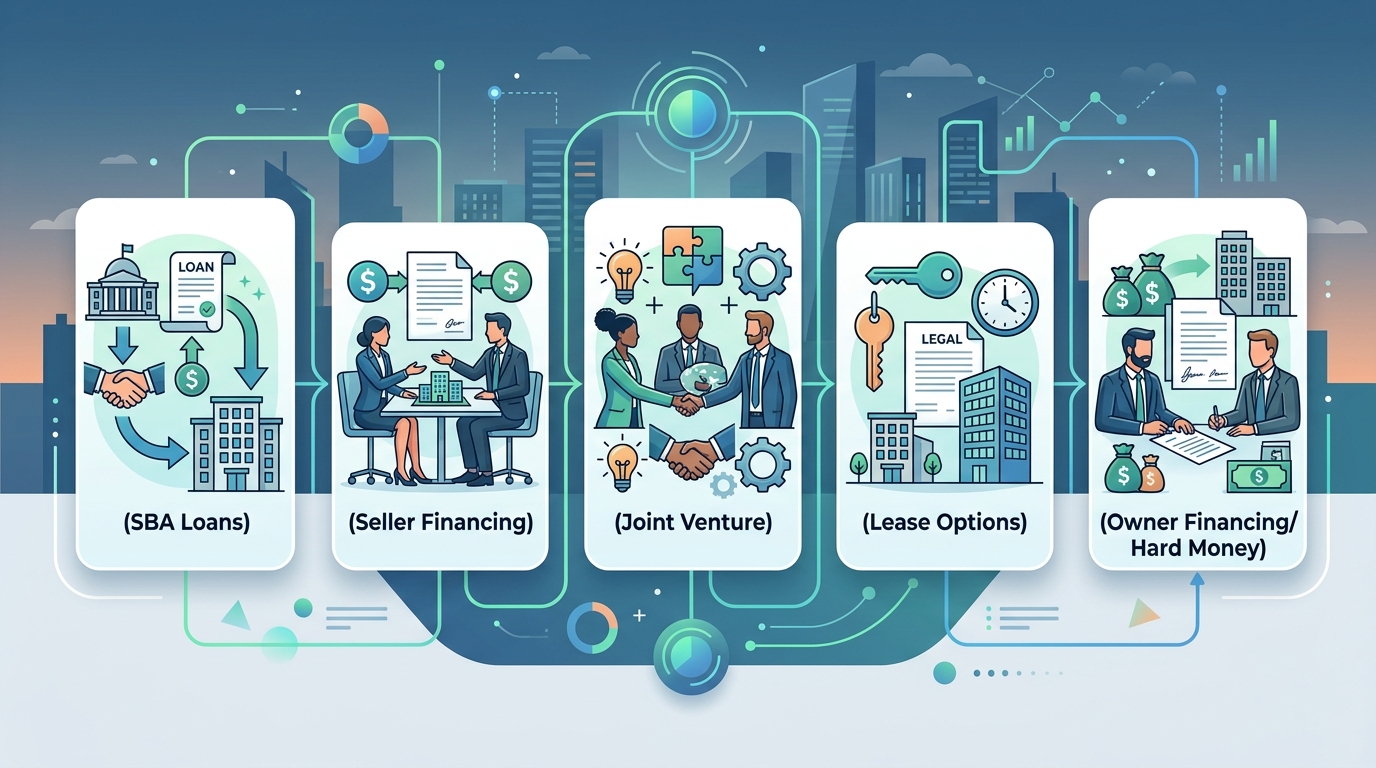
Five primary financing models offer pathways to minimize upfront capital outlays for commercial real estate, including options for no down payment.
1. SBA Loans for Owner-Occupied Properties
For small business owners purchasing commercial property for their own operations, Small Business Administration (SBA) loan programs offer the standard baseline for low down payment financing.
Under the SBA 504 and SBA 7(a) programs, qualified buyers can purchase real estate with as little as 10% down.
– Occupancy Requirement: The business must occupy at least 51% of the building’s rentable space.
– Key Advantage: Standard banks require 20% to 25% down, making SBA financing a 50% to 60% reduction in required upfront cash.
– Amortization: Up to 25 years with no balloon payments, ensuring long-term cash flow predictability.
To understand detailed qualification standards, review official SBA loan down payment rules.
2. Can Seller Financing Count Toward Down Payment?
Yes, seller financing (also called a seller carryback note) can count toward a commercial loan down payment, provided the senior lender agrees to the arrangement.
In a seller carryback structure, the property seller agrees to finance a portion of the purchase price by accepting a promissory note secured by a second mortgage lien.
How a 0% Out-of-Pocket Seller Structure Works:
- Senior Lender (Bank): Issues a 1st mortgage for 75% LTV.
- Property Seller: Issues a 2nd mortgage for 15% to 20% LTV.
- Borrower Cash Out-of-Pocket: Contributes 5% to 10% (or 0% if the bank allows a 80/20 split).
Senior Lender Rules on Seller Carrybacks:
To approve a seller carryback counting toward your equity contribution:
1. Standby Requirements: Institutional lenders often mandate that the seller note be placed on full standby (no principal or interest payments allowed) for 1 to 3 years, ensuring debt service on the seller note does not strain property cash flows.
2. DSCR Inclusion: Once standby expires, debt service on the seller note must be included when calculating the property’s total Debt Service Coverage Ratio (DSCR).
3. Mezzanine Debt & Secondary Financing
For larger commercial deals ($2,000,000+), real estate investors utilize mezzanine financing or preferred equity to bridge the gap between senior mortgage debt and available borrower cash.
Mezzanine debt sits directly behind senior bank debt in the capital stack. While senior lenders might offer 65% to 70% LTV, a mezzanine lender can provide an additional 15% to 20% LTV, bringing total leverage up to 85% or 90% LTV.
- Senior Debt: 70% LTV
- Mezzanine Debt: 15% to 20% LTV
- Borrower Cash Down Payment: 10% to 15%
Mezzanine lenders charge higher interest rates (typically 10% to 14%) to compensate for their secondary lien position, but this structure allows investors to control major commercial assets with minimal primary equity.
4. Equity Partnerships & Syndications
If you possess real estate deal-sourcing expertise, market knowledge, or property management capacity but lack liquid capital, you can achieve no down payment commercial real estate ownership by partnering with passive capital providers.
In a real estate joint venture or syndication:
– Limited Partners (LPs / Equity Investors): Supply 90% to 100% of the required down payment and closing capital.
– General Partner (GP / Sponsor): Sources the deal, secures senior bank financing, oversees asset management, and executes the business plan.
In exchange for sourcing and executing the transaction, the GP receives a promoting fee (“promote”) or equity split (typically 20% to 30% of profits), effectively gaining real estate ownership without contributing personal cash toward the down payment.
5. Cross-Collateralization Using Existing Assets
If you already own commercial real estate, multi-unit residential property, or land with built-up equity, you can utilize cross-collateralization to purchase new commercial real estate with zero cash down payment.
Instead of liquidating assets or writing a check for a 25% down payment, you allow the primary lender to place a blanket lien across both the target property and your existing property.
Cross-Collateralization Example:
- Target Commercial Building Purchase Price: $1,000,000
- Required 25% Down Payment: $250,000
- Equity Available in Existing Real Estate: $400,000
The lender issues a $1,000,000 loan (100% of the new purchase price) secured by both properties combined. Because total collateralized value satisfies the lender’s LTV safety limits, the buyer writes a $0 down payment check at closing.
Risks of Zero Down Payment Commercial Loans
While acquiring property with minimal personal cash preserves liquidity, creative financing commercial loan down payment strategies carry distinct operational and financial risks:
1. Elevated Debt Service & Cash Flow Pressure
Higher leverage results in higher monthly mortgage obligations. If property occupancy drops or market rents decline, highly leveraged assets face elevated risk of defaulting on loan covenants or failing to cover debt service.
2. Refinancing & Interest Rate Risk
If a property is financed at 90% total leverage utilizing short-term bridge debt or mezzanine capital, refinancing into long-term permanent debt requires the property value to appreciate significantly. If cap rates expand or market property values drop, the owner may face an equity shortfall when the loan matures.
3. Complex Intercreditor Agreements
When layering senior debt, seller carrybacks, and mezzanine debt, senior lenders enforce strict intercreditor agreements. Negotiating terms between multiple lenders increases legal fees and extends closing timelines.
To balance risk effectively, ensure you evaluate your full capital stack and total liquidity needed to close a commercial loan prior to removing financing contingencies. Compare these structured strategies against a standard commercial real estate loan down payment baseline to make informed capital decisions.
Frequently Asked Questions (FAQ)
Can you buy commercial real estate with no down payment?
Yes, buyers can acquire commercial property with zero personal cash down by combining senior bank financing with seller carryback notes, equity partners, mezzanine capital, or cross-collateralization against existing property equity.
How does seller financing help with a commercial loan down payment?
A seller carryback allows the seller to finance a portion of the purchase price via a secondary note. With primary lender approval, this seller debt reduces or replaces the cash down payment required from the buyer at settlement.
What is the lowest down payment option for an owner-occupied commercial building?
The SBA 504 and SBA 7(a) loan programs offer the lowest standard down payment for owner-occupied business real estate at 10% down, compared to 20% to 30% required by conventional bank lenders.
What is cross-collateralization in commercial real estate?
Cross-collateralization is a technique where a buyer pledges equity from an existing property as additional collateral for a new commercial loan, allowing the buyer to secure up to 100% financing on the new acquisition without using cash.
Do mezzanine loans require a personal guarantee?
Mezzanine loans may be structured as non-recourse with standard “bad boy” carve-outs (fraud, environmental liabilities, intentional default), though lenders may require partial or full personal guarantees depending on borrower financial strength and project leverage.