Commercial Loan Application Requirements & Paperwork Checklist
Organizing the required paperwork for a commercial mortgage is often the most time-consuming phase of securing property debt. Lenders mandate exhaustive documentation to verify borrower liquidity, evaluate business tax history, and analyze subject property income stream stability.
For real estate investors, developers, and business owners preparing in 2026, assembling a complete cre loan application documents binder ahead of submission is the single most effective way to prevent underwriting delays and secure competitive interest rate terms.
This guide provides a structured breakdown of all commercial loan application requirements, complete with itemized document checklists, tax form tables, personal credit benchmarks, and actionable resources to keep your application moving smoothly.
What Are the Commercial Loan Application Requirements?
To satisfy commercial underwriting standards, borrowers must provide verified documentation establishing debt coverage capability, borrower solvency, and collateral valuation.
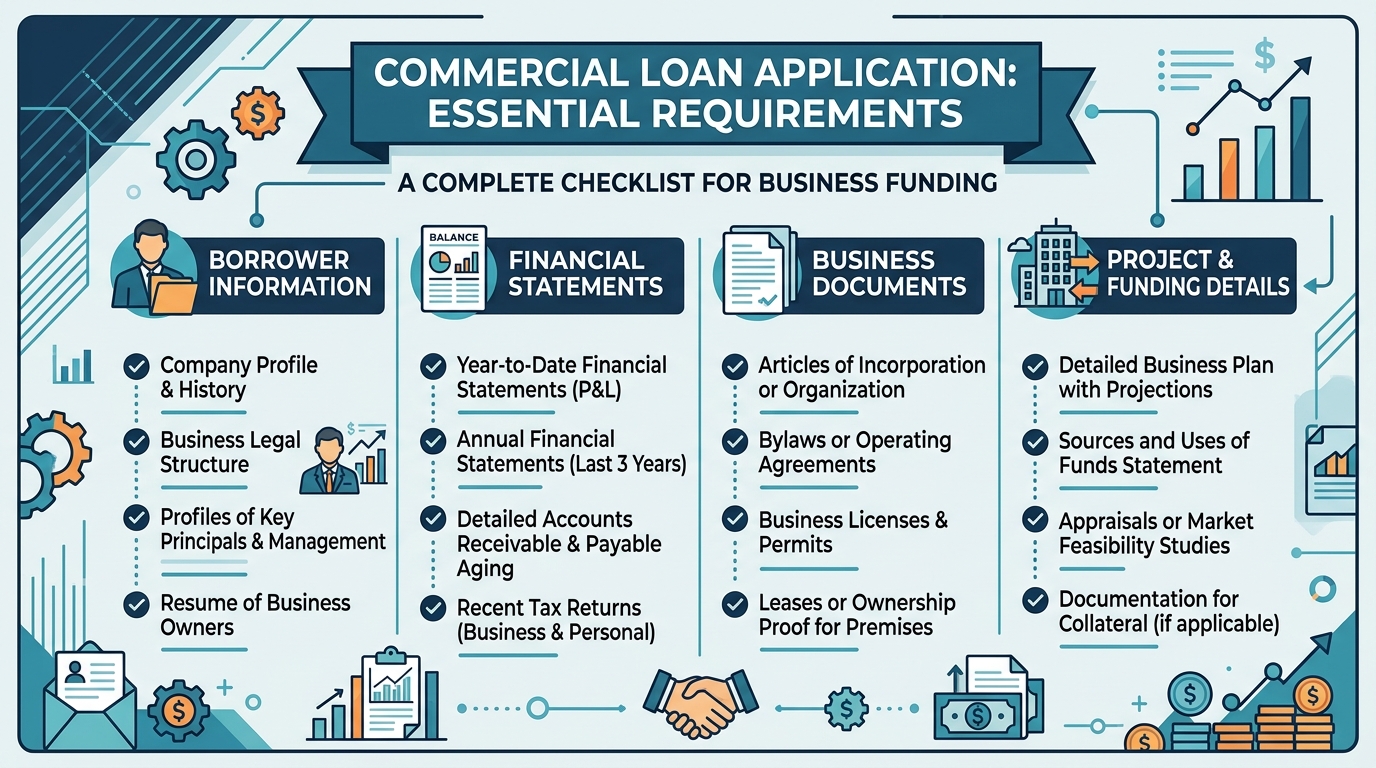
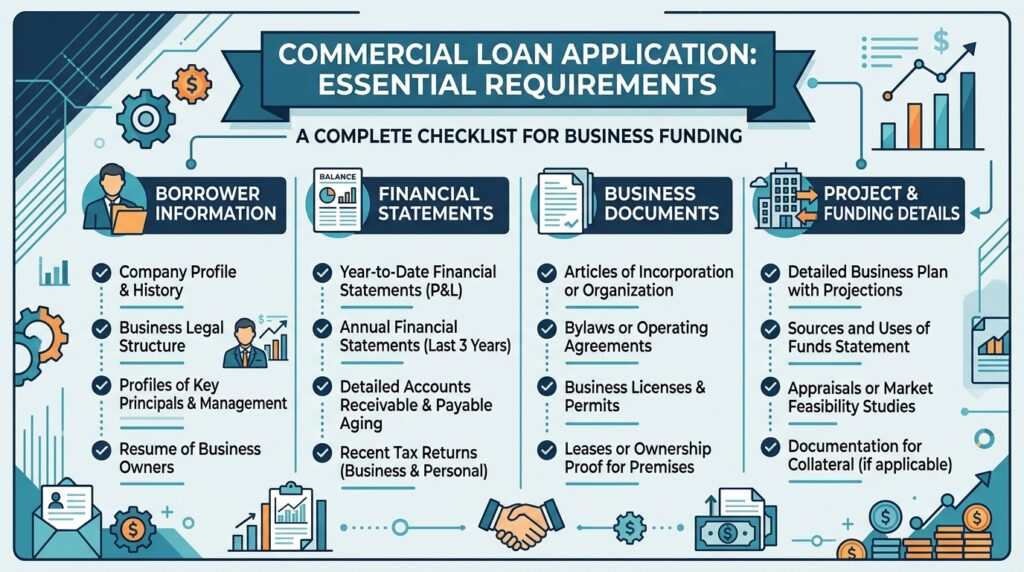
A comprehensive list of documents and requirements essential for a successful commercial loan application.
The core commercial loan application requirements include:
- 3 Years of Business Tax Returns: Complete federal tax filings (Form 1120, 1120-S, or 1065) with all attached K-1 schedules.
- 3 Years of Personal Tax Returns: Complete personal filings (Form 1040) for every guarantor holding 20% or greater equity ownership.
- Year-to-Date Interim Financial Statements: Current Profit & Loss (P&L) statement and Balance Sheet (dated within the last 60–90 days).
- Signed Personal Financial Statement (PFS): Detailed breakdown of personal assets, liabilities, liquid reserves, and contingent liabilities (SBA Form 413 equivalent).
- Certified Property Rent Roll: Itemized inventory of current tenant leases, monthly rents, suite square footages, security deposits, and lease expiration dates.
- Trailing 12-Month (T12) Operating Statements: Detailed historical breakdown of actual property revenues, utility expenses, maintenance fees, and real estate taxes.
- Entity Formation Documents: Executed Operating Agreement, Articles of Organization/Incorporation, Certificate of Good Standing, and Tax ID Number (EIN) for the single-purpose borrowing entity.
- Purchase and Sale Agreement (PSA): Fully executed purchase contract including all addendums and earnest money deposit verification.
Understanding these paper requirements helps streamline your submission. To review how these documents fit into the broader approval schedule, consult our guide on the steps in the commercial mortgage application process.
What Documents Are Required for a CRE Loan Application?
When gathering commercial real estate loan paperwork, organizing files into clear sub-categories prevents document loss during processing.
Financial and Tax Forms
Lenders audit financial tax forms to verify historical revenue stability and calculate historical cash flow trends.
| Document Category | Target Form / Required File | Key Information Analyzed by Underwriters |
|---|---|---|
| Business Taxes | IRS Form 1120 / 1120-S / 1065 | Gross revenue, EBITDA, officer compensation, and depreciation add-backs |
| Personal Taxes | IRS Form 1040 (All Schedules) | Personal adjusted gross income (AGI), liquid investment holdings, and external debt |
| Interim Financials | YTD P&L & Balance Sheet | Current-year income trajectory and real-time short-term liability balances |
| Bank Statements | 3 to 6 Months Complete Statements | Verification of cash equity down payment funds and post-closing liquidity buffers |
| Debt Schedule | Commercial Business Debt Schedule | Existing commercial obligations, monthly payments, maturities, and collateral pledges |
Property Documents (Rent Rolls, Leases, Appraisals)
Property documentation proves that the subject asset generates adequate cash flow to cover debt service obligations.
- Certified Rent Roll: Underwriters evaluate tenant concentration, vacancy trends, and lease expiration schedules across multi-tenant assets.
- Commercial Lease Agreements: Full copies of signed lease contracts for all existing tenants, including option periods, landlord expense responsibilities (NNN vs. Gross), and estoppel certificates.
- Property Site Plans & Photos: Building floor plans, site surveys, environmental studies, and color exterior/interior photographs.
- Historical Property Bills: Past 2 to 3 years of real estate tax bills, utility invoices, and property casualty insurance schedules.
Personal Financial Statements (PFS)
Question: Does a commercial loan submission require personal financial statements?
Answer: Yes. Commercial lenders virtually always require a fully executed Personal Financial Statement (PFS) from every individual holding 20% or more ownership in the borrowing entity, even for non-recourse or single-purpose LLC loans.
The PFS details a guarantor’s net worth by categorizing:
* Liquid Assets: Cash in bank accounts, money market funds, and publicly traded stocks.
* Illiquid Real Estate Assets: Estimated market value of primary residences and investment real estate holdings.
* Personal Liabilities: Outstanding residential mortgages, personal lines of credit, and auto loans.
* Contingent Liabilities: Guarantees provided on other active commercial loans or business debts.
Lenders analyze these figures to ensure the guarantor meets post-closing liquidity requirements (often requiring 6 to 12 months of principal and interest payments in liquid reserves). To see how underwriters convert these numbers into credit decisions, review our analysis of financial ratios needed for commercial loan underwriting.
What Credit Score is Required for a Commercial Real Estate Loan?
While commercial loans prioritize property Net Operating Income (NOI), personal credit history remains a key indicator of financial discipline.
[Credit Score Benchmark Guide]
720+ FICO   ---> Tier 1 Rate Qualification (Preferred Conventional & Bank Financing)
680 - 719   ---> Standard Approval Range (Conventional Commercial Banks)
650 - 679   ---> Approved Range for SBA 504 / 7(a) Government-Backed Programs
Below 650   ---> Specialized Debt / Hard Money / Higher Down Payment Required
Key Credit Score Benchmarks:
- Conventional Commercial Bank Loans: Minimum 680+ personal credit score required for primary guarantors.
- SBA 504 and 7(a) Loan Programs: Minimum 650+ credit score, provided the business demonstrates strong operational cash flows.
- CMBS & Non-Recourse Debt: Credit score requirements are flexible (typically 660+), but lenders impose strict borrower net worth standards equal to 100% of the total loan amount.
Where Can I Find a CRE Financing Application Checklist?
Having a organized document tracking sheet prevents missing files during underwriting intake.
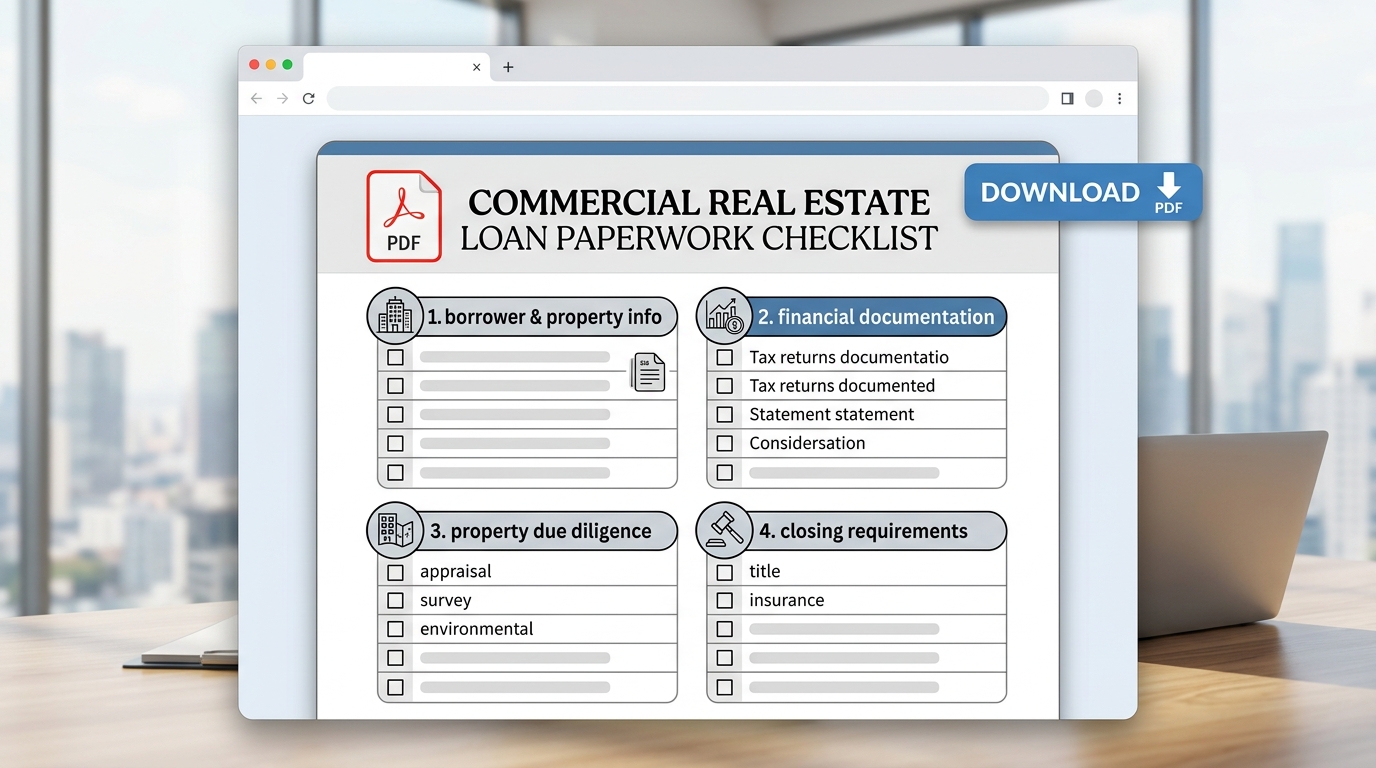
Download our comprehensive PDF checklist to streamline your commercial real estate loan application process.
📄 DOWNLOADABLE RESOURCE: Commercial Real Estate Application Document Binder
Streamline your submission with our free, downloadable CRE Loan Application Checklist PDF. Keep your underwriting package organized across four sections:
- [ ] Section 1: Entity & Corporate Documentation (Articles, EIN, Operating Agreement)
- [ ] Section 2: Borrower & Guarantor Financials (3 Yrs Tax Returns, PFS, Bank Statements)
- [ ] Section 3: Property Income & Operational Files (Certified Rent Roll, Leases, T12 P&L)
- [ ] Section 4: Acquisition & Physical Assets (Executed Purchase Agreement, Site Plans)
Download our complete checklist to assemble a professional borrower binder prior to approaching lenders.
Summary of Essential Commercial Real Estate Loan Forms
To recap the mandatory commercial real estate loan forms required during loan intake, maintain digital PDF copies of the following standard documents:
- Lender Commercial Loan Application Form: Standardized intake application detailing loan amount requested, entity structure, and property profile.
- SBA Form 413 (Personal Financial Statement): Required for SBA loan applications and standardly adapted across conventional banks.
- SBA Form 1919 (Borrower Information Form): Required for all SBA 7(a) and 504 debt submissions.
- IRS Form 4506-C: Request for Transcript of Tax Return, allowing the lender to verify tax returns directly with the IRS.
- Commercial Business Debt Schedule: Standard form listing all current commercial obligations, interest rates, monthly payments, and collateral assignments.
Preparing your commercial real estate submission package? Read our master guide to the commercial real estate loan application to structure your request for maximum approval success.