The CRE Loan Application Process: A Step-by-Step Timeline
Securing commercial debt for a real estate transaction requires navigating a structured, multi-stage workflow. Unlike residential home purchasing, the cre loan application process involves rigorous financial auditing, property valuation inspections, environmental reviews, and credit committee approvals.
For investors and business owners operating in 2026, understanding how to navigate the commercial mortgage application process is the key to executing timely property acquisitions and avoiding costly transaction delays. Knowing what happens at each stage of the commercial lender application process empowers borrowers to anticipate lender requirements, prepare thorough financial packages, and close on schedule.
This guide details the complete commercial real estate loan approval process, breaking down the step-by-step roadmap from initial pre-qualification to final debt funding.
What is the CRE Loan Application Process?
The cre loan application process is the end-to-end operational sequence that a borrower and commercial lender execute to evaluate, underwrite, approve, and fund a commercial mortgage.
This journey bridges the gap between an initial loan request and the final disbursement of funds. Rather than focusing solely on personal credit worthiness, the commercial loan submission process evaluates the property’s financial strength, net operating income (NOI), tenant lease stability, and market valuation, alongside the guarantor’s liquidity and track record.
Whether you are applying for a traditional bank loan, an SBA 504 loan, or commercial conduit debt, every submission moves through four distinct operational phases designed to measure risk and verify property collateral value.
How to Apply for a Commercial Real Estate Loan
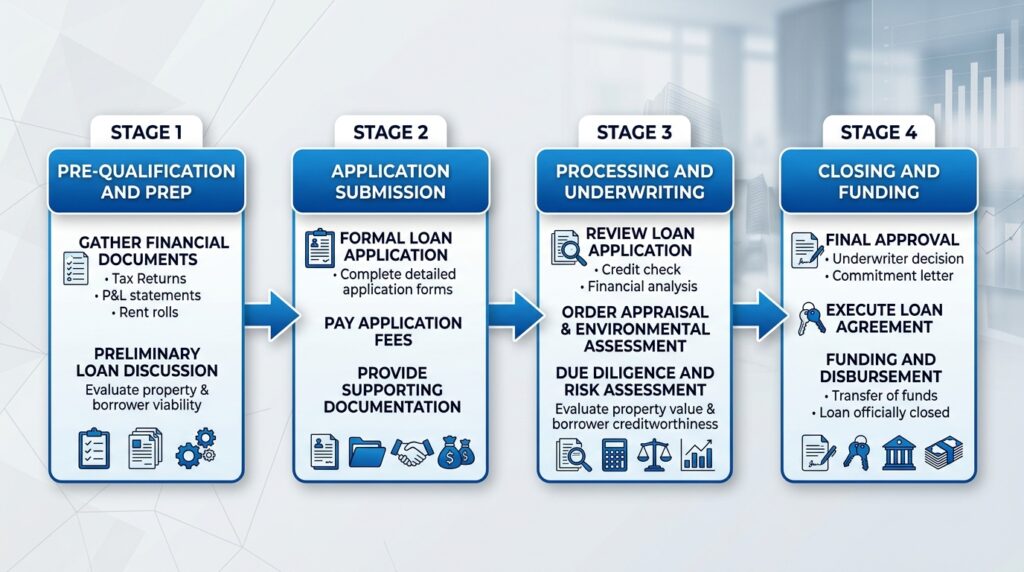
When learning how to apply for a commercial real estate loan, breaking the workflow into four sequential stages ensures you collect required documentation early and eliminate operational friction.
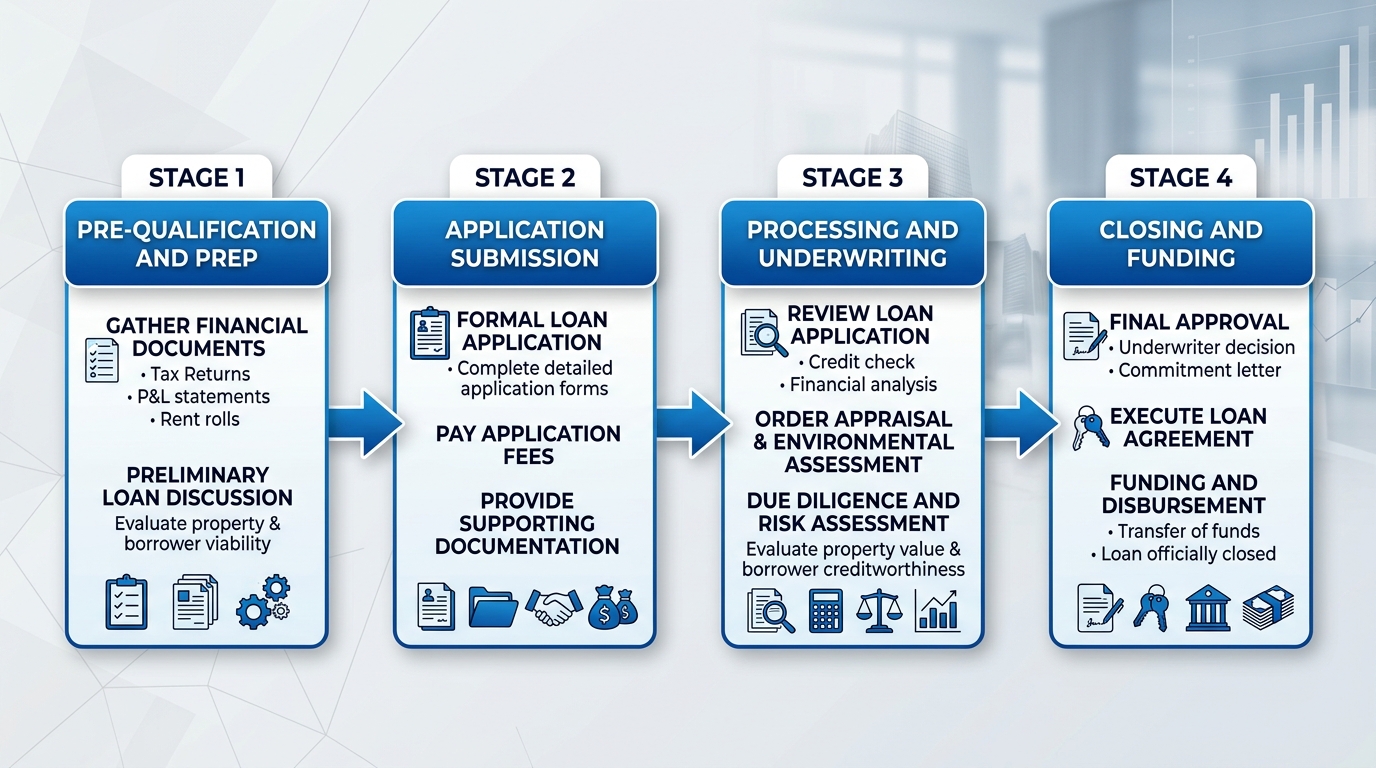
The commercial real estate loan application process is typically broken down into four distinct stages, from initial pre-qualification to final funding.
Follow these commercial mortgage application steps to complete your application:
- Stage 1: Pre-qualification and Prep
Begin by evaluating property financials, net operating income, and your personal balance sheet. Approach commercial lenders or mortgage brokers to discuss tentative loan terms, loan-to-value (LTV) limits, and debt service coverage ratio (DSCR) expectations. Obtain a formal preliminary term sheet or letter of intent (LOI). - Stage 2: Application Submission
Formally complete the lender’s commercial real estate loan application forms. Compile and submit the complete borrower binder, including 3 years of tax returns, personal financial statements, property rent rolls, operating statements, and entity formation documents. Pay third-party diligence fees (appraisal and environmental review deposits). - Stage 3: Processing and Underwriting
The lender’s processing department orders third-party reports (commercial appraisal, Phase I Environmental Site Assessment, property condition report, and title search). The credit analyst and underwriter analyze financial ratios, verify lease contracts, and present the loan package to the bank’s Credit Committee for formal underwriting approval. - Stage 4: Closing and Funding
Upon receiving Credit Committee approval and a commitment letter, bank counsel prepares final loan documentation, mortgage deeds, and personal guarantees. The title company verifies clear ownership title, loan covenants are finalized, final settlement statements are signed, and funds are wire-transferred to escrow to complete the closing.
To ensure your documentation packet contains every mandatory financial document before submitting, review our comprehensive commercial mortgage application checklist.
How Long Does the Commercial Real Estate Loan Approval Process Take?
Direct Answer: The commercial real estate loan approval process typically takes 45 to 90 days from initial document submission to final loan funding.
While fast-turnaround bridge lenders can close in 14 to 30 days, conventional commercial banks, life insurance companies, and SBA lenders require a multi-week timeline due to third-party diligence requirements and formal credit committee calendars.
Here is a realistic timeline breakdown showing key milestones across the 60-day standard window:
[Days 1 – 10]   Initial Intake, Term Sheet Execution & Document Gathering
[Days 11 – 25]  Third-Party Reports Ordered (Appraisal, Phase I ESA, Title Review)
[Days 26 – 40]  Underwriting Analysis, DSCR Verification & Credit Committee Review
[Days 41 – 50]  Formal Commitment Letter Issued & Loan Document Preparation
[Days 51 – 60]  Final Closing Execution, Title Clearance & Loan Wire Funding
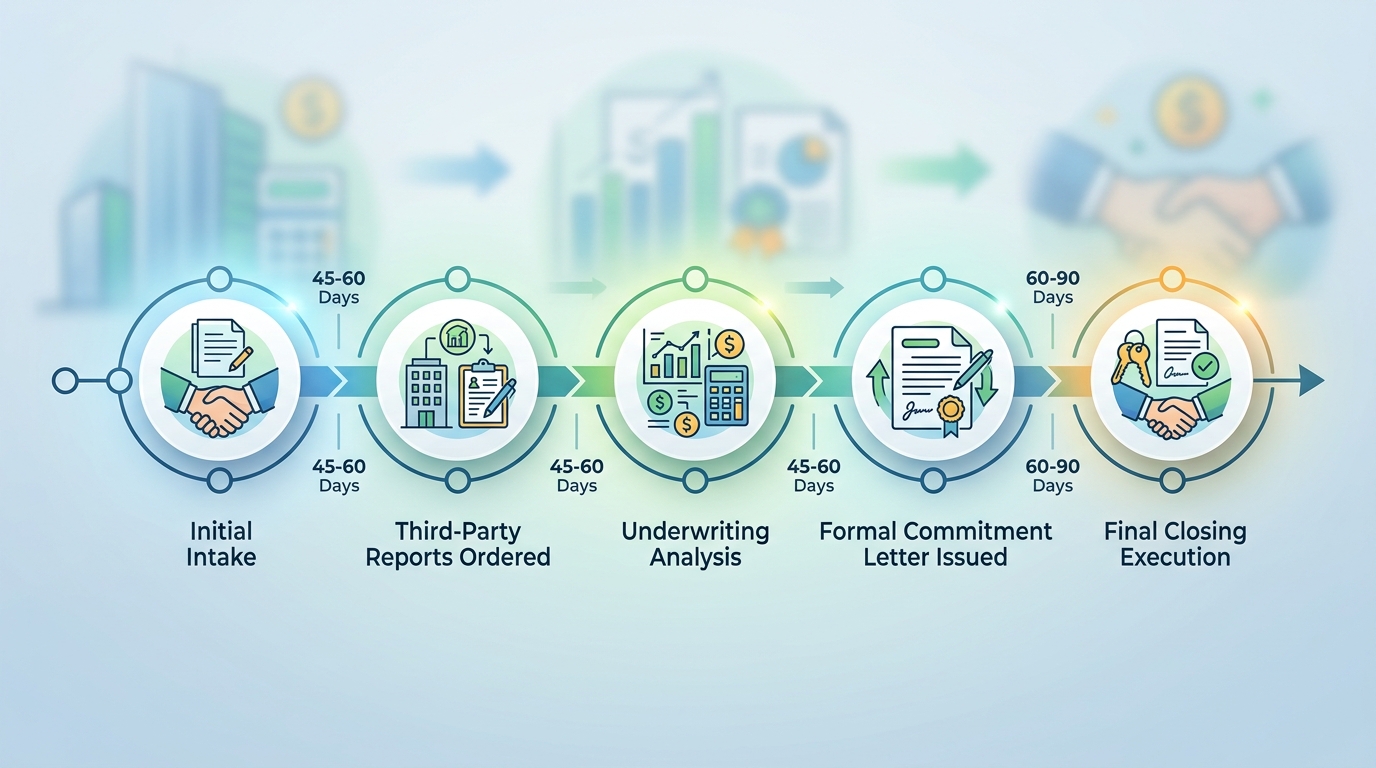
The commercial real estate loan approval process typically spans 45 to 90 days, with various stages contributing to the overall timeline.
Timeline Drivers by Diligence Step:
- Commercial Appraisal (14 – 21 Days): Certified commercial appraisers must perform physical site visits, conduct local commercial sales comp analysis, and complete multi-page narrative appraisal reports.
- Phase I Environmental Site Assessment (21 – 30 Days): Environmental engineers investigate historical property records, state database filings, and surrounding land usages to verify zero environmental contamination risks.
- Credit Committee Review (3 – 7 Days): Most commercial institutions schedule Credit Committee meetings weekly or bi-weekly. Missing an agenda deadline by a single day can push loan decisions back an entire week.
To gain a deeper understanding of what underwriters analyze during these weeks, examine our deep-dive guide on commercial real estate loan approval process stages.
Why Do Commercial Loan Applications Get Delayed or Denied?
Even experienced real estate investors encounter hurdles during the commercial loan submission process. Identifying risk factors ahead of time allows you to proactively resolve vulnerabilities before credit committee review.
⚠️ WARNING: Top 5 Commercial Application Errors
- Incomplete Financial Documentation: Submitting partial tax returns, missing W-2/K-1 schedules, or uncertified financial statements halts initial underwriting intake immediately.
- Inadequate Net Operating Income (Low DSCR): If actual property net income drops below the lender’s required minimum Debt Service Coverage Ratio (standardly 1.20x–1.25x), the loan request will be rejected or forced to size down.
- Unresolved Title or Environmental Red Flags: Discovering underground storage tanks (USTs) during a Phase I ESA or encumbrances on the title record creates severe delays while remediation strategies are negotiated.
- Inconsistent Entity and Ownership Structures: Mismatches between borrowing entity legal documentation (LLC operating agreements) and guarantor equity ownership distributions require legal amendments prior to document drafting.
- Unfavorable Changes in Property Occupancy: Tenant lease cancellations or sudden non-renewals during active underwriting alter cash flow projections, forcing underwriters to reassess risk profile.
FAQs on the Commercial Lender Application Process
What is the difference between a Letter of Intent (LOI) and a Commitment Letter?
A Letter of Intent (LOI) or term sheet is an initial, non-binding outline of proposed loan terms issued early in the process. A Commitment Letter is a legally binding approval document issued AFTER formal underwriting and Credit Committee review, specifying exact closing conditions and debt covenants.
How early should I start the commercial loan application process before closing?
You should begin the formal application process at least 60 to 90 days prior to your contractual closing date or existing debt maturity date. This provides sufficient cushion for third-party appraisal and environmental site assessment scheduling.
Can I speed up the commercial real estate loan approval process?
Yes. You can accelerate processing by organizing a complete, digitized loan binder beforehand, responding to underwriter document requests within 24 hours, and paying third-party appraisal deposits immediately upon term sheet signing.
What happens if the commercial appraisal comes in lower than the purchase price?
If the appraisal value is lower than expected, the lender’s maximum loan amount (based on LTV) will decrease. The borrower must either bring additional equity down payment to bridge the shortfall, renegotiate a lower purchase price with the seller, or seek secondary gap financing.
Does applying for a commercial property loan require a full property appraisal?
Yes. Federal banking regulations mandate that regulated financial institutions order an independent appraisal performed by a Certified General Real Estate Appraiser for commercial real estate transactions exceeding regulatory threshold amounts.
Preparing your initial loan package? Explore our comprehensive core guide on the commercial real estate loan application to structure your documentation and secure optimal commercial terms.