
Commercial Real Estate Loan Fees: The Complete Borrower Guide
Executive Summary: Commercial Real Estate Financing Costs at a Glance
Securing debt capital for commercial real estate (CRE) acquisitions, developments, or refinances requires navigating a multi-layered landscape of transaction charges. Whether you are an institutional CRE investor, a financial controller, or a business owner-occupier acquiring property, underestimating capital deployment friction can erode projected debt service coverage ratios (DSCR) and trigger cash-at-closing shortfalls.
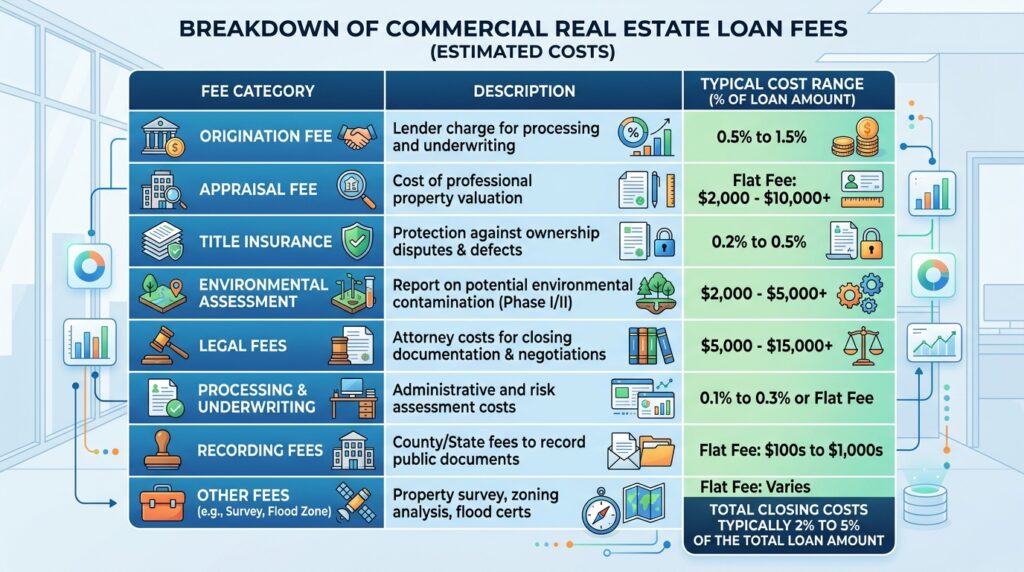
On average, standard commercial real estate loan fees total between 1.5% and 5.0% of the principal loan balance. On a $5,000,000 commercial mortgage, borrowers typically incur between $75,000 and $250,000 in combined upfront financing costs, including lender origination points, third-party due diligence reports, legal representation, and settlement fees.
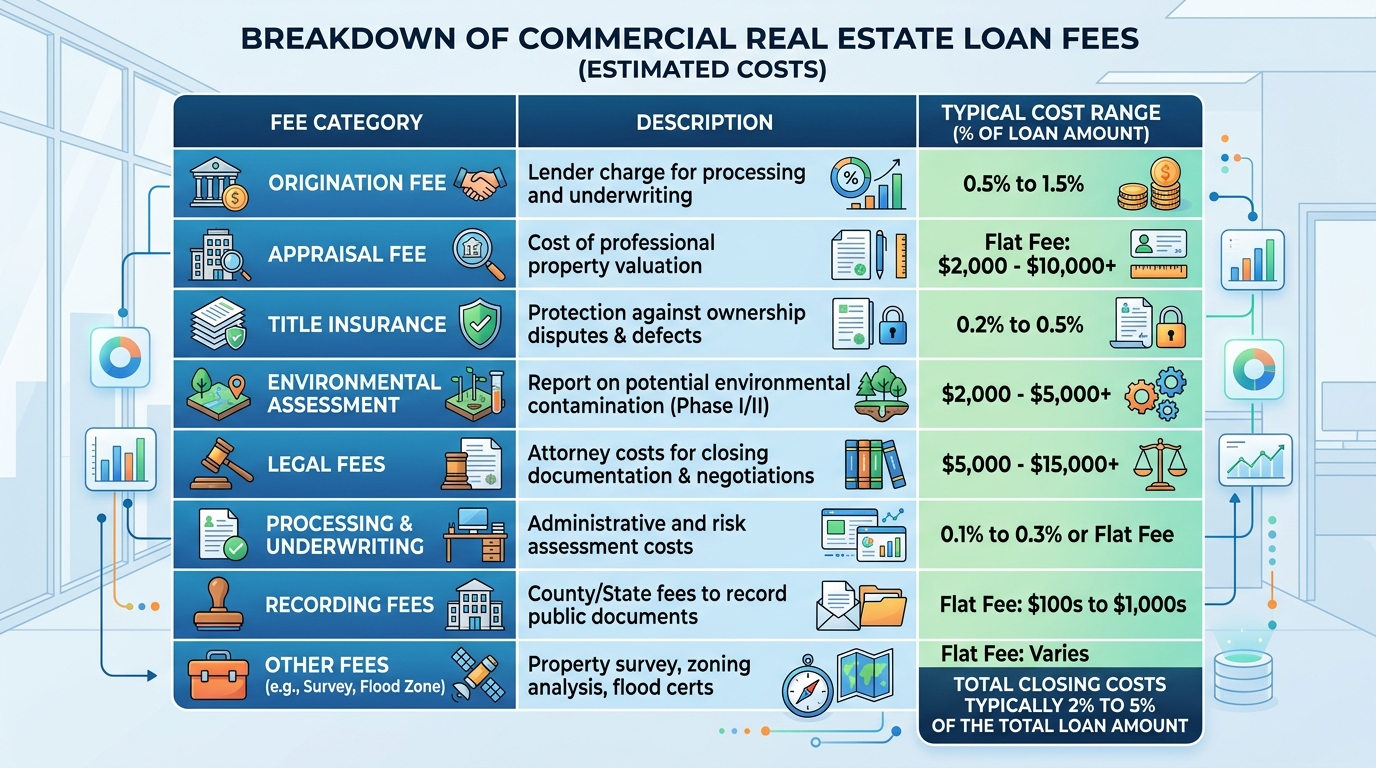
A comprehensive breakdown of commercial real estate loan fee categories and their typical cost percentages, offering a quick overview of financing costs.
Understanding how these fees are structured, when they are due, and whether they are refundable is critical for accurate underwriting and capital modeling. This master guide breaks down every line item on a commercial loan fee schedule, outlines market benchmarks for 2026 across lender types, and highlights strategic tactics to protect your cash flow during term sheet negotiation.
What Are Standard Fees for a Commercial Real Estate Loan?
Standard fees for a commercial real estate loan represent the administrative, underwriting, evaluation, and capital deployment charges assessed by direct lenders, third-party vendors, and intermediaries. Unlike residential mortgage transactions, which operate under standardized consumer protections and predictable flat fees, commercial financing costs scale with asset complexity, deal risk, and capital source requirements.
Commercial financing costs fall into two broad buckets: upfront transaction fees (paid prior to or at loan closing) and ongoing or exit charges (assessed during the loan lifecycle or upon payoff).
Master Commercial Loan Fee Benchmark Table ($5,000,000 Loan)
The table below outlines standard benchmarks for a typical $5,000,000 commercial property transaction across senior debt structures in 2026:
| Fee Category | Typical Range (% or Flat) | Benchmark Cost ($5M Loan) | Payment Timing | Refundable Status |
|---|---|---|---|---|
| Loan Origination Fee | 0.50% – 2.00% | $25,000 – $100,000 | At Closing (Deducted from proceeds) | Non-Refundable |
| Underwriting & Processing | $1,500 – $5,000 | $2,500 | Application / Term Sheet | Non-Refundable |
| Appraisal Report | $4,000 – $15,000 | $7,500 | Upfront Vendor Deposit | Unused Deposit Only |
| Environmental Site Assessment (Phase I) | $3,000 – $6,000 | $4,500 | Upfront Vendor Deposit | Unused Deposit Only |
| Property Condition Assessment (PCA) | $2,500 – $6,000 | $3,500 | Upfront Vendor Deposit | Unused Deposit Only |
| Lender Legal Counsel Fee | $5,000 – $20,000+ | $12,500 | Paid from Retainer / Closing | Deposit Excess Only |
| Commercial Mortgage Broker Fee | 1.00% – 2.00% | $50,000 – $100,000 | At Settlement / Closing | Non-Refundable |
| Title Insurance & Settlement Escrow | 0.50% – 1.00% | $25,000 | At Closing | Non-Refundable |
To review a granular, step-by-step breakdown of settlement line items, see our itemized commercial closing costs breakdown.
Core Categories of CRE Financing Costs
Commercial mortgage fees are divided into four main operational categories. Evaluating your loan estimate along these category boundaries allows you to isolate lender yield costs from third-party vendor pass-through charges.
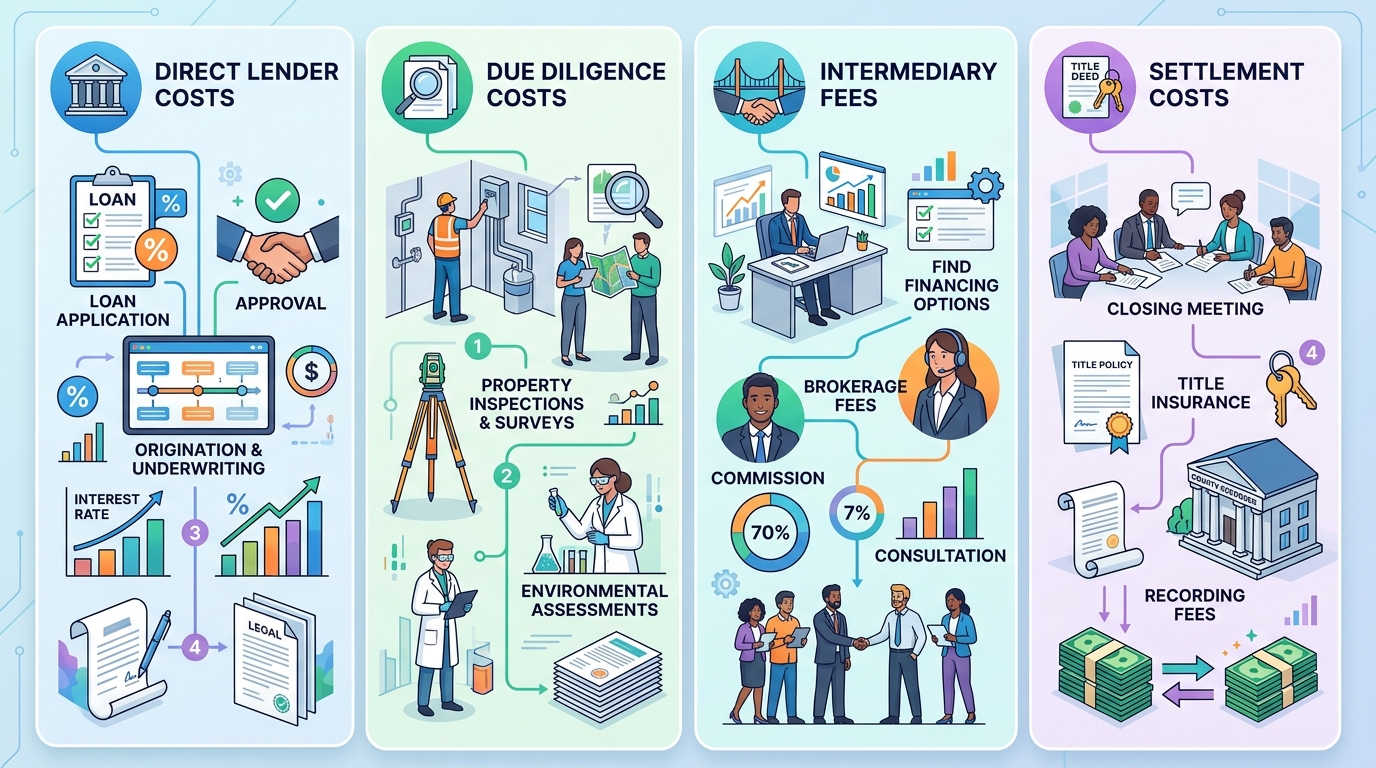
An infographic breaking down the four core categories of commercial real estate financing costs for better understanding.
1. Direct Lender Charges (Origination, Underwriting & Commitment)
Direct lender charges represent the internal cost of capital allocation, risk evaluation, and administrative loan setup. These fees generate yield for the debt provider and cover institutional overhead.
- Origination Fee (Points): Expressed as a percentage of the total loan commitment (where 1 point = 1.0% of loan amount). Origination fees cover capital sourcing, credit analysis, and deal execution.
- Underwriting & Application Fees: Fixed administrative fees ($1,500 to $5,000) collected to offset the cost of internal credit committee reviews, stress-testing property cash flows, and financial background checks.
- Commitment Fee & Rate Lock Deposit: Collected upon signing the formal term sheet (typically 1.0% of the loan amount). This fee reserves capital commitment and locks the interest rate benchmark (e.g., U.S. Treasuries or SOFR). In most cases, the commitment fee is credited toward total origination charges at final closing.
For detailed rate tables and lender point comparisons, explore our guide on lender origination fees and points.
2. Third-Party Vendor & Due Diligence Fees
Lenders do not perform property evaluations in-house; instead, they hire independent, licensed professional vendors. The borrower pays these third-party report costs directly or through a lender expense deposit.
- Commercial Appraisal: An independent property valuation conducted by a MAI-certified appraiser examining income capitalization, comparable sales, and replacement cost approaches.
- Environmental Site Assessment (ESA): A Phase I ESA evaluates environmental liability risks, historical site uses, and chemical containment. If environmental recognized hazards (RECs) are identified, a intrusive Phase II report may be required.
- Property Condition Assessment (PCA): An engineering inspection evaluating structural integrity, foundation quality, mechanical systems (HVAC, plumbing, electrical), and roof life expectancies.
- Lender Legal Counsel: External legal representation hired by the lender to draft loan documents, review title policies, negotiate intercreditor agreements, and oversee closing mechanics.
To examine detailed vendor cost matrices, consult our resource on third-party due diligence report fees.
3. Intermediary & Placement Costs
When capital is arranged through capital advisors or financial intermediaries rather than directly with an end-lender, additional representation charges apply.
- Commercial Mortgage Broker Fees: Success-based commissions ranging from 1.0% to 2.0% of loan proceeds, paid upon successful debt placement and loan funding.
- Placement & Advisory Fees: Charged by investment banking firms or specialized debt advisors for structuring complex mezzanine debt, preferred equity, or capital stack syndications.
To evaluate intermediary fee structures against direct lending options, read our analysis on commercial mortgage broker fee structures.
4. Settlement, Escrow & Title Fees
Settlement costs cover the physical transaction execution, public recordation, and title insurance policies protecting the lender’s lien position.
- Lender’s Title Insurance Policy: Insures the debt holder against title defects, unrecorded liens, and ownership disputes up to the full loan amount.
- Escrow & Settlement Closing Fees: Charged by the title company or escrow agent to manage document execution, escrow accounts, and wire distribution.
- Mortgage Recording Taxes & Municipal Stamp Fees: State or county transfer taxes levied on recorded mortgages (e.g., New York’s Mortgage Recording Tax or Florida’s Documentary Stamp Tax), which can significantly increase closing costs in specific jurisdictions.
Average Commercial Real Estate Loan Fees in 2026
Commercial property loan fees vary based on lender capital source, risk profile, loan size, and underlying asset quality. Below are market benchmarks observed across major institutional lending channels in 2026.
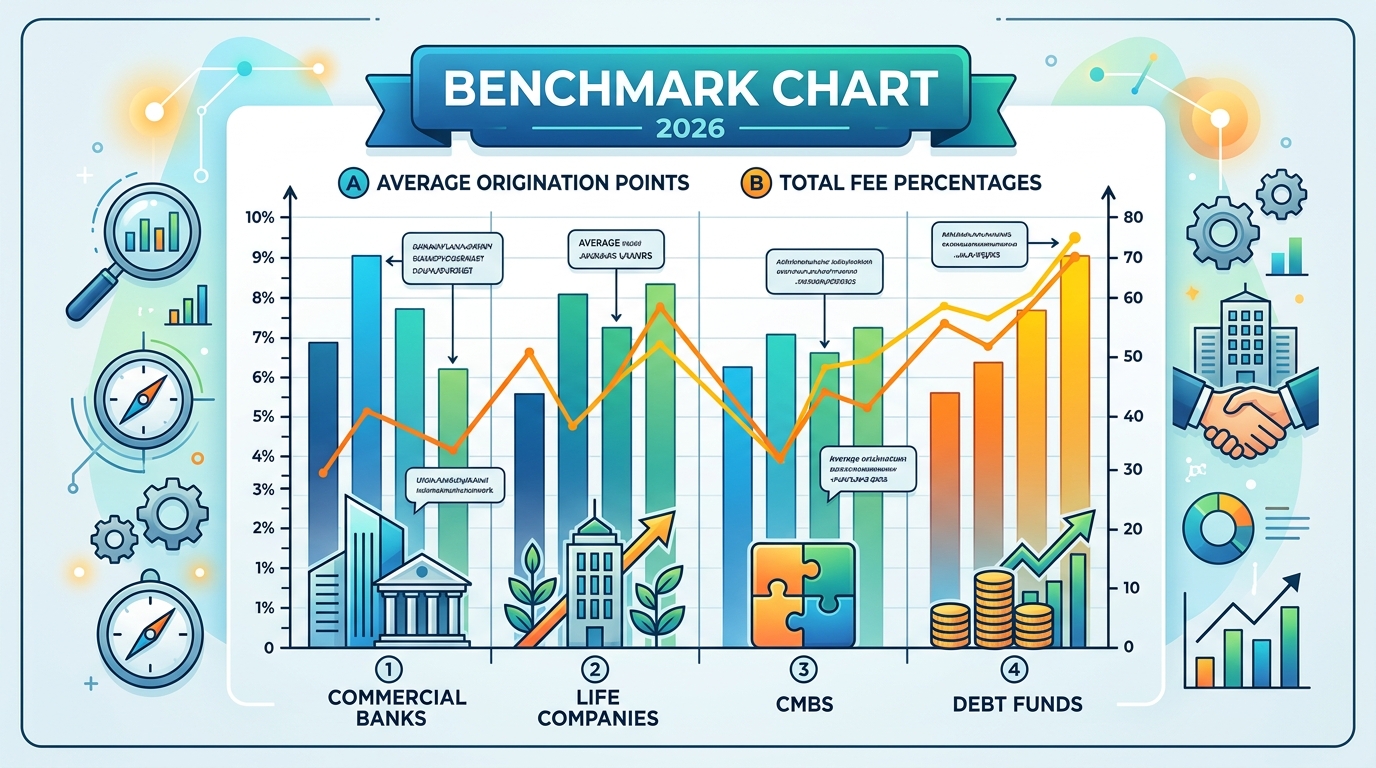
Average commercial real estate loan fees in 2026, benchmarked across various lender types such as commercial banks, life companies, CMBS, and debt funds.
Fee Benchmarks by Lender Type
Commercial Banks (Regional & National)
- Origination Points: 0.50% – 1.00%
- Underwriting / Admin: $2,000 – $3,500
- Key Characteristics: Commercial banks offer conservative leverage (65%–75% LTV) with competitive origination points. However, third-party report requirements and legal reviews are strictly enforced.
Debt Funds & Private Bridge Lenders
- Origination Points: 1.00% – 2.00%+
- Exit Fees: 0.50% – 1.00%
- Key Characteristics: Used for opportunistic acquisitions, heavy value-add repositioning, or fast execution. Higher upfront origination points are balanced against speed, flexible DSCR requirements, and higher leverage limits.
SBA 7(a) & SBA 504 Loan Programs
- Packaging Fees: $2,000 – $4,000 (standardized)
- SBA Guaranty Fee: 2.00% – 3.75% (based on guaranteed amount)
- Key Characteristics: Backed by the U.S. Small Business Administration for owner-occupied commercial real estate. While upfront guaranty fees are higher, they can generally be capitalized into the total loan balance.
Life Insurance Companies
- Origination Points: 0.25% – 0.75%
- Legal / Vendor Fees: High standards, moderate cost
- Key Characteristics: Life co financing provides the lowest origination fee structures for low-risk, core institutional assets (40%–65% LTV). However, exit flexibility is restricted by strict yield maintenance provisions.
CMBS / Conduit Loans
- Origination Points: 0.50% – 1.00%
- Securitization & Legal Fees: $15,000 – $30,000+
- Key Characteristics: CMBS financing offers non-recourse terms and competitive rates, but legal and third-party document processing fees are substantially higher due to secondary market securitization guidelines.
Fee Benchmarks by Property Type
Asset class risk directly impacts lender diligence requirements and fee schedules:
- Multifamily (5+ Units): Standardized agency guidelines (Fannie Mae / Freddie Mac) keep third-party report costs lower ($8,000–$12,000 total due diligence).
- Industrial & Logistics: Low structural complexity keeps property condition reports affordable, though environmental Phase I reviews are scrutinized for chemical hazards.
- Retail & Office: Complex tenant lease audits and tenant rollover stress-testing increase legal counsel fees and appraisal costs ($6,000–$10,000 for appraisal alone).
- Hospitality & Self-Storage: Considered operationally intensive real estate; lenders assess higher underwriting fees and specialized operational appraisals ($8,000–$15,000+).
Common Hidden Fees & Term Sheet Traps to Avoid
When reviewing commercial real estate loan fee schedules, borrowers must look beyond headline origination points to identify potential fee traps that increase out-of-pocket expenses.
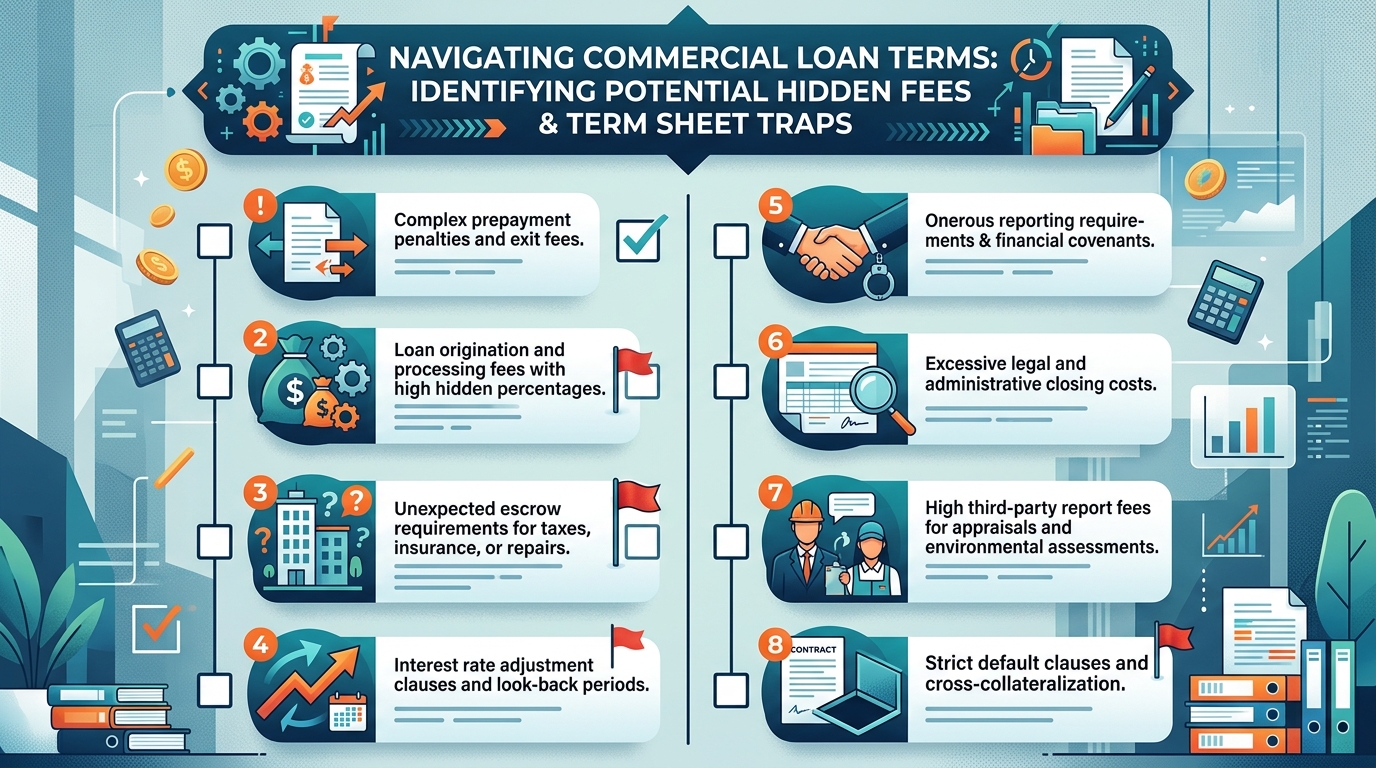
A checklist graphic to help identify and avoid common hidden fees and term sheet traps in commercial real estate loans.
1. Application Deposits vs. Non-Refundable Expense Retainers
Upon signing a term sheet, lenders require an upfront expense deposit (ranging from $10,000 to $30,000) to cover initial legal counsel, appraisal ordering, and background checks.
The Trap: Ensure the term sheet explicitly states that this deposit is an expense retainer rather than a non-refundable application fee. If the loan fails to close due to lender default or credit committee rejection, unexpended deposit funds must be returned to the borrower with an itemized accounting of vendor expenditures.
2. Rate Lock Extension & Legal Expense Overruns
- Rate Lock Extensions: If closing is delayed past the agreed commitment window (typically 30–60 days) due to title delays or third-party report lag, lenders may charge a per-diem rate lock extension fee (often 0.125% to 0.25% of loan amount per 15-day extension).
- Lender Legal Overruns: Lenders pass 100% of their external legal counsel fees to the borrower. Without a contractual legal fee cap written into the term sheet, lengthy loan document negotiations can quickly push legal charges from $10,000 to over $25,000.
3. Unannounced Exit Fees & Re-inspection Charges
Bridge loans and construction debt often include exit charges (0.5%–1.0%) assessed when the principal is repaid. Furthermore, construction financing structures charge draw re-inspection fees ($500–$1,500 per draw request) for physical progress inspections.
To avoid unexpected payoff charges down the road, study our detailed guide on yield maintenance and prepayment penalties.
Frequently Asked Questions About CRE Loan Fees
What are standard fees for a commercial real estate loan?
Standard upfront fees for a commercial real estate loan generally total 1.5% to 5.0% of the loan amount. Key expenses include lender origination fees (0.5% to 2.0%), third-party due diligence reports ($8,000 to $25,000 combined), lender legal counsel ($5,000 to $15,000), title insurance, and mortgage recording taxes.
Are commercial real estate loan fees tax deductible?
Under IRS guidelines (IRC Sections 263 and 461), commercial real estate loan fees are generally not fully deductible in the year they are paid. Instead, financing costs must be capitalized and amortized on a straight-line basis over the life of the loan. However, if the loan is paid off early or refinanced, any remaining unamortized fee balance can typically be written off in full during that tax year.
How do CRE loan fees differ from residential mortgage fees?
Commercial loan fees differ from residential mortgage fees in several key ways:
1. Custom Negotiation: CRE fee schedules are negotiated directly on term sheets, whereas residential closing costs are strictly standardized under TRID guidelines.
2. Higher Third-Party Costs: Commercial appraisals ($4,000–$15,000) and environmental reports ($3,000–$6,000) are far more expensive than residential inspections.
3. Lender Legal Counsel: Commercial borrowers must pay for the lender’s external legal team to draft customized loan documents.
Strategic Next Steps: Evaluating Your Term Sheet Fee Schedule
When evaluating competing commercial real estate term sheets, comparing headline interest rates alone is insufficient. A lower interest rate can quickly be negated by excessive origination points, uncapped legal retainers, or steep exit penalties.
Term Sheet Comparison Checklist
- Request an Itemized Fee Estimate: Require each lender to provide a complete line-item breakdown of all internal, third-party, and legal costs before paying an application deposit.
- Establish Fee Caps: Contractually cap lender legal counsel fees and administrative processing charges within the signed commitment letter.
- Compare Net Capital Deployment: Calculate total effective cost by adding upfront fee percentages to interest expenses over your planned holding period.
To learn proven strategies for reducing upfront financing costs and negotiating term sheet concessions, review our guide on tactics to negotiate term sheet fees.
For an overarching view of commercial debt structuring, you can also consult our comprehensive guide on commercial real estate loans and review essential closing cost considerations.