
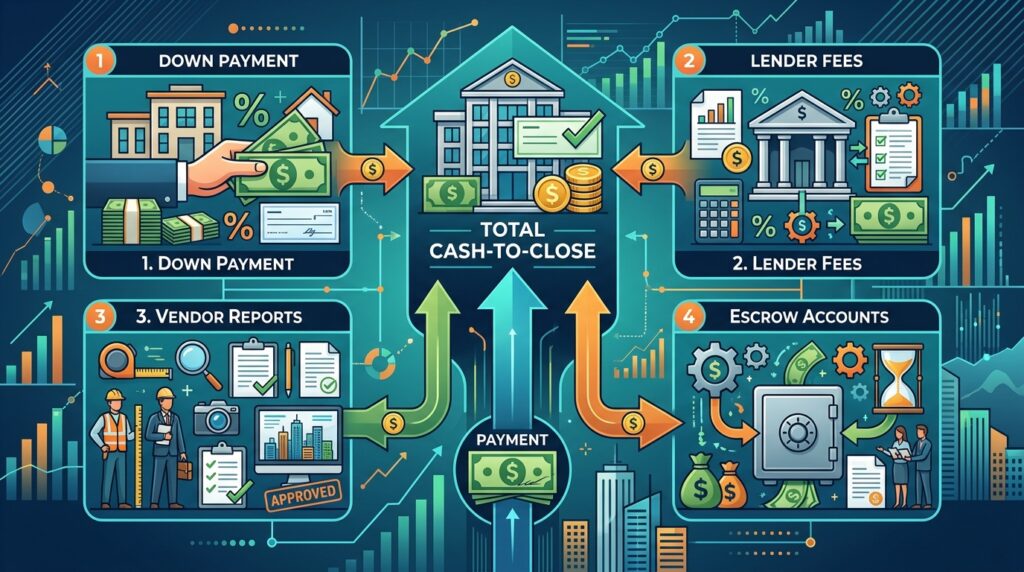
Commercial Real Estate Closing Costs: Line-Item Breakdown & Cash-to-Close
Introduction: Managing Cash-to-Close in Commercial Property Acquisitions
Acquiring or refinancing commercial real estate involves far more than securing a down payment and negotiating an interest rate. One of the most critical steps in transaction planning is accurately estimating your cash-to-close—the total liquid capital required at the closing table to fund the property purchase, pay financing costs, cover third-party due diligence, and establish required escrow reserves.
Miscalculating total commercial real estate closing costs can lead to severe capital shortfalls immediately prior to funding, forcing buyers to secure expensive last-minute gap equity or risk forfeiting earnest money deposits.
Understanding every line item on the settlement statement empowers borrowers to verify charges, negotiate fee reductions, and structure financing efficiently.
What Is Included in Commercial Real Estate Closing Costs?
Total commercial real estate closing costs typically range from 2.0% to 5.0% of the total loan amount, or 1.5% to 3.5% of the total property purchase price. These settlement charges comprise lender origination fees, administrative processing charges, third-party due diligence reports, legal representation, title insurance, and municipal recording taxes.
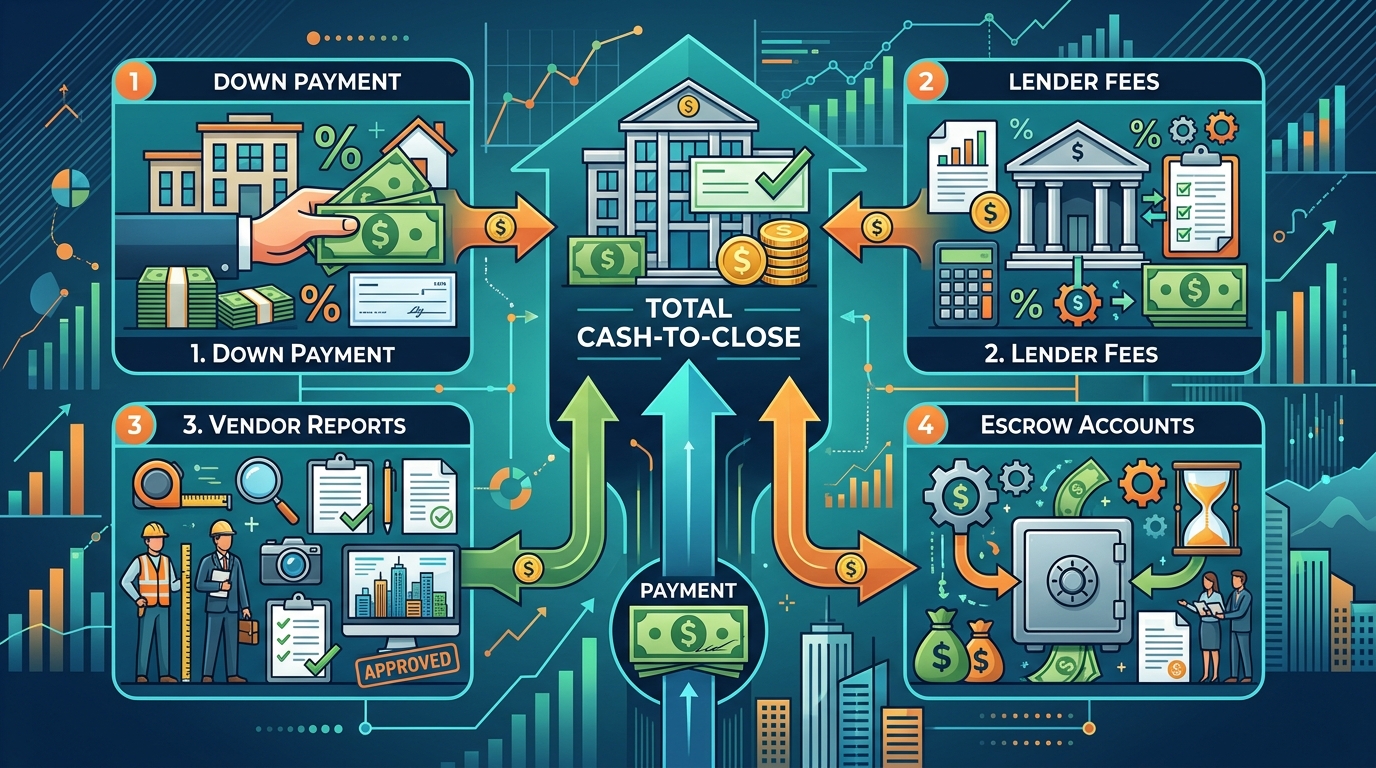
A visual breakdown of the key components contributing to the total cash required at closing for a commercial real estate transaction.
Unlike residential mortgage transactions, commercial closing costs are not governed by standardized consumer caps. Every line item is established through contract terms, vendor fee schedules, and local tax statutes. For a broader overview of how closing fees fit into overall financing, refer to our master guide to commercial real estate loan fees.
Complete Line-Item Breakdown of Commercial Closing Costs
To prevent settlement day surprises, commercial borrowers should review closing expenses across four major operational stages.
1. Pre-Closing & Term Sheet Fees
Pre-closing expenses are paid when a term sheet or letter of intent (LOI) is executed to initiate loan underwriting and property evaluation.
- Application & Expense Retainer: Charged by lenders upon term sheet signing ($10,000 to $30,000) to cover initial third-party report orders and legal drafting. Unexpended funds are credited back at closing.
- Rate Lock Commitment Fee: A refundable or creditable deposit (typically 1.0% of the loan amount) paid to lock the benchmark interest rate during the 30-to-60-day underwriting window.
- Commercial Loan Term Sheet Fees: Administrative processing fees assessed to issue initial term sheets and conduct preliminary credit analysis ($1,000 to $3,000).
2. Administrative & Lender Processing Charges
These charges cover the direct operational costs incurred by the debt provider during credit committee review and file assembly.
- Commercial Loan Origination Points: Primary lender fee ranging from 0.50% to 2.00% of the principal loan balance, collected at funding.
- Commercial Real Estate Processing Fees: Internal file preparation, administrative handling, and doc prep fees ($1,000 to $2,500).
- Underwriting Fee: Fixed cost ($1,500 to $5,000) for risk modeling, cash flow stress-testing, tenant credit audits, and DSCR analysis.
- Flood Certification & Tax Monitoring Fees: Mandatory compliance checks ($150 to $500) verifying flood zone status and establishing ongoing property tax tracking.
3. Title, Escrow & Settlement Charges
Title and escrow charges guarantee clear ownership transfer and protect the lender’s first-lien security position.
- Lender’s Title Insurance Policy: Mandatory title insurance policy covering the lender’s loan amount against unrecorded liens or ownership challenges (typically 0.20% to 0.50% of loan value).
- Owner’s Title Insurance Policy: Optional (but highly recommended) policy protecting the buyer’s equity position in the property.
- Escrow & Settlement Closing Fee: Fee charged by the title company or closing attorney to handle escrow funds, execution of closing documents, and wire transfers ($2,000 to $5,000).
- Survey Fee: Architectural boundary and easement survey ($2,500 to $8,000 depending on parcel size and complexity).
4. Government Taxes & Municipal Recording Fees
Government fees are mandatory state and municipal transfer taxes determined by jurisdiction.
- Mortgage Recording Tax: Taxes levied by state or local governments on recorded mortgage liens. In states like New York, Florida, and Maryland, mortgage recording taxes can range from 0.50% to over 2.00% of the loan amount.
- Deed Transfer Taxes: State or municipal taxes assessed on real property ownership transfers, usually split between buyer and seller per purchase contract terms.
- Recording Fees: Fixed administrative filing fees charged by county clerk offices to record deeds, mortgages, and assignment of leases ($250 to $1,000).
To evaluate mandatory due diligence expenses, consult our detailed analysis on third-party due diligence costs like appraisals and environmental reports.
Estimating Your Total Cash-to-Close
Determining your required liquidity at settlement involves adding capital obligations and subtracting net loan proceeds and credits.
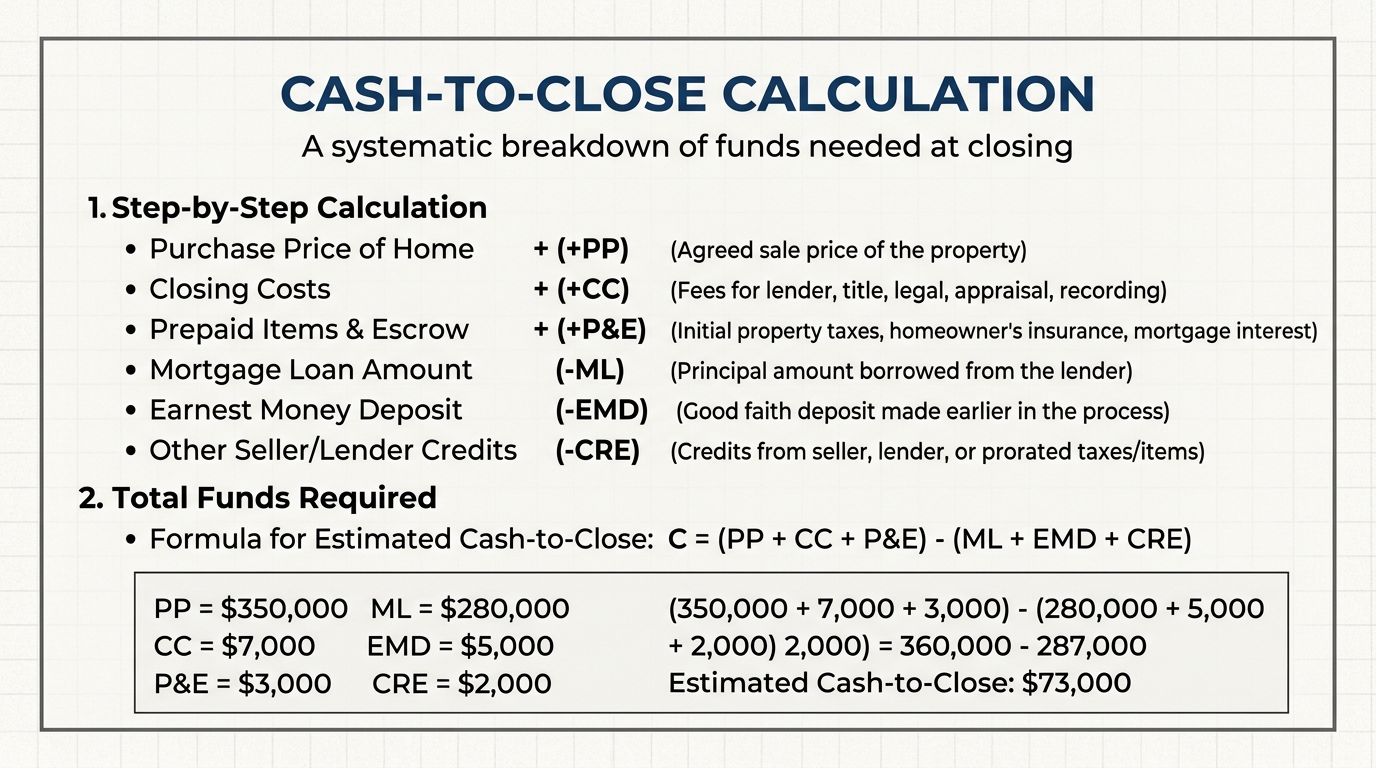
The essential formula for estimating your total cash-to-close, detailing how purchase price, costs, and credits are factored.
The Cash-to-Close Formula
$$\text{Cash-to-Close} = \text{Purchase Price} + \text{Total Closing Costs} + \text{Prepaids \& Escrow Reserves} – \text{Loan Principal} – \text{Earnest Money Deposit} + \text{Seller Credits}$$
Sample Itemized Calculation Schedule ($5,000,000 Purchase / $3,750,000 Loan)
The following schedule illustrates an itemized cash-to-close calculation for a $5,000,000 commercial acquisition with 75% LTV senior debt ($3,750,000 loan balance):
| Line Item Category | Calculation Basis | Estimated Cost |
|---|---|---|
| Property Purchase Price | Agreed Purchase Price | $5,000,000 |
| Lender Origination Fee (1.0 point) | 1.00% of $3,750,000 Loan | $37,500 |
| Lender Processing & Underwriting | Flat Fee Schedule | $3,500 |
| Appraisal & Phase I Environmental (ESA) | Third-Party Vendor Cost | $11,000 |
| Property Condition Assessment (PCA) | Third-Party Vendor Cost | $3,500 |
| Lender Legal Counsel Fee | Retainer / Invoice | $12,500 |
| Lender Title Insurance & Escrow Fees | ~0.60% of Purchase Price | $30,000 |
| State Transfer & Recording Taxes | ~0.50% of Loan Amount (Est.) | $18,750 |
| Initial Tax & Insurance Escrow Reserves | 3 Months Property Tax & Insurance | $15,000 |
| SUBTOTAL CAPITAL REQUIRED | Purchase + Fees + Escrows | $5,131,750 |
| Less: Senior Loan Proceeds | 75% Loan-to-Value | ($3,750,000) |
| Less: Earnest Money Deposit Paid | Initial Contract Deposit | ($100,000) |
| TOTAL ESTIMATED CASH-TO-CLOSE | Net Liquid Funds Required | $1,281,750 |
Financing Closing Costs vs. Paying Out-of-Pocket
A common question among real estate investors is whether closing costs can be capitalized into the loan balance to reduce out-of-pocket cash requirements.
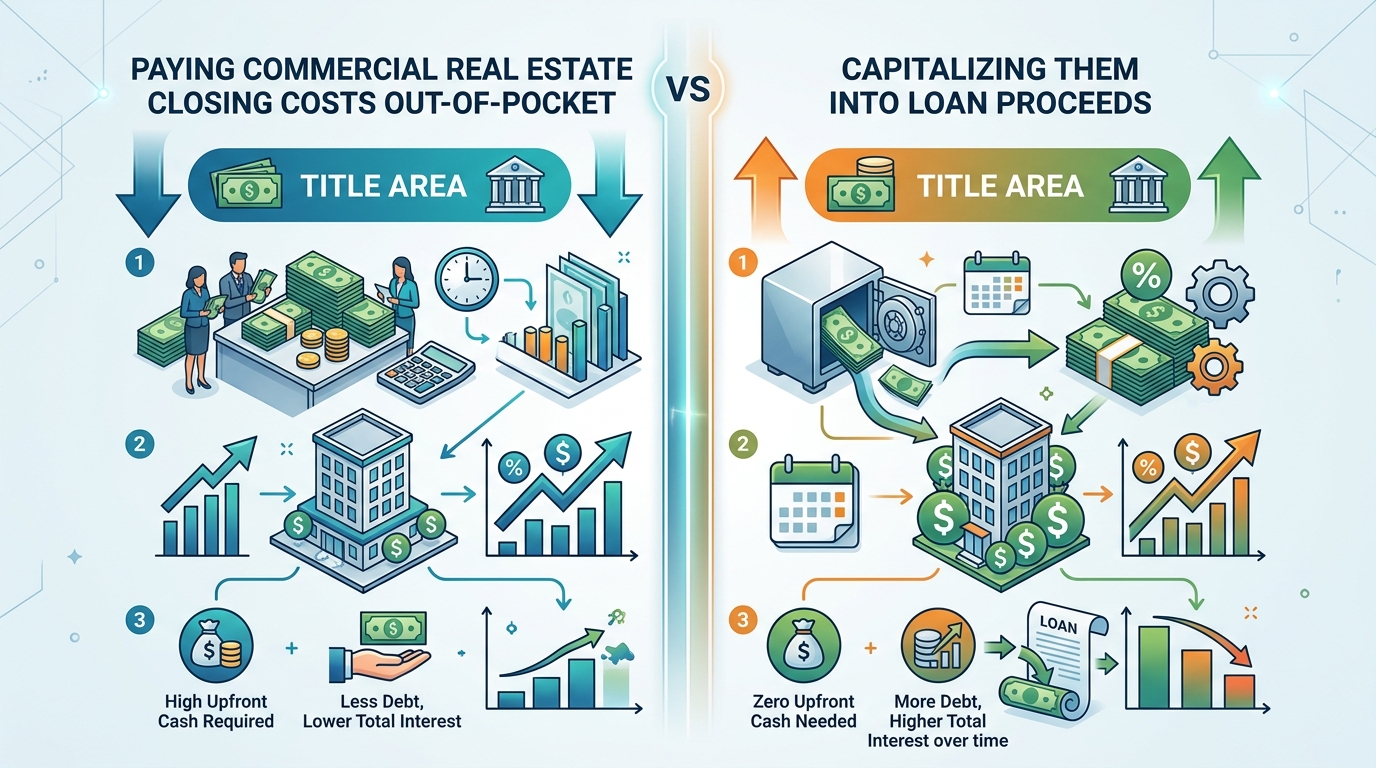
A comparison of strategies for handling commercial real estate closing costs: paying directly versus rolling them into the loan.
Can CRE Loan Fees Be Rolled Into the Loan?
In commercial financing, whether closing costs can be rolled into loan proceeds depends on lender guidelines and Loan-to-Value (LTV) limits:
- LTV & LTC Caps: Senior debt lenders enforce strict LTV caps (e.g., 75% LTV of appraised value or 75% LTC of total project cost). If total loan proceeds including capitalized fees exceed the maximum allowed LTV threshold, the borrower must pay excess fees out-of-pocket.
- SBA Loan Programs: SBA 7(a) and 504 loan structures permit borrowers to roll SBA guaranty fees, packaging costs, and standard closing fees directly into the loan balance, significantly lowering upfront cash friction.
- Bridge & Construction Debt: Private debt funds frequently capitalize interest reserves, origination points, and closing fees directly into total facility commitments.
For actionable strategies on structuring financing terms, explore our guide on how to finance closing costs into loan proceeds.
Frequently Asked Questions
What is included in commercial real estate closing costs?
Commercial real estate closing costs include direct lender fees (origination points, underwriting, processing), third-party reports (commercial appraisal, Phase I ESA, Property Condition Assessment), settlement services (lender’s title insurance, survey, legal fees), and municipal government taxes (mortgage recording tax and deed filing fees).
Can commercial real estate loan fees be rolled into the loan balance?
Yes, commercial real estate loan fees can be rolled into the loan balance provided the total capitalized loan amount does not breach the lender’s maximum Loan-to-Value (LTV) or Loan-to-Cost (LTC) limits. SBA loans and private bridge debt routinely allow fee capitalization.
Who pays closing costs in a commercial real estate transaction—buyer or seller?
In commercial transactions, the buyer (borrower) pays all financing costs, lender legal fees, and loan-related third-party due diligence reports. Property transaction costs—such as owner’s title policies, deed transfer taxes, and real estate broker commissions—are negotiable and customary based on local real estate market practices.
Closing Settlement Playbook: Reviewing Your Settlement Statement (ALTA)
At least 48 to 72 hours prior to loan funding, the title company or closing attorney will issue a draft ALTA (American Land Title Association) Settlement Statement.
Settlement Review Checklist
- Cross-Check Against Signed Term Sheet: Compare every lender fee on the ALTA statement against the fees agreed upon in your signed commitment letter. Look for duplicate line items (e.g., “document prep fee” listed alongside a “processing fee”).
- Verify Deposit Credits: Confirm that your initial expense deposit and earnest money deposit are fully credited on the settlement statement.
- Audit Legal Counsel Charges: Ensure lender legal fee invoices match agreed term sheet legal caps before authorizing wire transfers.
To ensure your loan file contains all required closing paperwork, review our detailed guide on closing document requirements and settlement statements.