
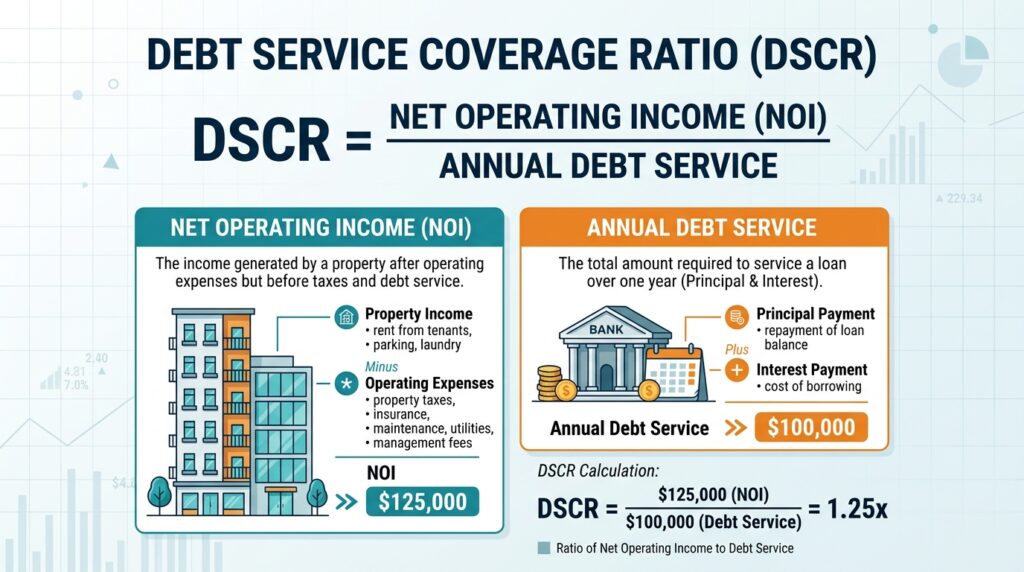
DSCR Calculation for Commercial Mortgage Rates
For commercial real estate investors and syndicators, optimizing borrowing costs is one of the most effective ways to enhance equity returns. Mastering the DSCR calculation for commercial mortgage rates gives borrowers a direct quantitative advantage when negotiating with commercial banks, agency originators, and private lenders in 2026.
The Debt Service Coverage Ratio (DSCR) measures the cash flow buffer available to service mortgage principal and interest. Because lenders use this metric to assign pricing tiers and rate spreads, even small adjustments to your calculated DSCR can translate into major interest rate reductions.
This actionable how-to guide breaks down the core mathematical formula, provides concrete strategies for boosting property coverage ratios, and presents a step-by-step mathematical example demonstrating real-world interest savings.
How is DSCR Calculated for Commercial Mortgage Rates?
Understanding how underwriters calculate coverage ratios ensures you present financial statements that accurately reflect your property’s true cash flow strength.
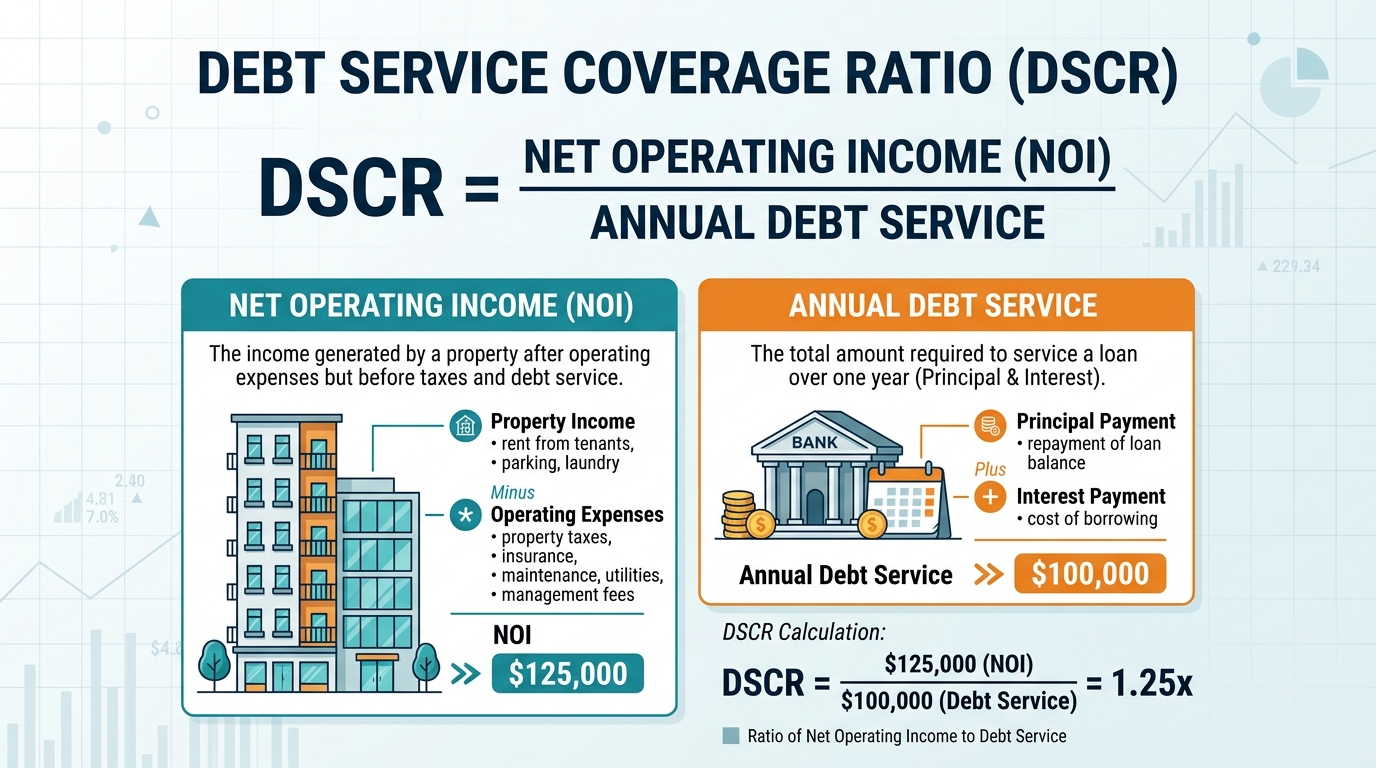
The Debt Service Coverage Ratio (DSCR) is a critical metric for commercial mortgage lenders, calculated by dividing Net Operating Income (NOI) by Annual Debt Service.
The Formula: NOI / Annual Debt Service
Formula Callout Snippet:
The Debt Service Coverage Ratio is calculated using the following standard mathematical equation:$$\text{DSCR} = \frac{\text{Net Operating Income (NOI)}}{\text{Annual Debt Service (Principal + Interest)}}$$
To compute this ratio accurately for commercial loan underwriting, underwriters evaluate two primary financial components:
1. Net Operating Income (NOI)
Net Operating Income represents total property revenues minus necessary operating expenses:
* Gross Income: Total rental income, tenant expense reimbursements (NNN charges), parking fees, and auxiliary revenues, minus a market vacancy and credit loss factor (typically estimated at 5% to 10%).
* Less Operating Expenses: Real estate property taxes, building insurance, utilities, contract services, property management fees (typically standardized at 3% to 5% of gross revenue), and replacement reserves ($250–$350 per unit or $0.15–$0.30 per square foot).
* Exclusions: NOI excludes depreciation, amortization, capital improvements, personal owner draws, and existing income tax liabilities.
2. Annual Debt Service
Annual Debt Service represents the total sum of all principal and interest payments due on the commercial mortgage over a 12-month period. Underwriters calculate this based on the proposed loan principal, interest rate, and amortization schedule (typically 25 or 30 years).
How to Get Better Commercial Loan Rates with High DSCR
Lenders establish standardized risk matrices that reward higher coverage assets with substantial credit spread discounts. Knowing how to get better commercial loan rates with high DSCR performance involves positioning your asset into institutional prime debt tiers:
- Crossing Key Benchmark Thresholds: Commercial lenders price debt in pricing bands. Moving a property from a 1.20x DSCR (Tier 3) to a 1.35x or 1.40x DSCR (Tier 1) moves your file into prime pricing matrices, reducing rate spreads by 50 to 125 basis points.
- Qualifying for Non-Recourse Execution: High DSCR levels (1.35x+) unlock non-recourse debt options through life insurance companies and agency lenders. Non-recourse loans protect personal sponsor assets while providing competitive fixed rates.
- Securing Interest-Only (IO) Structuring: Achieving a robust baseline coverage ratio allows underwriters to approve 1 to 5 years of interest-only payments. This temporary elimination of principal amortization further reduces debt service, boosting ongoing cash flow distributions.
- Negotiating Reduced Lender Fees: Assets with strong DSCR performance carry lower perceived credit risk, allowing borrowers to negotiate reduced origination points, lower application fees, and eliminated cash sweep covenants.
To analyze how high coverage ratios influence specialized property sectors, review our complete analysis of multifamily DSCR loan rates.
How Can Borrowers Improve DSCR for Lower Commercial Mortgage Rates?
If your property’s calculated DSCR falls near minimum lender guidelines (1.15x–1.20x), implementing targeted operational and capital improvements prior to applying for debt can significantly improve loan pricing.

Implementing strategic operational and capital improvements can significantly boost a property’s DSCR, leading to more favorable commercial mortgage rates.
When evaluating strategies for improving DSCR for lower commercial mortgage rates, borrowers should focus on two strategic levers: increasing Net Operating Income (the numerator) and reducing Annual Debt Service (the denominator).
Revenue Expansion Tactics (Increasing NOI)
- Audit Tenant Utility Reimbursements: Transitioning multi-tenant commercial leases from gross lease structures to Triple-Net (NNN) or modified gross structures passes utility, tax, and insurance cost increases directly to tenants, expanding net operating margin.
- Capitalize on Ancillary Income: Implement revenue-generating property upgrades, such as reserved parking fees, storage unit rentals, billboard signage, or high-speed internet resale packages.
- Reduce Unnecessary Expense Leakage: Re-bid vendor contracts (landscaping, trash pickup, janitorial services), appeal property tax assessments using recent submarket comps, and shop commercial building insurance policies through specialized commercial insurance brokers.
Debt Restructuring Options (Reducing Debt Service)
- Inject Capital to Right-Size Loan Proceeds: Making a larger equity down payment or paying down existing principal balance reduces total loan proceeds, lowering annual debt service obligations to achieve target coverage tiers.
- Negotiate Extended Amortization: Requesting a 30-year amortization schedule instead of a 25-year schedule spreads principal repayment across a longer timeframe, lowering annual debt service burdens.
- Structure Interest-Only (IO) Periods: Securing an initial interest-only period lowers immediate debt service costs, artificially raising the calculated DSCR during the loan’s initial term.
To understand how broader underwriting terms interact with coverage metrics, explore our guide on the overall DSCR impact on commercial loan terms.
Practical Example: Calculating Rate Savings from Increasing DSCR from 1.20x to 1.40x
To illustrate the financial impact of improving property coverage, let us examine a practical real-world scenario involving a $4,000,000 commercial acquisition.
Baseline Scenario (Tier 3 – Baseline Coverage)
- Property NOI: $360,000
- Target Loan Amount: $4,000,000
- Calculated DSCR: 1.20x ($360,000 NOI / $300,000 Debt Service)
- Lender Pricing Tier: Tier 3 (+300 bps credit spread over benchmark)
- Quoted Commercial Rate: 7.25% (25-Year Amortization)
- Annual Debt Service: $347,184
- Net Cash Flow After Debt Service: $12,816 / year
Optimized Scenario (Tier 1 – Prime Coverage)
Through operational improvements—such as sub-metering tenant utilities and trimming vendor management costs—the sponsor expands Net Operating Income from $360,000 to $420,000.
- Optimized Property NOI: $420,000
- Target Loan Amount: $4,000,000
- Calculated DSCR: 1.40x ($420,000 NOI / $300,000 Debt Service)
- Lender Pricing Tier: Tier 1 Prime (+200 bps credit spread over benchmark)
- Quoted Commercial Rate: 6.25% (100 bps rate discount achieved!)
- Annual Debt Service: $316,008
- Net Cash Flow After Debt Service: $103,992 / year
Financial Impact Summary
By raising the DSCR from 1.20x to 1.40x, the borrower achieved a 100 basis point rate discount (6.25% vs 7.25%). This single pricing tier adjustment delivered:
* Annual Debt Service Savings: $31,176 / year
* Total 5-Year Interest Savings: $155,880
* Net Operating Cash Flow Increase: Expanded from $12,816 to $103,992 annually!
Frequently Asked Questions (FAQ)
What is the formula for calculating DSCR on a commercial mortgage?
The formula is $\text{DSCR} = \frac{\text{Net Operating Income (NOI)}}{\text{Annual Debt Service}}$. NOI equals property gross revenue minus operating expenses, while annual debt service equals total principal and interest payments due over 12 months.
How quickly can improving property NOI reduce my interest rate?
If you are refinancing or placing new debt, improving NOI prior to loan application immediately impacts loan pricing. On existing loans with adjustable rates, achieving higher DSCR metrics during annual lender reviews can unlock contractual rate reduction options or covenant releases.
Does capital expenditure (CapEx) get subtracted from NOI when calculating DSCR?
Routine operating maintenance is subtracted from NOI. Major non-recurring capital improvements (such as roof replacements or building additions) are excluded from NOI, though lenders deduct a standardized annual replacement reserve ($250–$350/unit) to account for ongoing CapEx needs.
Conclusion & Strategic Recommendations
Calculating and optimizing your commercial property’s DSCR before approaching debt providers is one of the highest-leverage activities in commercial real estate finance. By taking proactive steps to expand revenue, control operating expenses, and structure debt efficiently, borrowers can unlock Tier 1 pricing tiers and capture significant interest savings.
For personalized underwriting support or assistance calculating optimal commercial loan structures, contact the commercial debt advisors at Hunter Fisher LLC today.