
Current Commercial Refinance Rates & Market Benchmarks
Understanding current commercial refinance rates is vital for real estate investors, property owners, and capital managers seeking to time debt refinancing, optimize property performance, and reduce borrowing overhead in 2026. Commercial interest rates fluctuate continuously based on macroeconomic policy, Federal Reserve open market operations, U.S. Treasury yield dynamics, and capital supply across debt markets.
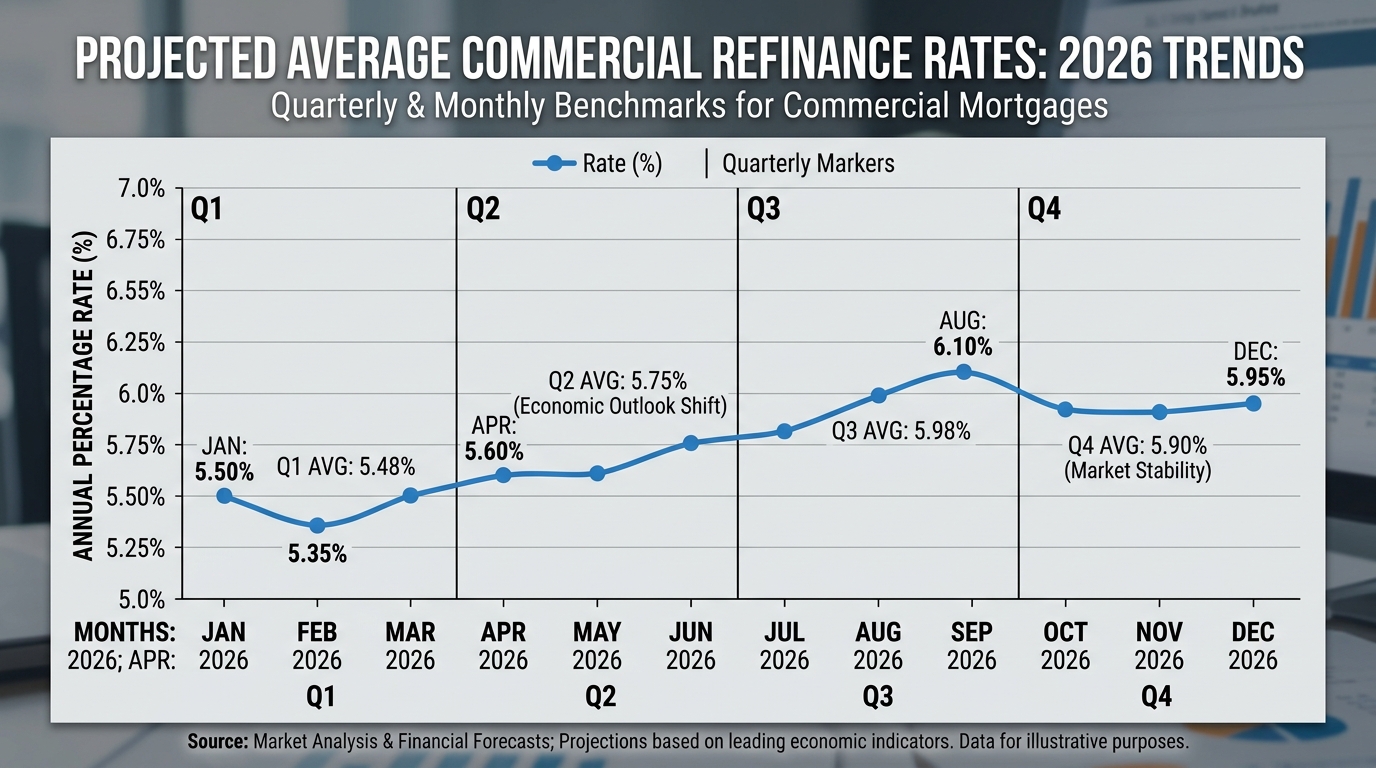
A visual representation of the average commercial refinance rates projected for 2026, highlighting key market benchmarks.
This market report provides actionable benchmarks, historic interest rate trends, index analyses, and key insights for borrowers evaluating commercial debt refinancing across all property sectors.
What Are Current Commercial Refinance Rates Today?
Direct Answer:
As of 2026, commercial mortgage rates today for standard stabilized properties range from 6.15% to 8.25%, depending on the lender type, Loan-to-Value (LTV), property sector, and credit structure. Prime multifamily and industrial assets receive the tightest credit spreads, while office and hospitality properties price at higher interest levels.
Dynamic Market Rate Tracker Summary
- 5-Year Treasury Benchmark: 4.15% – 4.35%
- 10-Year Treasury Benchmark: 4.25% – 4.50%
- 30-Day Term SOFR: 4.80% – 5.10% (SOFR)
- Prime Rate: 7.50% – 7.75%
- Average Bank Spread: +200 to +300 bps over base index
- Average Debt Fund Spread: +350 to +550 bps over SOFR
Borrowers seeking long-term debt options can explore full commercial property refinance terms to evaluate loan-to-value limits, DSCR thresholds, and lender approval requirements.
What is the Average Commercial Refinance Rate for 2026?
The overall average commercial refinance rate across all commercial asset classes in 2026 stands at approximately 6.85%. However, actual pricing varies substantially across capital sources, loan structures, and amortization periods.
Benchmark Comparison Chart
The chart below details standard interest rate ranges, maximum LTV allowances, and target Debt Service Coverage Ratio (DSCR) benchmarks by lender tier:
| Lender Category | Average Interest Rate Range | Maximum Loan-to-Value (LTV) | Typical DSCR Threshold | Loan Term / Amortization |
|---|---|---|---|---|
| Life Insurance Companies | 5.85% – 6.75% | 55% – 65% | 1.30x – 1.45x | 10–25 Year Fixed / 30 Year Amortization |
| Fannie Mae / Freddie Mac (Agency) | 5.95% – 6.85% | 75% – 80% | 1.25x – 1.30x | 5–10 Year Fixed / 30 Year Amortization |
| Regional & Community Banks | 6.50% – 7.50% | 65% – 75% | 1.20x – 1.25x | 5–10 Year Fixed / 25 Year Amortization |
| CMBS (Conduit Loans) | 6.40% – 7.35% | 70% – 75% | 1.25x – 1.35x | 5–10 Year Fixed / 30 Year Amortization |
| Debt Funds & Private Lenders | 8.25% – 10.50% | 70% – 80% | 1.10x – 1.20x | 1–3 Year Floating / Interest-Only |
Investors choosing between loan structures should also compare fixed and variable rates to determine whether floating index volatility fits their risk tolerance.
Historical Commercial Rates vs. Today’s Forecast
To put commercial real estate loan rates into proper strategic context, borrowers must evaluate long-term market trends. Over the past two decades, commercial borrowing costs have experienced distinct historical cycles.
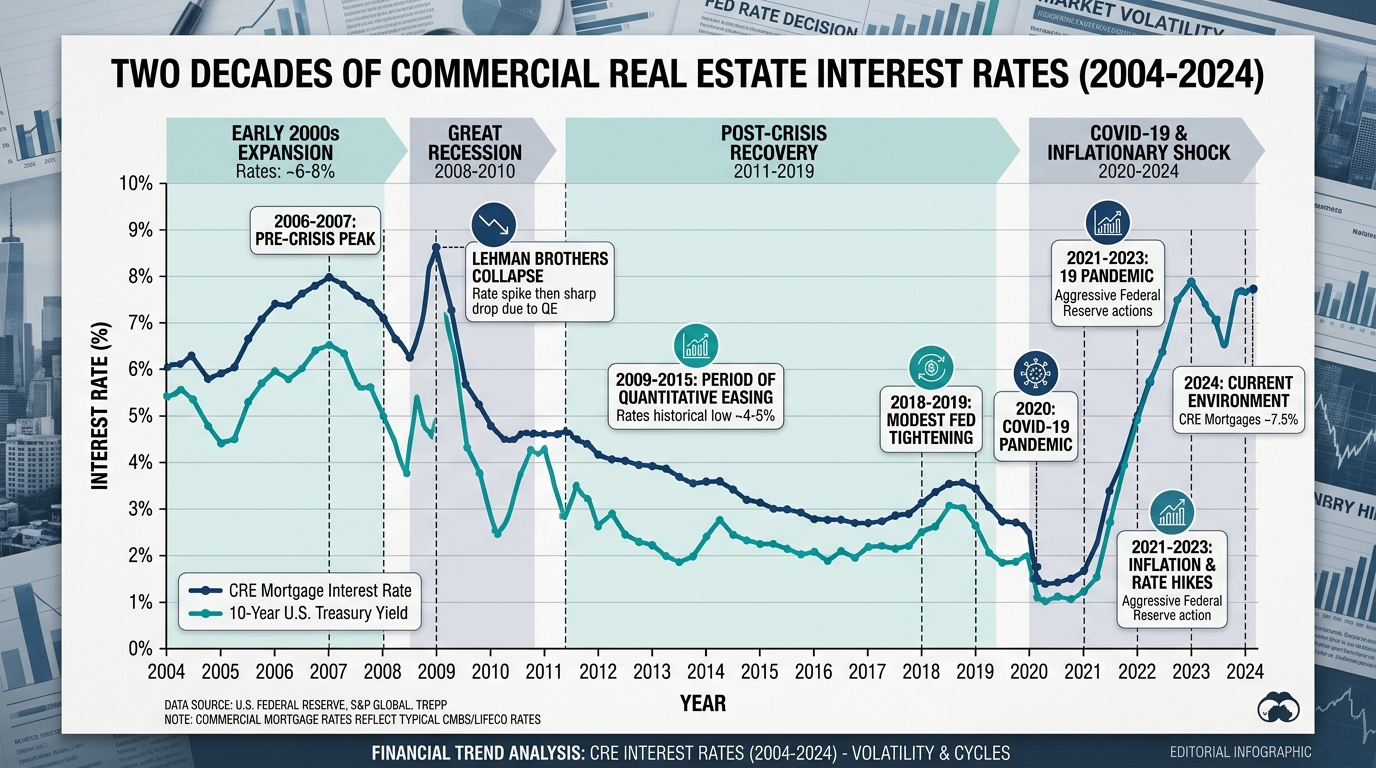
An overview of historical commercial real estate interest rates, providing context for today’s market forecasts and strategic decisions.
Key Historical Milestones vs. 2026 Projections
- Pre-2008 Financial Crisis (2005–2007): Commercial mortgage interest rates averaged between 6.50% and 7.75%, supported by aggressive bank lending and expanding CMBS issuance.
- Post-Crisis Era & Historic Lows (2010–2021): Federal Reserve quantitative easing drove commercial real estate interest rates down to historic lows between 3.25% and 4.50%, fueling unprecedented commercial cap rate compression.
- Monetary Tightening Cycle (2022–2024): Rapid Federal Reserve rate hikes to combat inflation pushed benchmark interest rates above 8.00%–9.50%, causing property valuation recalibrations.
- Normalized Market Equilibrium (2025–2026): Current commercial interest rates have stabilized in the 6.00% to 7.50% range. Forecasters expect moderate rate stabilization through late 2026 as benchmark treasury yields settle into sustainable long-term channels.
How Do Rising Treasury Yields Impact Commercial Refinancing Rates?
Direct Answer:
Fixed commercial mortgage rates are directly priced off U.S. Treasury yields of matching maturities (typically 5-year or 10-year Treasuries). When Treasury yields rise due to economic expansion, federal borrowing, or inflation, lenders increase commercial borrowing rates by adding their risk spread to the updated yield benchmark.
Commercial lenders utilize the 5-Year and 10-Year U.S. Treasury yields as risk-free risk benchmarks. The pricing formula for fixed-rate commercial mortgages is:
$$\text{Commercial Fixed Rate} = \text{U.S. Treasury Yield} + \text{Credit Spread (Margin)}$$
For example, if the 10-Year U.S. Treasury yield trades at 4.25% and a lender requires a spread of 225 basis points (2.25%) for a retail center, the finalized interest rate offered to the borrower will be 6.50%.
Understanding spread mechanics is crucial when evaluating government-backed programs or owner-occupied properties. Business owners exploring government-assisted options should evaluate current SBA commercial loan rates for long-term fixed terms.
What is the Difference Between Commercial Mortgage Interest Rates and APR?
Direct Answer:
The commercial mortgage interest rate is the percentage fee charged by the lender on the principal balance annually. The Annual Percentage Rate (APR) reflects the true, total annual cost of borrowing because it includes the interest rate plus upfront origination fees, appraisal costs, legal fees, and closing administrative costs amortized over the loan term.
When comparing loan estimates from multiple lenders, evaluating only the base interest rate can lead to inaccurate conclusions. A lender advertising a 6.50% interest rate with a 2.00% origination fee may result in a higher annual borrowing cost than a lender offering 6.75% interest with zero origination fees. Always request a full APR disclosure statement during underwriting.
Frequently Asked Questions (FAQ)
What are current commercial refinance rates today?
Current commercial refinance rates today range from 6.15% to 8.25% across conventional bank, agency, and conduit lenders, depending on asset class, LTV, and property DSCR.
Will commercial interest rates drop further in 2026?
Financial analysts project moderate interest rate stabilization in late 2026, with benchmark rates remaining anchored near current mid-6% levels rather than returning to ultra-low pandemic levels.
How often do commercial refinance rates change?
Fixed commercial mortgage pricing updates daily with movements in U.S. Treasury yields. Variable-rate commercial loans adjust monthly or quarterly based on index benchmarks such as 30-day SOFR.