
Fixed-Rate vs. Variable-Rate Multifamily Financing
Choosing between fixed-rate and variable-rate debt is one of the most critical structural decisions an apartment investor makes. The choice dictates monthly debt service predictability, overall capital risk, flexibility during disposition, and potential exposure to shifting macroeconomic rate environments.
When analyzing options, borrowers must align their loan structure with their hold period, risk tolerance, and business plan. Investors starting their capital comparison can review broad market benchmarks for average multifamily interest rates before finalizing debt terms.
Should I choose a fixed or variable interest rate for a multifamily property?
Deciding whether to select a fixed or floating interest rate depends primarily on your investment strategy, project timeline, and market expectations:
- Select a Fixed-Rate Loan If: Your objective is long-term capital preservation, stable cash flow distribution, and extended hold periods (5 to 10+ years). Fixed debt eliminates interest rate volatility risk and stabilizes cash flow forecasting for syndicators and passive investors.
- Select a Variable-Rate Loan If: You are executing a short-term value-add renovation program, planning an asset sale within 1 to 3 years, or anticipate benchmark interest rate declines. Floating-rate debt offers maximum flexibility without heavy long-term prepayment penalties.
Fixed Rate vs. Floating Rate Multifamily Financing: Pros and Cons
Both loan structures offer unique operational advantages and structural trade-offs.
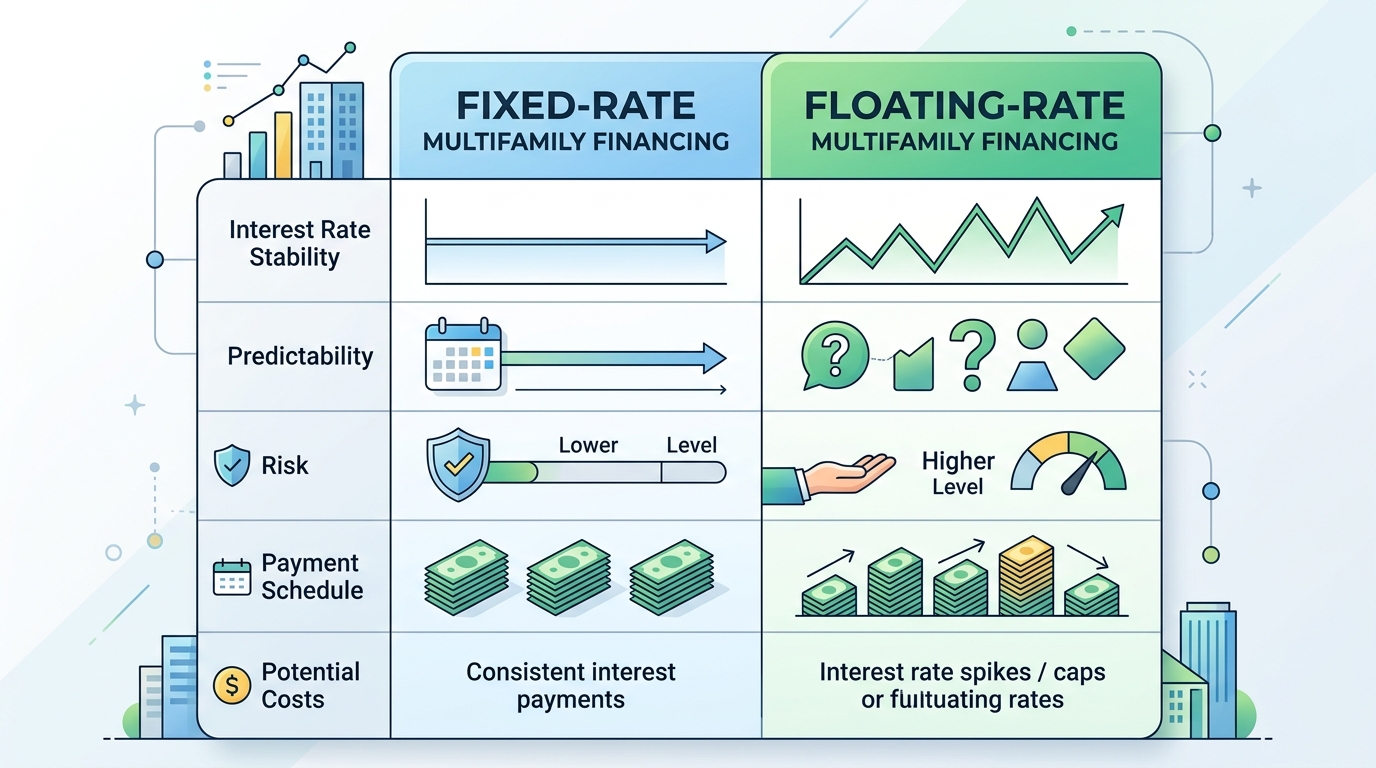
A side-by-side comparison of fixed-rate and floating-rate multifamily financing, highlighting their respective pros and cons for investors.
Fixed-Rate Multifamily Financing
Advantages:
- Debt Service Certainty: Monthly principal and interest payments remain identical throughout the fixed term, insulating net cash flow from interest rate increases.
- Lower Base Pricing Spreads: Permanent fixed-rate agency programs (such as Fannie Mae and Freddie Mac fixed terms) frequently offer lower starting coupon rates than unhedged floating-rate debt.
- Longer Amortization Schedules: Fixed-rate permanent loans typically offer standard 30-year amortization, reducing required annual principal payments.
Disadvantages:
- Prepayment Penalties: Fixed-rate commercial loans carry strict prepayment structures (Yield Maintenance or Defeasance) that make early payoff or refinancing expensive.
- Strict Underwriting Caps: Fixed loans evaluate historical stabilized earnings (T-12 NOI), restricting borrowing capacity on underperforming properties.
Variable-Rate (Floating) Multifamily Financing
Advantages:
- Prepayment Flexibility: Floating-rate loans feature minimal prepayment penalties (such as 1% or step-down structures), enabling investors to refinance or sell assets without substantial payoff penalties.
- Interest-Only Options: Floating-rate bridge debt often includes full-term interest-only payments during the initial loan term.
- Opportunity to Benefit from Rate Cuts: If benchmark interest rates decrease during the loan term, borrowing costs decline automatically.
Disadvantages:
- Interest Rate Volatility Risk: Uncapped floating rates expose borrowers to cash-flow squeezes if benchmark yields spike unexpectedly.
- Mandatory Interest Rate Caps: Lenders require borrowers to purchase third-party interest rate cap hedges, adding significant upfront capital expenditure.
How SOFR Volatility Affects Variable-Rate Multifamily Mortgages
Most floating-rate commercial real estate loans in 2026 are benchmarked against the Secured Overnight Financing Rate (SOFR). (Secured Overnight Financing Rate (SOFR))
What is SOFR and how does it affect floating rate apartment loans?
SOFR is a broad measure of the cost of borrowing cash overnight collateralized by U.S. Treasury securities. It replaced LIBOR as the standard benchmark rate for floating-rate debt in commercial real estate.
In a variable-rate loan, the total interest rate equals:
$$\text{Total Interest Rate} = \text{30-Day Term SOFR} + \text{Lender Credit Spread}$$
When central bank monetary policy shifts, SOFR moves in tandem. A 100-basis-point increase in SOFR raises monthly debt service costs proportionally. For example, on a $10,000,000 floating-rate loan, a 1% spike in SOFR increases annual debt service by $100,000 unless capped by an interest rate hedge.

This chart illustrates how fluctuations in the Secured Overnight Financing Rate (SOFR) can directly influence the interest costs of variable-rate multifamily mortgages.
Investors acquiring value-add properties that require floating-rate flexibility should evaluate tailored short-term variable bridge loans to balance short-term capital needs against interest rate caps.
Understanding Prepayment Penalties and Risks
Prepayment penalties represent one of the most significant differences between fixed and floating multifamily loans.
What are prepayment penalties on fixed-rate commercial mortgages?
Prepayment penalties are contractual fees assessed by commercial lenders if a borrower pays off a loan prior to its scheduled maturity date. In commercial real estate, fixed-rate loans use specific mechanisms to preserve investor yield:
- Yield Maintenance: Calculates the loss experienced by the lender when reinvesting prepaid principal into U.S. Treasuries at current market rates.
- Defeasance: Replaces the real estate collateral with a portfolio of U.S. Treasury securities generating identical cash flows.
- Step-Down Prepayment (e.g., 5-4-3-2-1%): Assesses a fixed percentage fee based on the outstanding loan balance, declining by 1% each year.
What is yield maintenance vs. defeasance in commercial real estate?
| Feature | Yield Maintenance | Defeasance |
|---|---|---|
| Mechanism | Penalty fee paid directly to lender | Purchase of U.S. Treasury portfolio substitution |
| Common Lenders | Fannie Mae, Banks, Portfolio Lenders | Freddie Mac, CMBS (Conduit) Lenders (CMBS (Conduit) Lenders) |
| Execution Complexity | Straightforward financial calculation | Requires defeasance consultant, legal counsel, custodian |
| Prepayment Cost | Highly sensitive to prevailing U.S. Treasury yields | Highly sensitive to Treasury pricing and transaction fees |
Frequently Asked Questions (FAQ)
Can I convert a variable-rate multifamily loan into a fixed-rate loan?
Yes. Many floating-rate lenders offer internal conversion options or refinancing pathways that allow borrowers to convert floating debt into fixed-rate debt once property stabilization goals are met.
What is an interest rate cap, and why do floating-rate lenders require it?
An interest rate cap is a financial insurance contract purchased by the borrower that caps the maximum level to which SOFR can rise during the loan term. Lenders require interest rate caps to protect the property’s DSCR against rising interest rate environments.
Disclaimer: Interest rate dynamics, loan structures, and hedging costs change continuously. Borrowers should consult with qualified financial advisors and commercial debt brokers prior to committing to loan structures.