
Alternative Financing: Commercial Bridge & Hard Money Loans
In commercial real estate, timing is frequently the deciding factor between securing a high-yield acquisition and losing a profitable opportunity to a competing cash buyer. When traditional bank underwriting timelines of 60 to 90 days threaten to derail a time-sensitive acquisition—or when an un-stabilized asset fails to meet standard debt coverage thresholds—alternative financing vehicles step into fill the void.
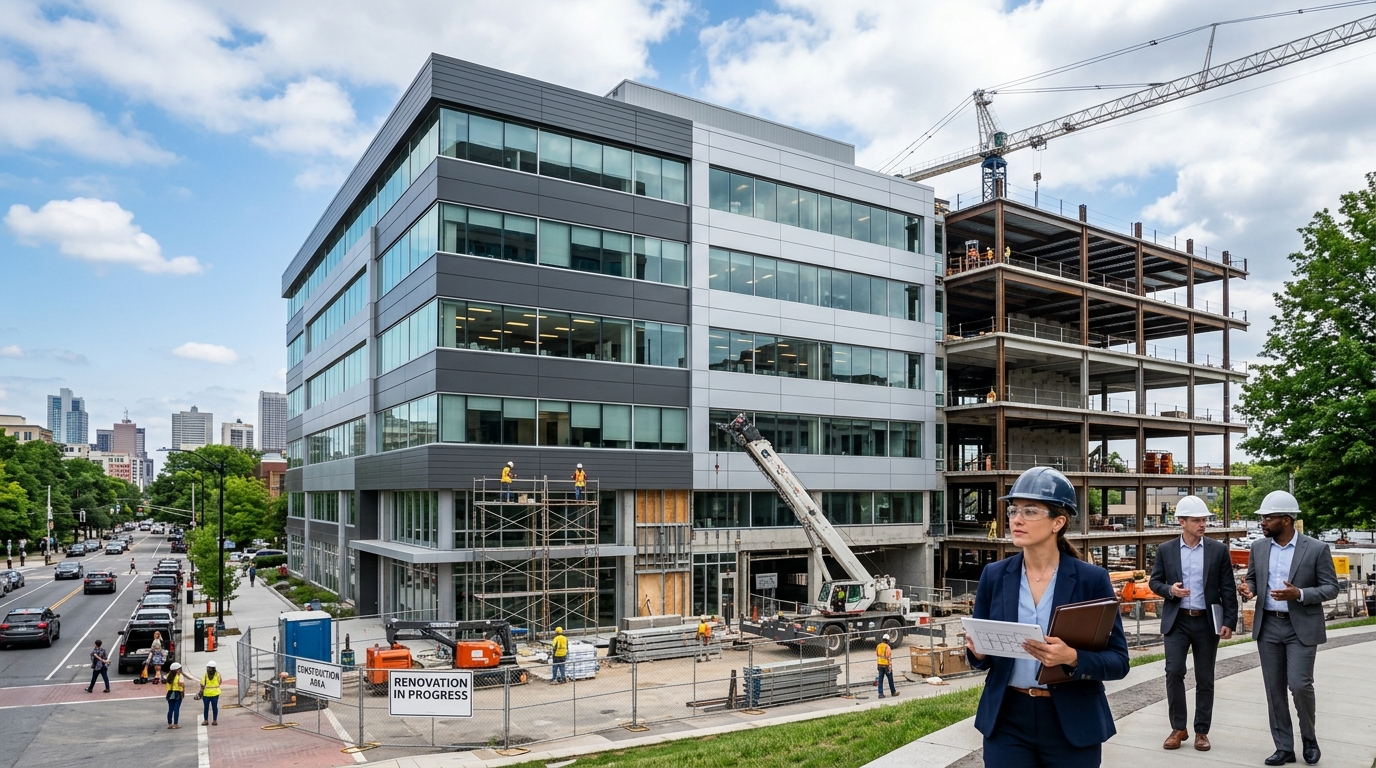
Commercial property hard money loans provide agile, short-term liquidity for value-add real estate investors, rehabbers, and developers.
Both commercial property hard money loans and commercial bridge loans provide agile, short-term liquidity designed specifically for value-add real estate investors, rehabbers, and developers. Before choosing an alternative debt provider, review broad commercial real estate financing options to evaluate how short-term capital compares with permanent debt instruments.
Traditional vs. Alternative Commercial Financing
Understanding the functional distinctions between traditional bank mortgages and alternative short-term capital helps investors choose the right financing strategy for specific transaction requirements.
Traditional commercial lenders evaluate transactions with a primary focus on historical Debt Service Coverage Ratios (DSCR), borrower tax returns, and stabilized property operations. Alternative lenders, by contrast, focus on asset equity, collateral valuation, execution speed, and the sponsor’s Post-Renovation Pro-Forma business plan.
What is the difference between hard money loans and traditional commercial loans?
The table below contrasts key underwriting and operational characteristics between traditional commercial loans, commercial bridge debt, and private hard money loans:
| Feature / Metric | Traditional Commercial Loans | Commercial Bridge Loans | Commercial Hard Money Loans |
|---|---|---|---|
| Primary Underwriting Driver | Historical Cash Flow & Personal Credit | Pro-Forma NOI & Stabilization Plan | Real Estate Collateral Equity Value |
| Average Time to Close | 45 to 90 Days | 14 to 30 Days | 7 to 14 Days |
| Typical Loan Term | 5 to 10 Years (25-Yr Amort) | 12 to 36 Months | 6 to 24 Months |
| Interest Rate Range | Competitive / Low Fixed Rates | Moderate Floating Rates (SOFR + Spread) | Higher Rates (9.00% – 13.00%+) |
| Origination Fees / Points | 0.50% to 1.00% | 1.00% to 2.00% | 2.00% to 4.00% |
| Prepayment Penalties | Yield Maintenance / Defeasance | Minimal / Short Lockout (3–6 Mos) | Often No Prepayment Penalty |
| Property Occupancy Needed | High Occupancy (85%+ Leased) | Low / Vacant / Transitioning | Any (Distressed, Vacant, Un-stabilized) |
Process Explainer: How do bridge loans work?

Commercial bridge loans provide flexible capital through a structured, multi-phase funding process for real estate investors.
For real estate investors acquiring properties that require capital improvements or aggressive lease-up strategies, commercial bridge loans for investors provide flexible capital through a structured, multi-phase funding process:
-
Application & As-Is vs. As-Stabilized Valuation:
The sponsor submits property financial records, current rent rolls, a scope of work budget, and detailed pro-forma financial projections. The lender orders an appraisal that provides two values: the As-Is Value today and the projected As-Stabilized Value post-renovation. -
Loan Sizing & Holdback Construction Reserves:
The bridge lender sizes the loan up to 75%–80% of total project costs (Loan-to-Cost or LTC), funding the acquisition purchase price at closing and placing the construction renovation budget into an escrow account (“holdback reserve”). -
Closing and Immediate Project Execution:
Funding closes within 14 to 30 days. The borrower takes ownership of the commercial asset and begins executing tenant buyouts, structural updates, or exterior renovations. -
Draw Requests & Construction Funding:
As renovation milestones are completed, the borrower submits draw requests. The lender conducts brief site inspections and releases holdback reserve funds to reimburse completed work. -
Stabilization & Exit Execution:
Once renovations are complete and new commercial leases elevate property occupancy to market levels, the stabilized asset satisfies traditional banking DSCR criteria. The investor then executes their pre-planned exit strategy—either refinancing into permanent long-term debt or selling the property for a profit.
Commercial Hard Money Eligibility
While bridge loans cater to middle-market value-add projects, commercial property hard money loans serve as emergency capital or opportunistic debt for distressed assets, distressed note purchases, or bankruptcy acquisitions.
Asset Value vs. Borrower Credit
Hard money lenders operate primarily as asset-based risk takers. Unlike commercial banks that reject applications due to past credit issues or seasonal cash flow dips, hard money underwriters focus on two core metrics:
- Loan-to-Value (LTV) Safety Margin: Hard money lenders rarely lend above 65% to 70% of the current As-Is Appraised Value. Requiring 30% to 35% equity skin-in-the-game from the borrower ensures the lender’s capital remains protected even if market conditions deteriorate.
- Property Collateral Liquidity: The property must be located in a viable commercial market with demonstrated transaction volume, ensuring the lender can easily liquidate the physical real estate if the borrower defaults.
While personal tax returns and debt-to-income metrics carry minimal weight, sponsors with proven execution experience receive better loan pricing and higher equity leverage.
Rates, Fees, and Exit Strategies for Short-Term Debt
Alternative commercial capital commands higher risk premiums than traditional bank financing. Calculating total cost of capital is essential when building investment pro-formas.
What are commercial bridge loan interest rates and fees?
Pricing on short-term debt reflects market interest rate indices plus lender risk margins:
- Commercial Bridge Loan Rates: Typically structured as variable pricing tied to the Secured Overnight Financing Rate (SOFR) plus 3.50% to 6.50%, resulting in overall interest rates of 7.50% to 10.50%. Origination fees range from 1.00% to 2.00% of the total loan commitment.
- Commercial Hard Money Loan Rates: Rates are generally fixed or floating between 9.00% and 13.00%+, accompanied by origination fees (“points”) ranging from 2.00% to 4.00%.
- Additional Transaction Fees: Borrowers must account for underwriting fees, legal document preparation costs, construction draw inspection fees, and appraisal charges.
Because alternative debt carries higher interest expenses, borrowers must maintain a crystal-clear exit strategy before drawing funds. Check current commercial property loan rates for short-term debt to evaluate floating interest rate risks.
Strategy Section
How can investors finance value-add commercial real estate projects?
Executing a successful value-add commercial turnaround requires aligning your capital stack with construction timelines and leasing benchmarks.
+-------------------------------------------------------------------------+
|                  VALUE-ADD CAPITAL TIMELINE & EXIT STRATEGY             |
|                                                                         |
|   Month 01: Acquire Property via Bridge / Hard Money Debt              |
|   Month 02 - 08: Execute Renovation & Tenant Buildouts                  |
|   Month 09 - 14: Lease Up Vacant Units to Market Rents                  |
|   Month 15: Achieve 90%+ Occupancy & Stabilized Net Operating Income    |
|   Month 16+: Refinance into Permanent Debt OR Sell Asset                |
+-------------------------------------------------------------------------+
Real-World Case Study: Retail Center Repositioning
- The Opportunity: A 25,000 sq. ft. suburban retail center with 50% vacancy is listed for $2,000,000. Traditional banks decline financing due to insufficient current cash flow (DSCR < 0.70x).
- Alternative Capital Solution: The investor secures a $1,800,000 commercial bridge loan (75% LTC), providing $1,500,000 toward the purchase price and $300,000 held in reserve for tenant improvements and roof repairs.
- Execution & Value Creation: Over 12 months, the investor completes exterior renovations and leases vacant suites to creditworthy retail tenants, boosting Net Operating Income from $90,000 to $280,000.
- The Exit: With the property stabilized at a 1.35x DSCR, the investor refinances the bridge debt into a permanent 10-year conventional commercial mortgage at an appraised value of $3,500,000, returning all original investor equity while locking in cash flow.
Investors looking to execute similar acquisition strategies can review tailored capital solutions designed specifically for loans for commercial real estate investors.
Frequently Asked Questions
Can I get a commercial hard money loan with poor credit?
Yes. Hard money lenders prioritize physical asset value and equity cushion (LTV) over personal credit scores. A sponsor with bad credit can obtain funding if the property collateral offers sufficient equity margin (60%–65% LTV) and a viable exit plan.
Are bridge loans interest-only?
Yes. Most commercial bridge loans feature monthly interest-only payments, allowing investors to minimize monthly cash outflows while executing property renovations and tenant lease-up activities.
What happens if I cannot refinance my bridge loan before maturity?
Most bridge lenders offer pre-negotiated 6-to-12-month extension options, provided the property achieves minimum performance hurdles and the borrower pays an extension fee (typically 0.25% to 0.50% of the principal balance).
What is the minimum loan size for a commercial bridge loan?
While private hard money lenders fund transactions as small as $250,000, institutional commercial bridge funds generally enforce minimum loan thresholds of $1,000,000 to $2,000,000.