
Complete Checklist for Commercial Property Loan Requirements
Navigating commercial real estate underwriting can present significant hurdles for investors and business owners who are accustomed to residential mortgages. While residential approval hinges almost entirely on personal gross income and debt-to-income (DTI) ratios, qualifying for commercial debt requires demonstrating that the property’s cash flow, borrower balance sheet liquidity, and overall asset management strategy meet strict lender benchmarks.

A comprehensive checklist helps streamline the commercial property loan application process.
Understanding essential commercial property loan requirements before submitting loan documents prevents costly delays and accelerates underwriting approvals. For a comprehensive overview of commercial capital options, start with our broad commercial property loans guide, and use this checklist to streamline your preparation.
Essential Commercial Loan Requirements Checklist
To secure debt approval across banks, credit unions, and non-bank financial institutions, borrowers must satisfy criteria spanning property cash flow performance, financial leverage thresholds, personal liquidity, and property condition metrics.
What are the requirements for a commercial property loan?
The essential qualifications and documentation needed to satisfy a standard commercial underwriting checklist include:
- Minimum Debt Service Coverage Ratio (DSCR): Property Net Operating Income (NOI) must equal at least 1.20x to 1.25x the annual debt service payments.
- Maximum Loan-to-Value Ratio (LTV): Lenders require down payments between 20% and 35%, capping maximum conventional leverage at 65% to 80% LTV.
- Minimum Credit Score: Guarantors generally need a minimum personal credit score of 660 to 680 (700+ for optimal interest rate pricing).
- Borrower Liquidity & Net Worth: Combined sponsor net worth must equal or exceed the total loan amount, with post-closing liquid reserves equal to 6 to 12 months of principal and interest payments.
- Property Occupancy Thresholds: Permanent financing requires property occupancy rates of 85% or higher with signed tenant lease agreements.
- Property Documentation: Trailing 12-month (T12) operating statements, rent rolls, lease agreements, and tax returns for the past 3 years.
- Third-Party Reports: Satisfactory Commercial Appraisal, Phase I Environmental Site Assessment (ESA), and Property Condition Assessment (PCA).
Debt Service Coverage Ratio (DSCR)
The Debt Service Coverage Ratio (DSCR) serves as the foundational metric used by commercial underwriters to measure default risk. It calculates the safety buffer between property operating cash flow and annual debt service obligations.
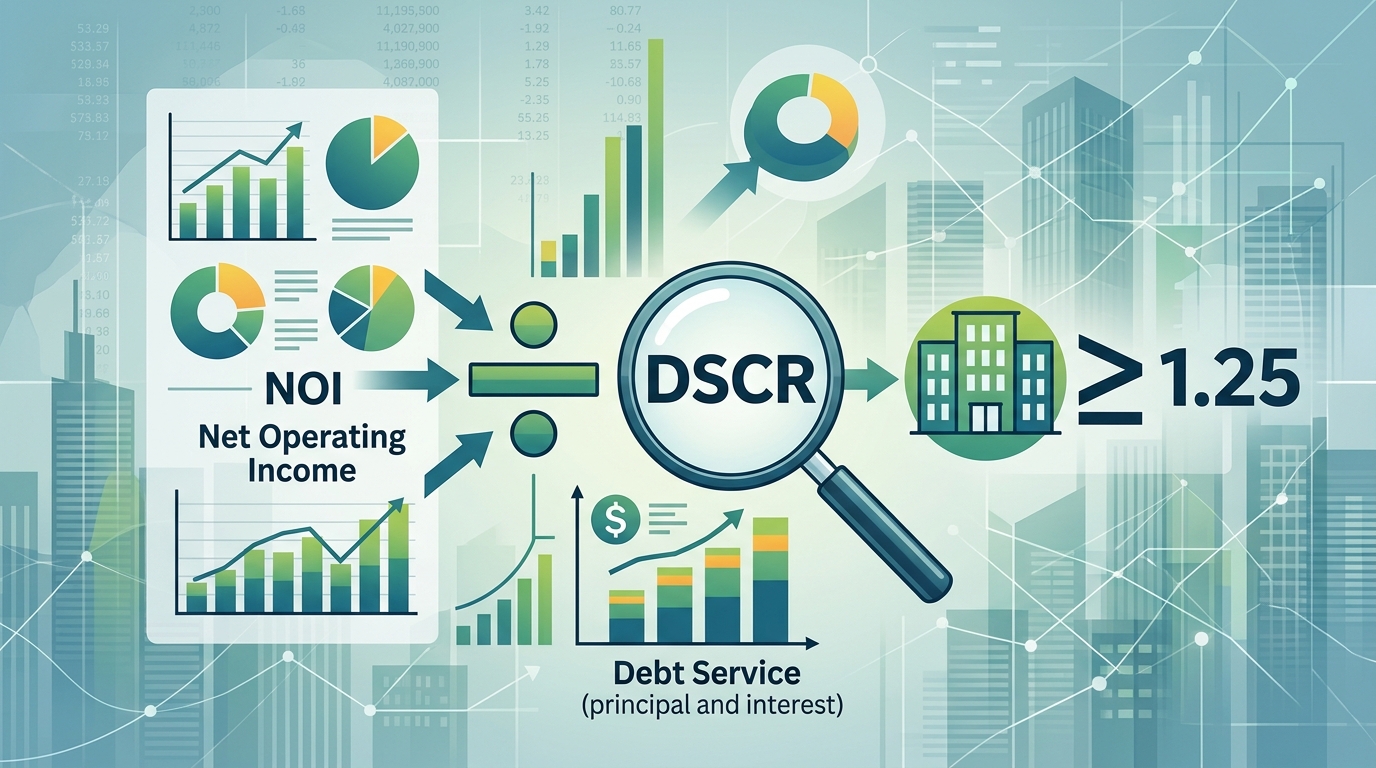
The DSCR formula is a critical metric for lenders assessing commercial real estate loan eligibility.
How does Debt Service Coverage Ratio (DSCR) impact commercial loan approval?
Lenders use DSCR to determine the maximum loan amount a commercial property can support. If property cash flow declines or interest rates rise, the DSCR drops, prompting underwriters to reduce maximum loan proceeds to preserve safety margins.
+-------------------------------------------------------------------------+
|                  DEBT SERVICE COVERAGE RATIO (DSCR) FORMULA            |
|                                                                         |
|            Net Operating Income (NOI)                                   |
|   DSCR = ---------------------------------                             |
|          Annual Principal & Interest Debt Service                       |
|                                                                         |
|   Example:                                                              |
|   - Net Operating Income (NOI): $150,000 / year                         |
|   - Annual Debt Payments:       $120,000 / year                         |
|                                                                         |
|   DSCR = $150,000 / $120,000 = 1.25x (Satisfies Standard Threshold)     |
+-------------------------------------------------------------------------+
- DSCR Below 1.00x: The property operates at a negative cash flow loss and cannot cover its debt payments without outside borrower subsidies. Lenders will decline conventional applications under this scenario.
- DSCR Between 1.00x and 1.20x: Tight cash flow coverage. Typically restricted to government-backed programs (SBA) or short-term bridge debt with cash reserves.
- DSCR of 1.25x or Higher: Standard baseline for conventional banks, CMBS conduits, and agency lenders.
For investors building multi-tenant portfolios, evaluating DSCR benchmarks across different property types is essential when reviewing investor loans for commercial property.
Loan-to-Value (LTV) Ratios and Down Payments
Loan-to-Value (LTV) defines the ratio of total loan proceeds relative to the property’s appraised market value or purchase price (whichever is lower).
What Loan-to-Value (LTV) ratio is required for commercial mortgages?
Maximum allowable LTV thresholds vary depending on lender type, asset class, and occupancy structure:
| Loan Program Category | Maximum Allowable LTV | Minimum Down Payment | Primary Qualifying Conditions |
|---|---|---|---|
| SBA 504 / 7(a) Loan Programs | Up to 90% LTV | 10% Down | Owner-occupied business (≥51% occupancy) |
| Conventional Bank Debt | 70% to 75% LTV | 25% to 30% Down | Stabilized commercial assets with strong DSCR |
| CMBS (Conduit) Loans | 70% to 75% LTV | 25% to 30% Down | Non-recourse debt for transactions > $2M |
| Life Insurance Companies | 55% to 65% LTV | 35% to 45% Down | Institutional Class A assets & credit tenants |
| Commercial Bridge / Hard Money | 65% to 75% LTV | 25% to 35% Down | Based on As-Is or As-Stabilized Value |
To understand how interest rate movements directly impact LTV sizing and debt service requirements, review how rates affect commercial property loan requirements.
Borrower Qualifications: Credit, Net Worth, Liquidity
Although the commercial property serves as primary collateral, underwriters evaluate the financial strength of individual guarantors holding a 20% or greater equity stake in the borrowing entity.
What credit score do you need for a commercial property loan?
While private bridge lenders focus primarily on property equity, traditional institutional lenders enforce strict personal credit and balance sheet standards:
- Credit Score Standards:
- 680+ Credit Score: Required for conventional bank mortgages, credit unions, and SBA loan approvals.
- 720+ Credit Score: Qualifies sponsors for optimal fixed-rate pricing and fee discounts.
- Sub-650 Credit Score: Directs borrowers toward hard money debt or non-conforming private capital until credit issues are resolved.
- Net Worth Benchmark: Most commercial lenders enforce a 1:1 Net Worth Rule, requiring the total net worth of key sponsors to equal or exceed the requested loan amount.
- Post-Closing Liquidity: Guarantors must demonstrate liquid assets (cash, money market accounts, publicly traded stocks) equal to 6 to 12 months of principal, interest, taxes, and insurance (PITI) debt service after making down payment contributions.
Required Documentation
Preparing a thorough documentation package upfront prevents underwriting delays and speeds up closing timelines.
Commercial Underwriting Document Checklist
-
Borrower & Entity Financial Records:
* Personal Financial Statements (PFS) for all guarantors with ≥ 20% equity.
* Signed personal tax returns for the past 3 consecutive years.
* Entity formation documents (Articles of Organization, Operating Agreement, EIN certificate).
* Schedule of Real Estate Owned (REO) listing current property values, existing debt balances, and annual cash flows. -
Property Financial Records:
* Trailing 12-Month (T12) Property Income and Expense Statements.
* Past 3 years of audited year-end profit-and-loss (P&L) statements.
* Certified Rent Roll including tenant names, unit square footages, rent amounts, lease expiration dates, and security deposits.
* Copies of all current tenant lease agreements and amendments. -
Property Due Diligence Reports:
* Full Commercial Appraisal conducted by an approved MAI-designated appraiser.
* Phase I Environmental Site Assessment (ESA) confirming no hazardous liabilities exist.
* Property Condition Assessment (PCA) identifying structural or deferred maintenance repairs.
* Title commitment policy and certified property boundary survey.
Frequently Asked Questions
How long does it take to close on a commercial property loan?
Closing a conventional bank mortgage or SBA commercial loan typically takes 45 to 90 days from application submission. The timeline is largely determined by third-party appraisal ordering, environmental site assessments (Phase I ESA), and legal document review. Private bridge loans can close in 14 to 30 days.
Can I get a commercial property loan with no tax returns?
Yes. Alternative debt options, such as asset-based hard money loans or DSCR-focused investor loans, allow real estate investors to qualify based solely on property cash flow and appraisal value without submitting personal tax returns.
What is a Phase I Environmental Site Assessment?
A Phase I ESA is an environmental due diligence report prepared by an environmental professional. It investigates historical land uses to ensure the property is free from hazardous contamination or chemical liabilities that could compromise collateral value.
What are bad-boy carve-outs in commercial mortgages?
Bad-boy carve-outs are specific legal conditions within non-recourse commercial loan agreements. If a borrower commits intentional wrongful acts—such as fraud, misappropriation of rental income, unapproved debt, or environmental contamination—the non-recourse protection is voided, making guarantors personally liable for the full loan balance.