Commercial Loan Approval Checklist & Closing Process Guide
Securing commercial mortgage financing requires systematic preparation and precise execution. Missing documentation or delayed legal verifications can stall loan processing, jeopardizing purchase contracts and earnest money deposits.
This comprehensive checklist and guide outlines complete cre loan approval requirements, details key components of a commercial loan commitment letter, and walks through each step of the commercial real estate loan closing process.
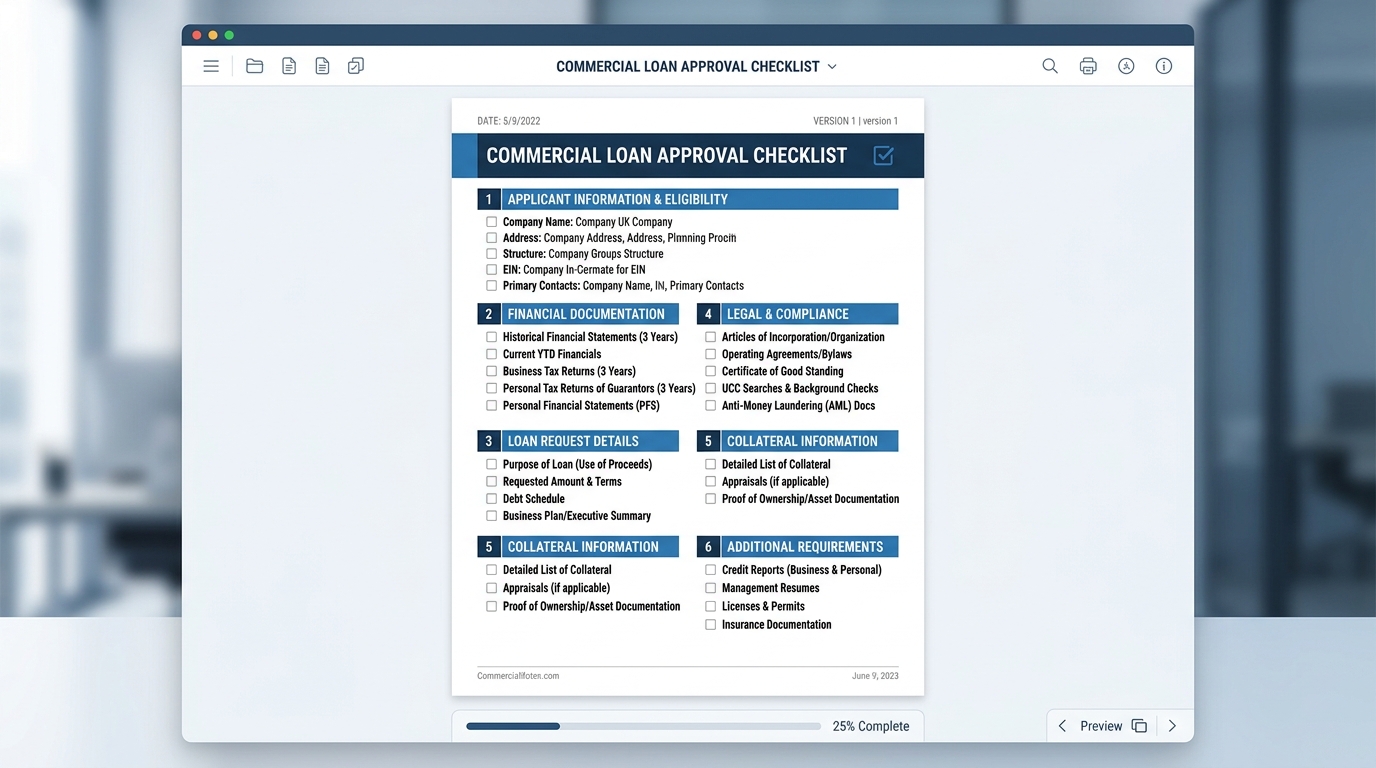
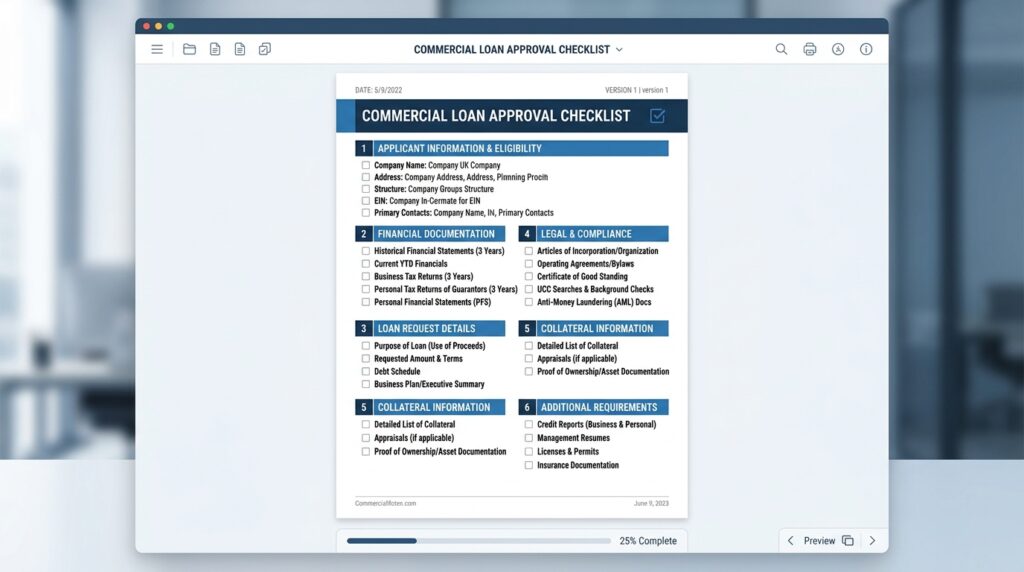
Streamline your application process with a detailed commercial loan approval checklist.
Complete CRE Loan Approval Requirements
Lenders require thorough documentation to verify borrower creditworthiness, business legal structure, and property cash flow. Organising these documents prior to submitting an application accelerates processing and improves underwriting outcomes.
Personal and Entity Documentation
Lenders evaluate loan sponsors and legal operating entities to confirm borrowing authority, background, and financial strength:
- Sponsor Financial Statements: Personal Financial Statements (PFS) signed and dated for all equity partners holding 20% or more ownership.
- Tax Returns: Three consecutive years of personal and corporate federal tax returns, including all schedules, K-1s, and W-2s.
- Government ID & Credit Authorizations: Clear copies of government-issued identification and signed background/credit check authorization forms.
- Entity Formation Documents: Articles of Organization or Incorporation, Certificate of Good Standing from the state of incorporation, Operating Agreements, and Corporate Resolutions detailing borrowing authority.
- Track Record / Real Estate Resume: A summary detailing past real estate acquisition, development, and asset management experience.
Property and Financial Documentation
Property-level documentation allows underwriters to stress-test historical cash flows and future earnings potential:
- Certified Rent Roll: A current rent roll listing tenant names, suite numbers, square footage, lease start/expiration dates, rental rates, renewal options, and security deposits.
- Historical Financial Statements: Year-to-date Profit & Loss (P&L) statements plus complete operating statements for the past three fiscal years.
- Existing Lease Agreements: Copies of all active commercial leases, amendments, addendums, and sublease agreements.
- Utility Statements & Tax Bills: Copies of real estate tax bills, municipal assessments, and utility invoices for the preceding 12 months.
- Capital Expenditure History: Itemized records detailing major structural improvements or building upgrades completed over the past 3–5 years.
Understanding how lenders evaluate these financial packages is easier when you understand the broader commercial lender approval process.
Downloadable Commercial Loan Approval Checklist
To streamline your application, follow this standardized master document collection checklist before submitting your file for formal processing:
- [ ] Borrower & Entity File
- Signed Personal Financial Statements (PFS) for all 20%+ sponsors
- 3 years of personal and business tax returns (with K-1s)
- LLC Operating Agreement / Corporate Bylaws & Certificate of Good Standing
- Real estate experience resume and portfolio track record
- [ ] Property Financial File
- Certified current rent roll matching lease records
- 3 years of audited or management-prepared P&L statements
- Year-to-date operating statement and balance sheet
- Service contracts (janitorial, elevator, property management)
- [ ] Property Physical & Legal File
- Copy of Purchase and Sale Agreement (for acquisitions)
- Existing property surveys, site plans, and floor plans
- Current insurance declaration pages and property coverage policies
- Historical Phase I ESA or environmental reports (if available)
What is in a Commercial Loan Commitment Letter?
A commercial loan commitment letter is a formal document issued by a lender after credit committee approval. It outlines the binding financial terms, pricing parameters, and legal obligations under which the lender agrees to fund the mortgage.
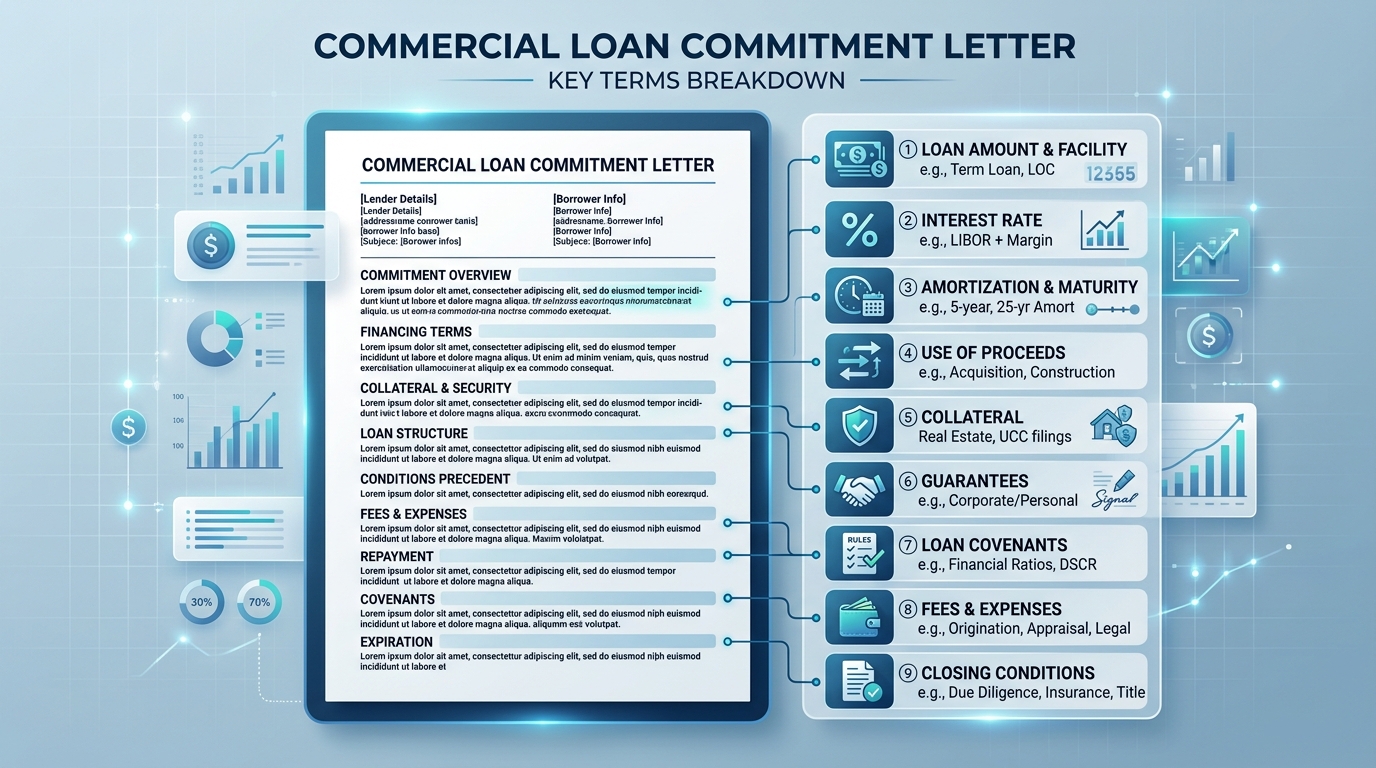
Understand the critical components and binding terms within a commercial loan commitment letter.
Key Terms Defined in a Commitment Letter
- Loan Amount & Interest Rate: Final approved principal balance, index type (e.g., SOFR, Treasury Benchmark), margin, and rate lock conditions.
- Amortization & Term: Total loan term (e.g., 5, 7, or 10 years) and amortization schedule (e.g., 25 or 30 years).
- Prepayment Penalties: Yield maintenance, defeasance, or step-down prepayment structures.
- Financial Covenants: Ongoing requirements such as maintaining a minimum 1.25x DSCR throughout the loan life.
Binding vs. Non-Binding Provisions
Borrowers must distinguish between preliminary term sheets and formal commitment letters:
- Term Sheet / LOI (Non-Binding): Outlines preliminary pricing and loan terms for discussion purposes. It does not obligate the lender to fund capital.
- Commitment Letter (Binding): Constitutes a legally enforceable agreement once fully executed and accompanied by required commitment fee deposits. It legally binds the lender to fund, subject strictly to the satisfaction of specified closing conditions.
Conditions Precedent to Closing
Commitment letters contain a comprehensive section titled Conditions Precedent to Closing. These represent mandatory milestones that must be cleared prior to wiring funds:
- Satisfactory completion and lender review of third-party appraisals, Phase I Environmental Site Assessments, and Property Condition Assessments.
- Verification that property cash flows satisfy target underwriting thresholds during the final commercial loan underwriting process.
- Delivery of clear, unencumbered title insurance policies and acceptable land surveys.
- Receipt of fully executed Tenant Estoppel Certificates from major commercial tenants.
How Does the Commercial Real Estate Loan Closing Process Work?
The commercial real estate loan closing process represents the final operational phase, transitioning an approved file from loan commitment to loan funding. This phase typically spans 15 to 30 days post-commitment.
Title Search and Insurance
Lender legal counsel coordinates with the title company to complete thorough title examinations:
- Title Search: Auditing public land records to identify existing mortgages, mechanic’s liens, tax judgments, or boundary disputes.
- Title Commitment: Issuing a title commitment detailing requirements to convey marketable title.
- Lender Title Insurance Policy: Procuring a lender’s title insurance policy protecting the mortgage holder against potential future title defects.
Final Signatures and Loan Funding
Once all conditions precedent are satisfied, closing logistics proceed to completion:
- Document Execution: Borrower sponsors sign loan documentation, including Promissory Notes, Mortgages/Deeds of Trust, Personal Guarantees, and Environmental Indemnity Agreements.
- Escrow Equity Settlement: The borrower wires required equity down payment funds, closing costs, and escrow reserves to title escrow.
- Loan Disbursement: The lender wires loan funds to title escrow, the transaction is recorded in municipal public records, and loan proceeds are disbursed.
Tracking these steps alongside the overall commercial real estate loan processing lifecycle ensures a smooth, predictable closing.
FAQ
Is a commercial loan commitment letter legally binding?
Yes. Once countersigned by the borrower and accompanied by required commitment deposits, a commercial loan commitment letter is a legally binding contract. The lender is obligated to fund the loan provided the borrower satisfies all conditions precedent outlined in the agreement.
What is in a commercial loan commitment letter?
A commercial loan commitment letter contains core transaction terms including approved loan amount, interest rate, amortization schedule, loan maturity date, prepayment penalty structure, ongoing financial covenants (e.g., minimum DSCR requirements), and closing conditions precedent (appraisal approvals, title clearance, tenant estoppels).
What are tenant estoppel certificates and why are they required?
A Tenant Estoppel Certificate is a legally binding document signed by commercial tenants confirming lease terms, monthly rent amounts, security deposits held, and verifying that the landlord is not in default under the lease. Lenders require estoppels to verify cash flow integrity prior to closing.
How long does the commercial real estate loan closing process take after commitment?
The closing process typically takes between 15 and 30 days after signing the commitment letter, depending on title clearance, insurance verification, and legal document preparation.