
Commercial Loan Interest Rate Calculator
Commercial real estate interest rates are a critical driver of net operating income (NOI) performance, overall cash flow, and asset valuation. Even a 50-basis-point (0.50%) shift in interest rates can dramatically alter debt service coverage ratios and long-term investment yields.
Our interactive commercial loan rate calculator empowers investors, business owners, and commercial mortgage brokers to model interest expenses across fixed-rate, variable-rate, and interest-only debt structures in 2026.

Input fields for the commercial loan rate calculator interface to enter loan parameters
Calculate Your Commercial Mortgage Rate Cost
Calculating commercial mortgage interest costs requires understanding how benchmark rates, credit spreads, and payment structures interact over time.
To determine your total debt service expense using our rate calculator:
1. Enter the Loan Amount: Input total principal required.
2. Select Base Interest Rate: Enter current fixed quotes or baseline floating index benchmarks.
3. Set Rate Type: Toggle between Fixed-Rate and Floating-Rate options.
4. Choose Payment Option: Select Fully Amortizing or Interest-Only (IO) payment phases.
5. Adjust Index Spread (For Variable Loans): Add lender credit spread margin over base indexes (e.g., SOFR + 2.50%).
Before finalizing interest rate sensitivity models, borrowers should estimate your overall commercial real estate loan payments to ensure overall monthly cash flow aligns with underwriting requirements.
Current Commercial Real Estate Interest Rates
Commercial loan interest rates vary significantly based on capital source, property type, loan-to-value (LTV) ratio, and property occupancy.
What interest rates are currently charged on commercial property loans?
Commercial property loan interest rates currently range from 5.75% to 8.50% across mainstream commercial lending channels in 2026. Bank commercial mortgages average 6.25% to 7.50%, Life Insurance Company loans range from 5.75% to 6.75% for high-grade assets, SBA 504 rates range from 6.00% to 7.25%, and bridge or private credit loans range from 8.50% to 12.00%+.
2026 Commercial Real Estate Benchmark Rates Summary
| Lender Channel | Typical Interest Rate Range | Loan Terms | Maximum LTV | Target Property Assets |
|---|---|---|---|---|
| Life Insurance Companies | 5.75% – 6.75% | 10 – 25 Years Fixed | 60% – 65% | Class-A Office, Industrial, Multifamily |
| Conventional Banks & Credit Unions | 6.25% – 7.50% | 5 – 10 Years (Adjustable/Fixed) | 70% – 75% | Owner-Occupied, Retail, Mixed-Use |
| SBA 504 / 7(a) Loans | 6.00% – 7.50% | 10 – 25 Years Fixed/Adjustable | 85% – 90% | Owner-Occupied Commercial Real Estate |
| CMBS (Conduit Loans) | 6.50% – 7.75% | 5 – 10 Years Non-Recourse | 70% – 75% | Anchored Shopping Centers, Industrial |
| Private Credit & Bridge Capital | 8.50% – 12.00%+ | 1 – 3 Years Floating | 65% – 75% | Value-Add Repositioning, Distress |
Interest rate pricing is directly driven by baseline financial market benchmarks. Borrowers evaluating floating-rate terms should understand SOFR and Prime Rate indexes to track potential rate reset risks over the loan lifecycle.
Interest-Only vs. Fully Amortizing Rates
Structuring a commercial loan with an initial interest-only (IO) period reduces cash outflow during initial lease-up or property stabilization phases. However, IO structures preserve the full principal balance, increasing total interest expenses over time compared to fully amortizing schedules.
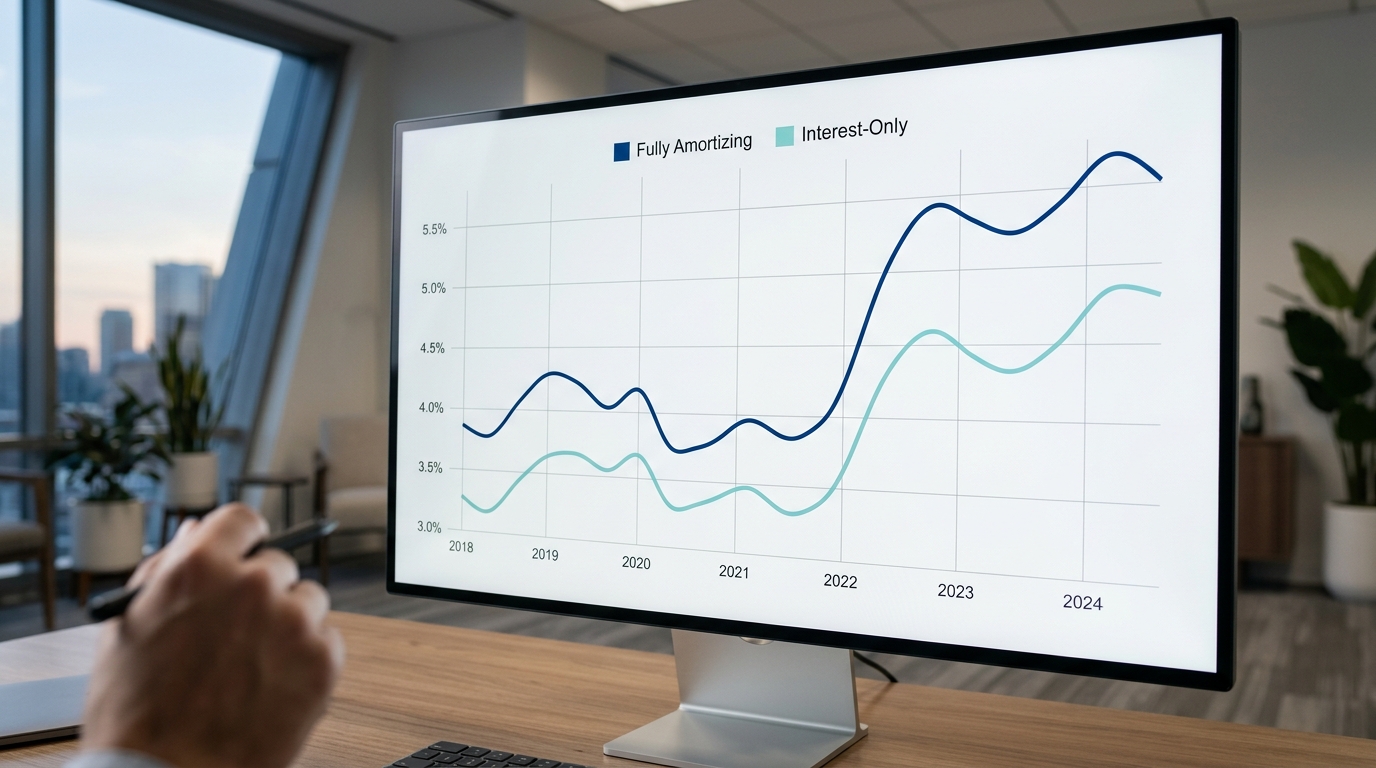
Graph comparing interest-only and fully amortizing commercial mortgage rates showing payment differences over time
How to calculate interest-only payments on a commercial mortgage?
To calculate an interest-only monthly payment on a commercial mortgage, multiply the total principal loan balance by the annual interest rate, then divide by 12 months:
$$\text{Monthly IO Payment} = \frac{\text{Principal Loan Balance} \times \text{Annual Interest Rate}}{12}$$
Step-by-Step Calculation Example:
- Loan Balance: $3,000,000
- Annual Interest Rate: 6.75% (0.0675)
- Annual Interest Expense: $\$3,000,000 \times 0.0675 = \$202,500$
- Monthly Interest-Only Payment: $\$202,500 / 12 = \$16,875 \text{ per month}$
In contrast, if this same $3,000,000 loan were fully amortizing over 25 years at 6.75%, the monthly payment would be $20,727.34. While the interest-only option conserves $3,852.34 per month during the IO period, zero principal equity is accumulated.
Investors planning property acquisitions can evaluate your commercial investment property ROI to test how interest-only debt affects cash-on-cash returns.
How does fixed vs. variable interest rate affect total commercial loan cost?
Choosing between fixed and variable commercial loan rates directly impacts total loan costs over the holding period:
1. Total Interest Expense Sensitivity
A fixed-rate loan establishes certainty. On a $2,000,000 loan over 10 years at a fixed 6.50% interest rate (25-year amortization), total interest paid equals $1,057,215. If a variable-rate loan starts at 5.75% but increases by 50 basis points annually due to inflation index shifts, average rates over 10 years could rise to 7.25%, raising total interest cost to over $1,180,000—a $122,000+ cost premium.
2. Rate Cap and Floor Protections
Variable commercial real estate loans typically incorporate Interest Rate Caps (limiting maximum upward adjustment) and Interest Rate Floors (establishing minimum interest expense for the lender). Borrowers must budget for maximum rate cap ceilings when evaluating worst-case debt service obligations.
Frequently Asked Questions (FAQ)
What is the difference between SOFR and Prime Rate in commercial loans?
SOFR (Secured Overnight Financing Rate) is an index based on actual overnight US Treasury repurchase agreements, heavily used for institutional commercial loans. Prime Rate is the base rate charged by commercial banks to corporate borrowers (typically set 3.00% above the Federal Funds Target Rate). Variable commercial loans are priced as SOFR + Margin or Prime + Margin.
How do lenders determine commercial interest rate spreads?
Lenders calculate rate spreads (margins) based on property asset class, sponsor net worth and experience, Debt Service Coverage Ratio (DSCR), Loan-to-Value (LTV), and geographic market stability. Lower risk profile deals earn narrower credit spreads.
Can commercial loan interest rates be locked prior to closing?
Yes, commercial borrowers can secure interest rate lock agreements, though fee structures vary. Life insurance lenders often offer rate locks at loan application, while banks and conduit lenders usually lock rates 3 to 10 days prior to closing or require a rate lock deposit (typically 1% to 2% of loan size).
What is a basis point (bps) in commercial real estate financing?
A basis point (bps) represents one-hundredth of a percentage point (0.01% or 0.0001). For example, 100 basis points equals 1.00%. If a commercial loan rate decreases from 6.75% to 6.25%, it has dropped by 50 basis points.