Commercial Loan Balloon Payment & Payoff Calculator
Most commercial real estate loans do not amortize completely over their contract term. Instead, commercial mortgages typically feature a 5-year, 7-year, or 10-year loan term paired with a 20-year or 25-year amortization schedule. When the loan term reaches maturity, the remaining unamortized principal balance becomes due immediately as a single lump-sum balloon payment.
Our commercial loan balloon payment and payoff calculator allows property owners, asset managers, and financial analysts in 2026 to project exact maturity payoff amounts, calculate prepayment penalties, and structure refinancing exit strategies ahead of loan expiration.
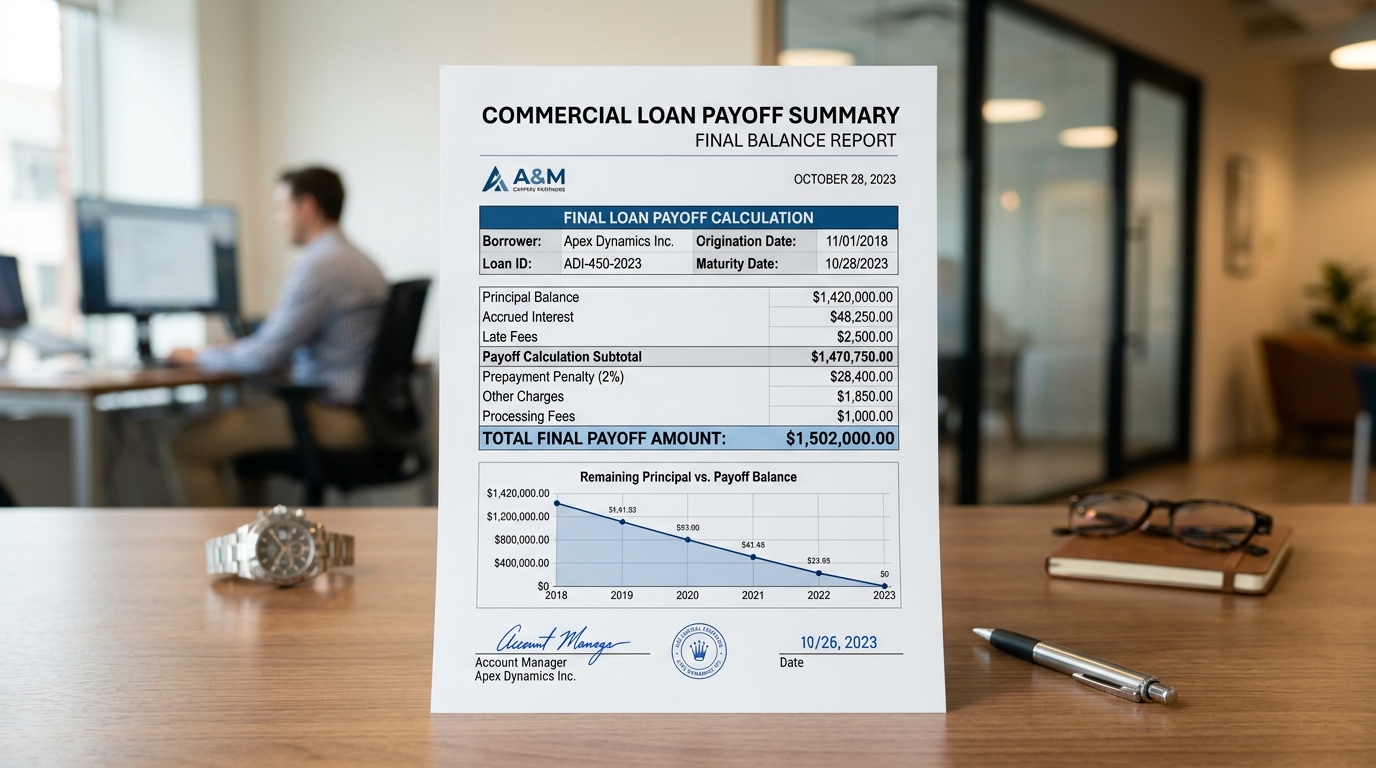
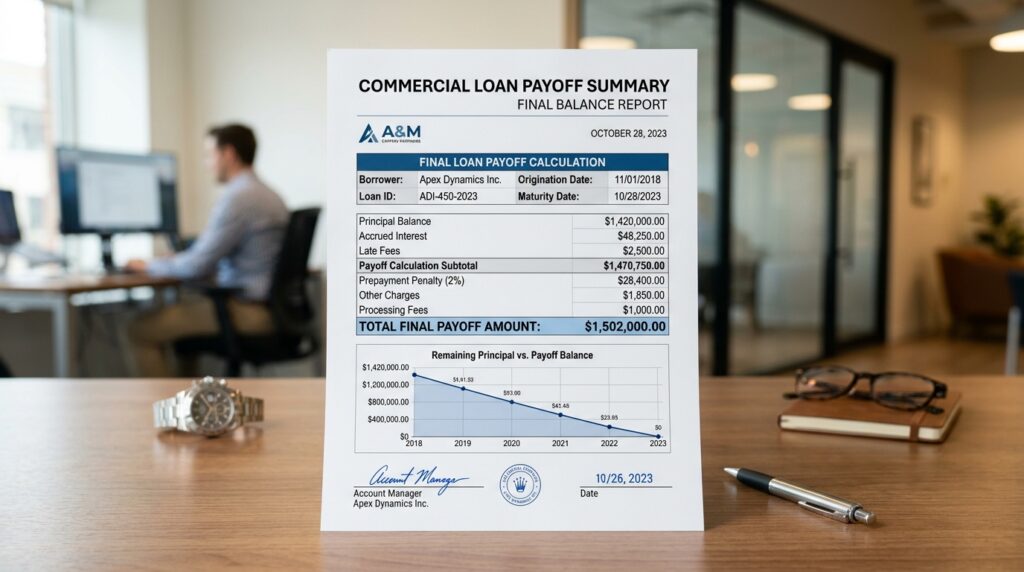
A visual summary of the final balance calculated by the commercial loan balloon payment calculator.
Calculate Your Final Balloon Payment
To accurately project your final balloon payment and payoff balance:
1. Original Loan Principal: Input initial loan balance funded at closing.
2. Annual Interest Rate: Enter contracted interest rate.
3. Amortization Period: Select compounding schedule (typically 20 or 25 years).
4. Loan Term (Maturity Horizon): Set contract length (e.g., 5 or 10 years).
5. Elapsed Time / Payoff Date: Specify when payoff will occur (at maturity or early prepayment).
6. Prepayment Penalty Structure (Optional): Input step-down percentage or yield maintenance terms for early payoff analysis.
To view complete month-by-month debt reduction leading up to your maturity date, view your full commercial loan amortization schedule before executing exit strategy calculations.
How do balloon payments work on commercial real estate loans?
A commercial balloon payment represents the remaining principal balance owed at the end of a commercial mortgage term. Because monthly payments during the loan term are calculated using a longer amortization schedule (e.g., 25 years), each payment covers monthly interest plus a modest principal reduction.
When the shorter contract term expires (e.g., Year 10), the borrower must repay the remaining principal balance.
Illustrative Balloon Payment Example
Consider a borrower who secures a commercial real estate loan with the following parameters:
* Original Loan Amount: $2,500,000
* Interest Rate: 6.25% fixed
* Amortization Schedule: 25 years (300 months)
* Loan Term: 10 years (120 months)
* Monthly Principal & Interest Payment: $16,488.20
Over 10 years, the borrower makes 120 payments totaling $1,978,584. However, because payments were calculated over 25 years, the remaining principal balance at the end of Year 10 is $1,894,220. This remaining $1,894,220 is the balloon payment due at maturity.
Why do commercial loans have balloon payments instead of full amortization?
Commercial lenders structure loans with balloon maturities rather than full 25-year or 30-year terms for three key economic reasons:
- Interest Rate Risk Management: Commercial banks and financial institutions fund commercial real estate loans using short-to-medium-term customer deposits and money market funds. Capping loan terms at 5 or 10 years prevents lenders from locking in low interest yields for extended 30-year windows.
- Re-underwriting Property Credit Risk: Balloon maturities force a periodic credit review. At loan expiration, lenders evaluate property physical condition, current Net Operating Income (NOI), local commercial market vacancy, and sponsor liquidity before extending or refinancing debt.
- Capital Recycling for Lenders: Term limits ensure lenders regularly recycle capital back into active credit markets, adjusting interest rate spreads to reflect current economic conditions.
Understanding Prepayment Penalties & Early Payoff
If a borrower elects to pay off or refinance a commercial real estate loan prior to its scheduled balloon maturity, commercial debt agreements usually impose prepayment penalties to protect lender interest yield expectations.
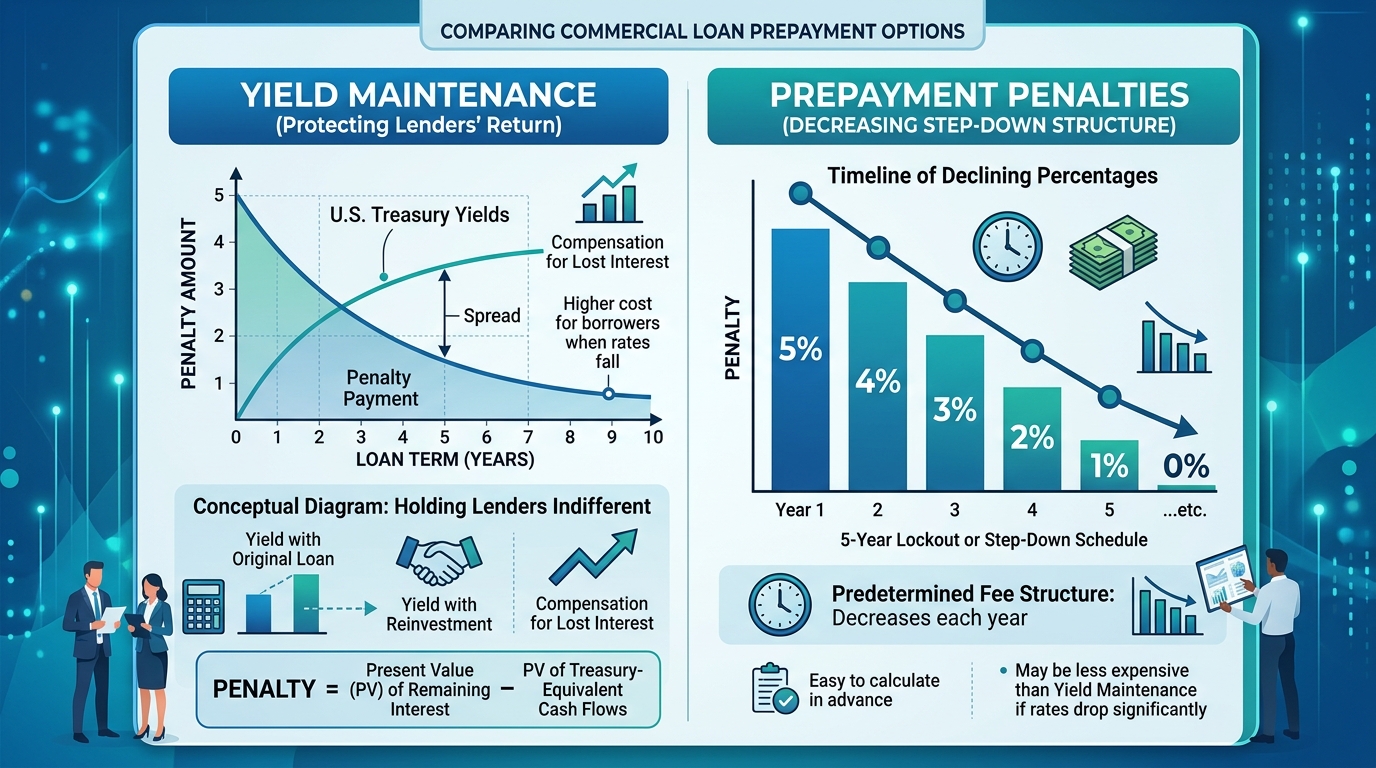
An overview explaining the mechanics of yield maintenance and prepayment penalties in commercial loan agreements.
How do prepayment penalties impact commercial loan payoff calculations?
Prepayment penalties directly increase total payoff balances if a commercial loan is liquidated prior to maturity. Prepayment structures fall into three primary categories:
1. Step-Down Prepayment Penalties
Step-down penalties decrease by 1.00% each year during the loan term.
* Example (5-4-3-2-1 Structure on a 5-Year Loan): Prepaying in Year 1 incurs a 5% penalty on outstanding balance; Year 2 incurs 4%; Year 3 incurs 3%; Year 4 incurs 2%; and Year 5 incurs 1%.
2. Soft vs. Hard Prepayment Clauses
- Soft Prepayment: Penalty applies only if the loan is refinanced with another lender; penalty is waived if property is sold to an arms-length third-party buyer.
- Hard Prepayment: Penalty applies under all early payoff conditions, including property sales.
How do yield maintenance and defeasance affect early payoff amounts?
Institutional commercial loans (such as CMBS conduit debt and Life Insurance Company loans) utilize yield maintenance or defeasance mechanisms to protect lender yield requirements:
- Yield Maintenance: A contractual fee requiring the borrower to pay the lender the present value of all remaining interest payments that would have been earned through maturity, discounted using U.S. Treasury benchmark yields. If Treasury yields drop below contracted loan interest rates, yield maintenance penalties can become extremely high (often 5% to 15%+ of remaining principal balance).
- Defeasance: A legal process where the borrower replaces commercial real estate collateral with a portfolio of U.S. Treasury bonds that mirror remaining debt cash flows. Defeasance requires specialized legal, accounting, and custodian fees ($25,000 to $75,000+) in addition to bond purchasing costs.
Refinance Exit Strategies
Managing balloon maturity risk requires initiating refinancing or disposition strategies 6 to 12 months prior to the balloon due date.
What happens when a commercial loan balloon payment is due?
When a commercial loan balloon payment reaches maturity, the borrower must execute one of four primary exit options:
- Refinance with a New Commercial Lender: Replace maturing debt with a new conventional bank loan, SBA loan, or agency mortgage. Borrowers should compare current commercial loan refinancing rates to evaluate prevailing borrowing costs.
- Negotiate Loan Modification or Term Extension: Negotiate a 1 to 3-year extension with the existing lender (often requiring an extension fee of 0.25% – 1.00% and partial principal paydown).
- Sell the Commercial Real Estate Asset: Liquidate the property prior to maturity to fully satisfy outstanding balloon obligations with sale proceeds.
- Capital Injection / Equity Paydown: Inject additional equity capital to reduce loan balances to satisfy lower LTV constraints required by new lenders during refinancing.
If you are facing an upcoming balloon maturity within the next 12 months, explore our commercial loan refinancing options to lock in competitive debt terms before maturity deadlines expire.
Frequently Asked Questions (FAQ)
What happens if I cannot pay the balloon payment on a commercial loan?
If a borrower cannot satisfy a commercial loan balloon payment at maturity, the loan goes into default. Lenders may issue a notice of default, charge default interest rates (typically 3% to 5% above normal rates), or initiate foreclosure proceedings. Most lenders prefer negotiating loan extensions or workouts over foreclosure if property NOI remains stable.
What is a balloon loan reset or extension fee?
A balloon loan extension fee is a fee charged by lenders (typically 0.25% to 1.00% of outstanding principal balance) to grant a temporary term extension (usually 6 to 24 months) when maturity debt cannot be refinanced immediately.
How far in advance should I prepare for a commercial balloon payment?
Borrowers should begin preparing for a commercial balloon payment 6 to 12 months prior to loan maturity. This window provides sufficient time to order updated commercial appraisals, complete Phase I environmental assessments, gather financial records, and shop multiple refinancing lenders.
Can a commercial balloon payment be rolled into a new loan?
Yes. In a standard commercial refinance, the new commercial loan proceeds are used to pay off the existing lender’s balloon balance at closing. If property appreciation or debt reduction has increased equity, borrowers may also execute a cash-out refinance.