
Commercial Loan Underwriting Timelines & Due Diligence Bottlenecks
The underwriting phase represents the core engine of the commercial real estate mortgage process. While loan origination and pre-approval establish initial deal viability, the commercial loan underwriting timeline determines whether a transaction successfully moves across the finish line.
During underwriting, financial institutions perform exhaustive quantitative and qualitative analysis to verify borrower creditworthiness, property cash flow sustainability, market fundamentals, and collateral value. Understanding what occurs behind closed doors during this 2-to-4 week window—and how third-party reports impact the schedule—is essential for keeping acquisition deadlines intact.
What Happens During Commercial Loan Underwriting?
Commercial real estate underwriting is a multi-layered risk evaluation process executed by credit analysts, underwriters, and risk officers. Unlike residential underwriting, which relies heavily on automated scoring algorithms, commercial underwriting requires manual verification of income-producing real estate assets.
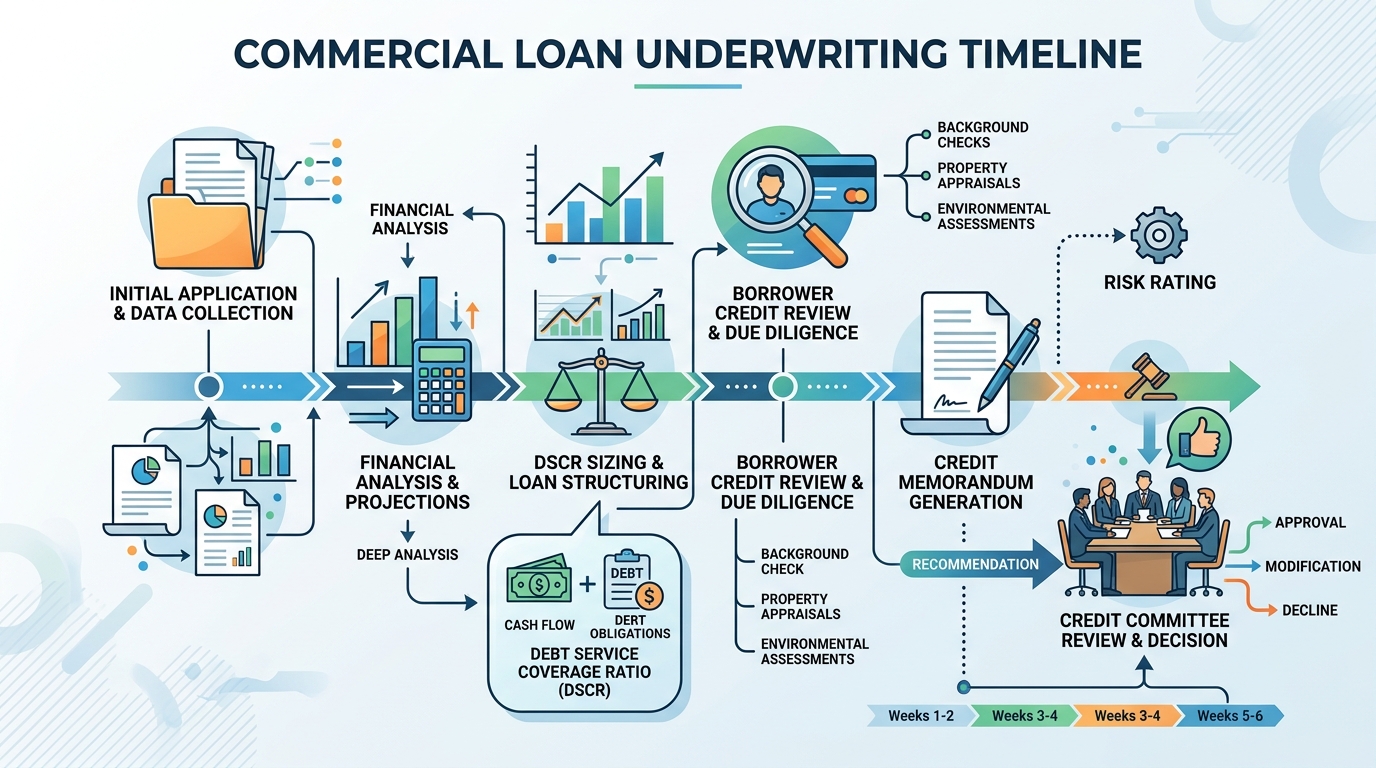
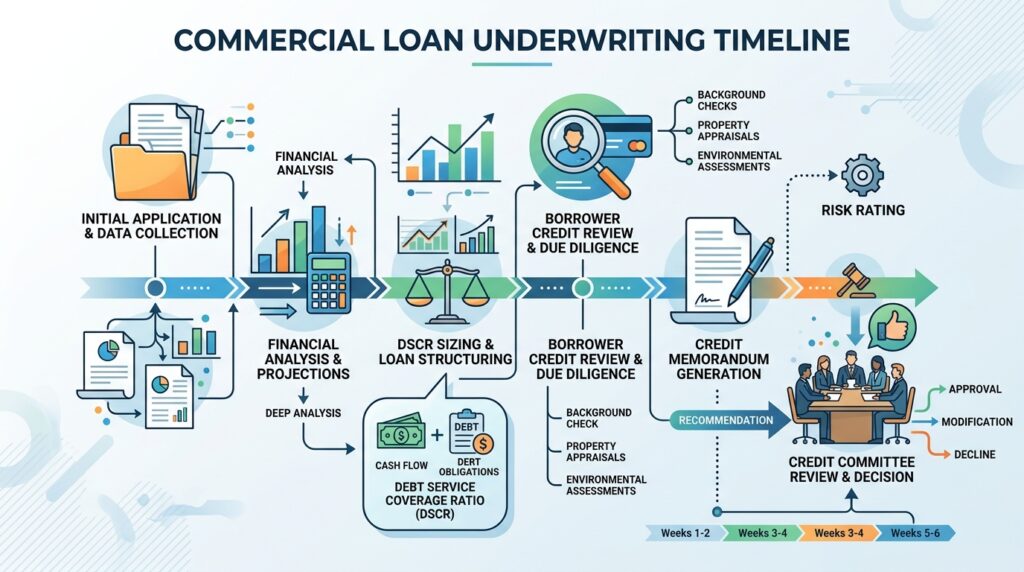
A visual representation of the commercial loan underwriting process, highlighting the various stages and the credit committee review.
The Core Underwriting Process (14 to 28 Days)
- Financial Analysis & Cash Flow Normalization: The underwriter analyzes three years of historical property financial statements, trailing 12-month (T12) operating figures, and current rent rolls. Non-recurring expenses are normalized to establish net operating income (NOI).
- Debt Service Coverage Ratio (DSCR) Sizing: Utilizing the verified NOI and proposed loan terms, the underwriter calculates the DSCR (typically requiring a minimum 1.20x to 1.35x coverage). The loan amount is sized based on the lower of LTV, DSCR, or debt yield limits.
- Borrower Credit & Global Cash Flow Review: The underwriter conducts credit checks, reviews global cash flow across all borrower-owned entities, evaluates liquid net worth requirements, and verifies contingent liabilities.
- Credit Memorandum Generation: The underwriter compiles a comprehensive credit memo detailing market dynamics, tenant creditworthiness, lease rollover risks, asset quality, and borrower experience.
- Credit Committee Review & Conditional Approval: The credit memo is presented to the lender’s Credit Committee (comprising senior executives and risk officers). Upon approval, the lender issues a formal Commitment Letter outlining final loan conditions.
For an overview of how this underwriting stage fits into the broader commercial transaction lifecycle, consult our guide on the standard commercial mortgage closing timeline.
Commercial Real Estate Appraisal Turnaround Times
The commercial property appraisal is widely recognized as the primary operational bottleneck within the underwriting schedule. A typical commercial appraisal turnaround time spans 3 to 5 weeks from engagement to final report delivery.
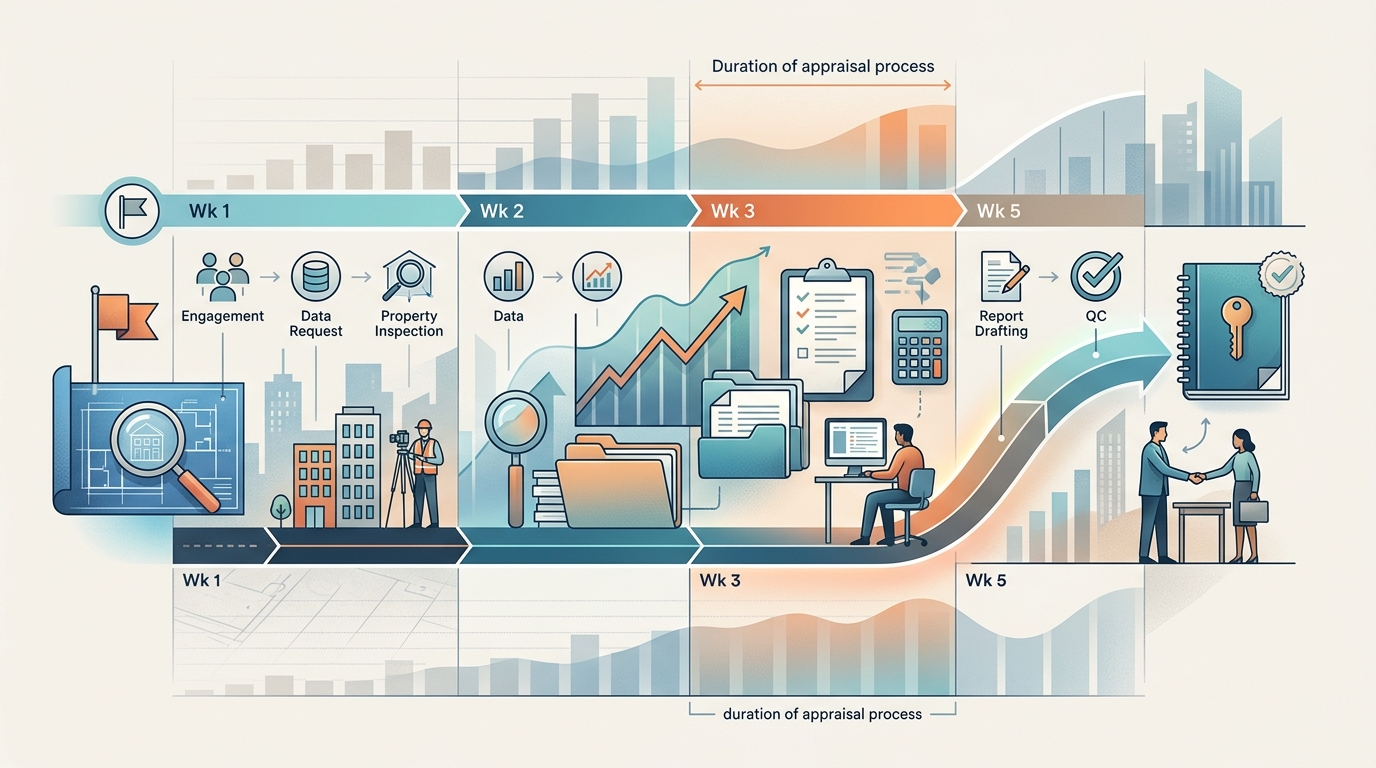
Understanding the typical 3 to 5 week turnaround time for a commercial real estate appraisal is crucial for managing loan underwriting expectations.
Why Commercial Appraisals Require 3 to 5 Weeks
Unlike residential appraisal reports, commercial valuations are highly complex, tailored research documents ranging from 50 to 150+ pages. The valuation process involves three distinct analytical approaches:
- Income Capitalization Approach: Analyzing market cap rates, tenant lease structures, vacancy rates, and discounted cash flows (DCF).
- Sales Comparison Approach: Inspecting and adjusting recent local comparable sales of similar property types.
- Cost Approach: Estimating land value plus current construction replacement costs minus physical depreciation.
Factors That Extend Appraisal Turnaround Times
- Appraiser Shortages & Workload: Qualified commercial appraisers (MAI designated) in specific secondary or rural markets often face significant backlogs.
- Property Complexity: Multi-tenant industrial parks, regional shopping centers, or specialized healthcare facilities demand far more research than single-tenant net lease (STNL) assets.
- Bidding & BPO Windows: Lenders must solicit competitive bids from approved appraisal management lists, consuming 3 to 5 days before an appraiser is officially engaged.
Rush Options: Many appraisal firms offer expedited 2-week rush engagements for an additional fee (typically $1,000 to $2,500). Borrowers facing tight purchase agreement deadlines should request a rush appraisal during initial loan intake.
Managing Third-Party Report Delays (Phase I ESA, ALTA Surveys)
Beyond appraisals, lenders mandate additional third-party due diligence reports to mitigate environmental and legal risk factors. Managing these vendors effectively prevents unexpected delays during the commercial loan underwriting timeline.
Phase I Environmental Site Assessment (ESA)
- Standard Timeline: 3 to 4 weeks
- Purpose: Identifies Recognized Environmental Conditions (RECs), historical land uses, and potential contamination risks under ASTM standards.
- The Bottleneck Risk: If historical records reveal past dry cleaners, gas stations, or industrial chemical storage, the environmental consultant may recommend a Phase II ESA (soil and groundwater testing). A Phase II assessment can add 30 to 60 days and several thousand dollars to the timeline.
ALTA/NSPS Land Title Survey (ALTA/NSPS Land Title Survey)
- Standard Timeline: 2 to 3 weeks
- Purpose: Maps boundary lines, building footprints, easements, setback requirements, utility access, and potential encroachments.
- The Bottleneck Risk: Severe weather conditions or unrecorded utility easements can delay surveyor fieldwork and drafting schedules.
Property Condition Assessment (PCA)
- Standard Timeline: 2 to 3 weeks
- Purpose: Evaluates structural integrity, roof lifespan, HVAC systems, electrical infrastructure, and immediate capital repair requirements.
Accelerating Underwriting Review
Borrowers do not have to remain passive during the underwriting window. Implementing targeted strategies can streamline credit reviews and help prevent administrative friction:
- Submit a Clean, Audit-Ready Financial Package: Provide all financial statements in standardized Excel formats alongside signed tax returns. Avoid sending illegible scans or incomplete document packages.
- Pre-Order Environmental & Survey Documents: When allowed by the lender, engage certified environmental engineers and surveyors immediately upon entering escrow.
- Establish Direct Communication with Underwriters: Request weekly status calls with your loan officer and underwriting lead to track document conditions and third-party report progress.
- Leverage Comprehensive Commercial Financing Expertise: Partnering with experienced financing specialists ensures your loan package is structured properly before reaching the underwriter’s desk. Explore our specialized commercial real estate financing services to see how expert advisory simplifies credit approvals.
For additional actionable strategies to eliminate administrative hurdles and fast-track loan execution, explore our guide featuring actionable tips to speed up your loan approval.