How Long Does It Take to Close a Commercial Real Estate Loan? (Complete Timeline)
Securing commercial real estate financing is fundamentally different from obtaining a residential mortgage. With complex property evaluations, extensive environmental reviews, and rigorous credit underwriting, understanding the commercial real estate loan closing time is vital for commercial real estate (CRE) investors, business owners, developers, and brokers.
Writing a realistic financing contingency into a Purchase and Sale Agreement (PSA) or Letter of Intent (LOI) can mean the difference between executing a seamless acquisition or forfeiting earnest money deposits. This comprehensive benchmark guide breaks down current 2026 timeline expectations, stage-by-stage approval processes, lender variations, and critical milestones to ensure your transaction stays on track.
What is the Average Commercial Mortgage Closing Time?
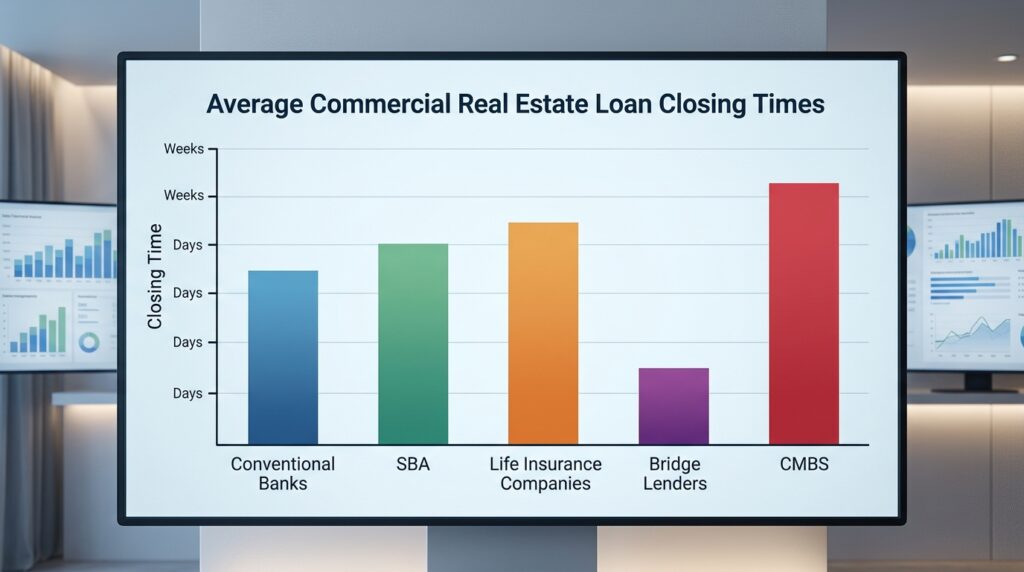
On average, the standard commercial real estate loan closing time ranges from 30 to 90 calendar days, with most conventional transactions closing in 45 to 60 days. Conventional bank financing typically requires 45 to 60 days, government-backed SBA loans take 60 to 90+ days, and short-term commercial bridge loans can close in as few as 10 to 30 days.
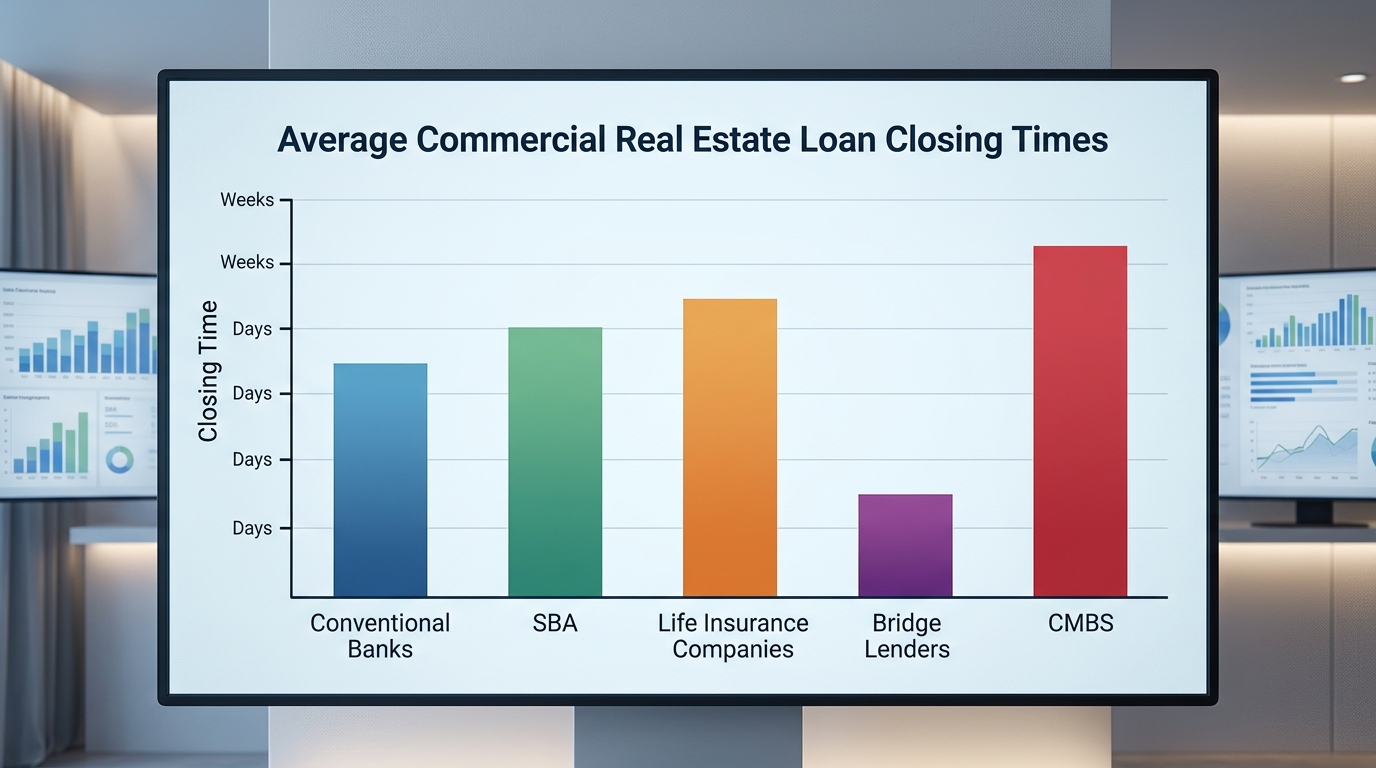
Average commercial real estate loan closing times vary significantly depending on the lender type, with bridge loans typically closing fastest and SBA loans taking the longest.
While residential mortgages focus heavily on the individual borrower’s income and credit score, commercial property acquisition loans require exhaustive due diligence on both the borrower’s balance sheet and the income-producing capacity of the underlying asset. Consequently, the average closing time for commercial real estate fluctuates based on lender type, asset complexity, environmental risk factors, and third-party vendor availability.
Baseline Benchmark Summary by Loan Type
- Conventional Commercial Bank Loans: 45 to 60 days
- SBA 7(a) & 504 Loans: 60 to 90+ days
- Life Insurance Companies: 45 to 75 days
- Commercial Bridge Loans: 10 to 30 days
- CMBS (Conduit) Loans: 45 to 60 days
Understanding these benchmarks enables investors to properly negotiate closing dates and inspection windows in initial purchase contracts.
Stage-by-Stage Commercial Loan Approval Timeline
To better navigate the commercial real estate loan timeline, it helps to view the financing lifecycle as three distinct, sequential operational phases. Each stage contains specific deliverables that directly influence overall commercial loan processing time.
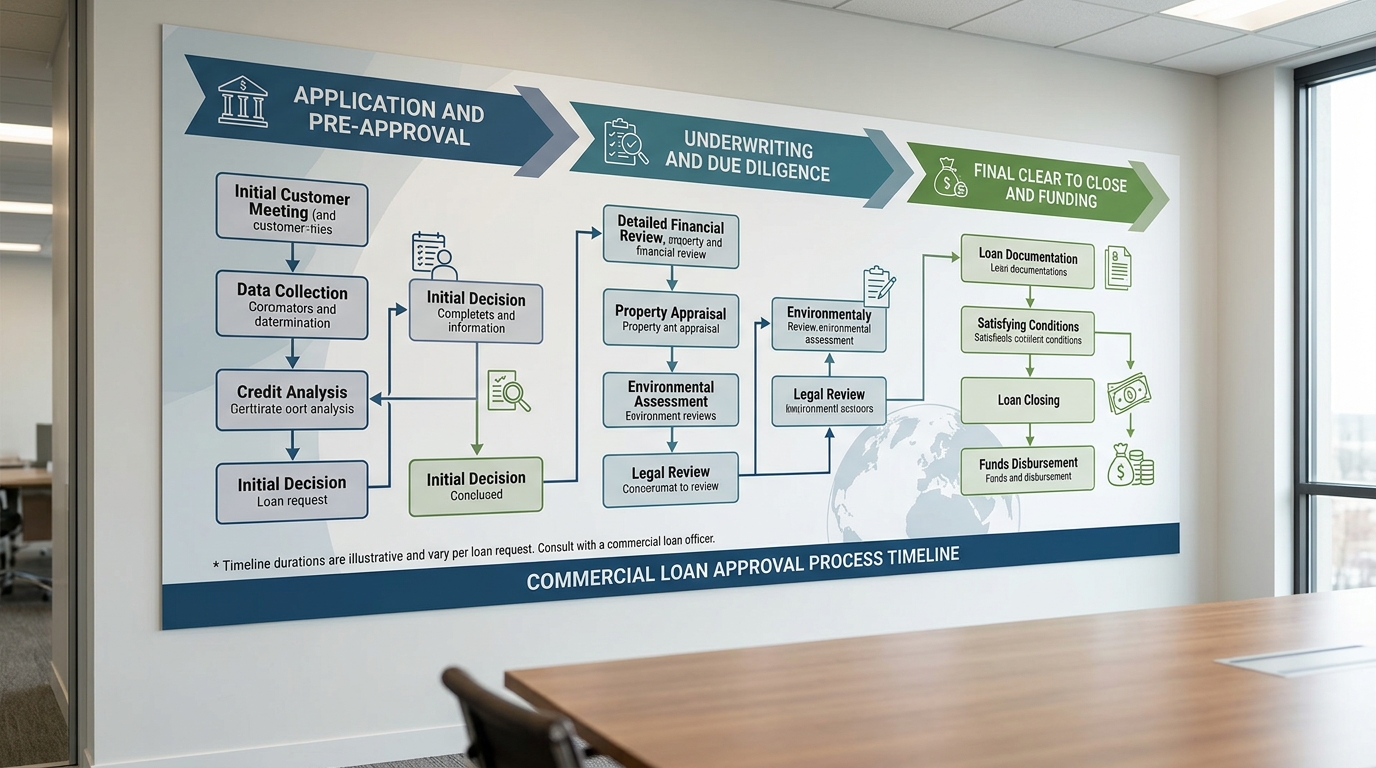
Navigating the commercial loan approval process involves distinct stages, each with specific deliverables that influence the overall timeline.
Application and Pre-Approval (Days 1–10)
The initial phase lays the groundwork for the loan request. During this period, the borrower submits a comprehensive financial package to the lender’s loan officer or originations team.
- Initial Submission & Deal Intake (Days 1–3): The borrower submits three years of corporate tax returns, personal financial statements (PFS), year-to-date income statements, balance sheets, rent rolls, and property operating statements.
- Lender Term Sheet / Letter of Intent (LOI) (Days 4–7): The lender analyzes the high-level debt service coverage ratio (DSCR) and loan-to-value (LTV) metric. If the deal meets underwriting thresholds, the lender issues a Term Sheet outlining proposed interest rates, amortization, loan structures, and closing fee estimates.
- Deposit and Formal Application (Days 8–10): The borrower signs the term sheet and provides an underwriting deposit (typically $5,000 to $15,000) to cover third-party report costs, initiating the formal review.
Underwriting and Due Diligence (Days 11–40)
The second phase represents the bulk of the commercial loan approval process timeline. During this window, the lender’s credit risk department subjects the property and borrower to thorough examination.
- Third-Party Report Ordering: The lender engages independent professionals to order a commercial real estate appraisal, Phase I Environmental Site Assessment (ESA), building condition assessment (PCA), and title search.
- Credit Committee Review: Concurrent with third-party report production, the underwriter reviews tax documentation, operating histories, entity organizational documents (LLC agreements, corporate charters), and bank statements.
- Formal Credit Committee Approval: Once the underwriter packages the credit memo, the file goes before the lender’s internal Credit Committee for final formal sanction.
For a deeper dive into mitigating third-party report delays during this critical window, review our guide on the commercial loan underwriting timeline.
Final Clear to Close and Funding (Days 41–60)
Once formal credit approval is issued, the file transitions to lender legal counsel and escrow officers for final execution.
- Closing Loan Documentation: Lender’s counsel prepares the promissory note, mortgage or deed of trust, personal guarantees, and assignment of leases/rents.
- Title and Insurance Clearance: Escrow finalizes the ALTA title policy binder, property/casualty insurance certificates, and liability policies listing the lender as loss payee.
- Closing Statement & Equity Funding: The closing statement (Settlement Statement or Closing Disclosure) is finalized. The borrower transfers required equity funds to escrow.
- Wire Disbursement & Loan Funding: Upon final verification of all executed loan documents, the lender wires proceeds to complete the time to fund commercial real estate loan requirements, officially closing the transaction.
How Lender Type Impacts Your Timeline (Banks vs. SBA vs. Private Lenders)
The entity providing your capital is often the single greatest determinant of how long to close a commercial loan. Understanding the operational realities of different lender types helps align your capital search with contract deadlines.
| Lender Category | Typical Closing Timeframe | Core Advantage | Primary Timeline Driver |
|---|---|---|---|
| Private Bridge Lenders | 10–30 Days | Speed & Flexibility | Asset-based focus, streamlined internal approval |
| Conventional Regional Banks | 45–60 Days | Competitive Rates | Local credit committee schedules, standard third-party reports |
| National Credit Unions | 45–60 Days | Member Terms & Pricing | Conservative underwriting, strict committee reviews |
| CMBS / Conduit Lenders | 45–60 Days | Non-Recourse Capital | Extensive legal documentation, standardized pool closing |
| SBA Lenders (7a / 504) | 60–90+ Days | High LTV / Low Equity Down | Federal eligibility compliance, CDC involvement |
When speed is the paramount priority—such as competing against all-cash buyers or securing tight 1031 exchange replacement properties—borrowers frequently utilize short-term private debt. To evaluate how government-backed programs stack up against expedited options, read our direct breakdown to compare SBA and bridge loan closing times.
Conversely, borrowers seeking low, long-term fixed interest rates through conventional banks or SBA programs must account for longer commercial mortgage processing time requirements and build at least 60 days into their contract purchase contingency.
Frequently Asked Questions (FAQ)
How many days to close commercial property?
Closing a commercial property purchase typically requires 45 to 60 days when utilizing conventional bank financing. If using private bridge loans, closings can occur in 14 to 30 days. Transactions involving SBA government-guaranteed financing generally require 60 to 90 days due to government compliance documentation.
How long does it take to fund a commercial real estate loan?
Once the lender issues a formal “Clear to Close” and all final loan documents are signed, actual loan funding and wire disbursement usually take 24 to 72 hours. The complete timeline from initial application submission to final funding takes between 30 and 90 days depending on the loan structure.
What causes the biggest delays during commercial mortgage processing?
The most common causes of delay during the commercial real estate closing process are slow commercial appraisal turnarounds (which can take 3 to 5 weeks), unorganized financial records provided by the borrower, unresolved title issues, and environmental red flags identified during Phase I ESA inspections.
Can you expedite your commercial loan closing?
Yes. Borrowers can significantly accelerate the financing timeline by preparing a complete “pre-flight” due diligence package in advance, utilizing preferred lender-approved third-party vendors, and maintaining proactive communication with underwriting teams. Learn actionable strategies to expedite your commercial loan closing in our practical playbook.