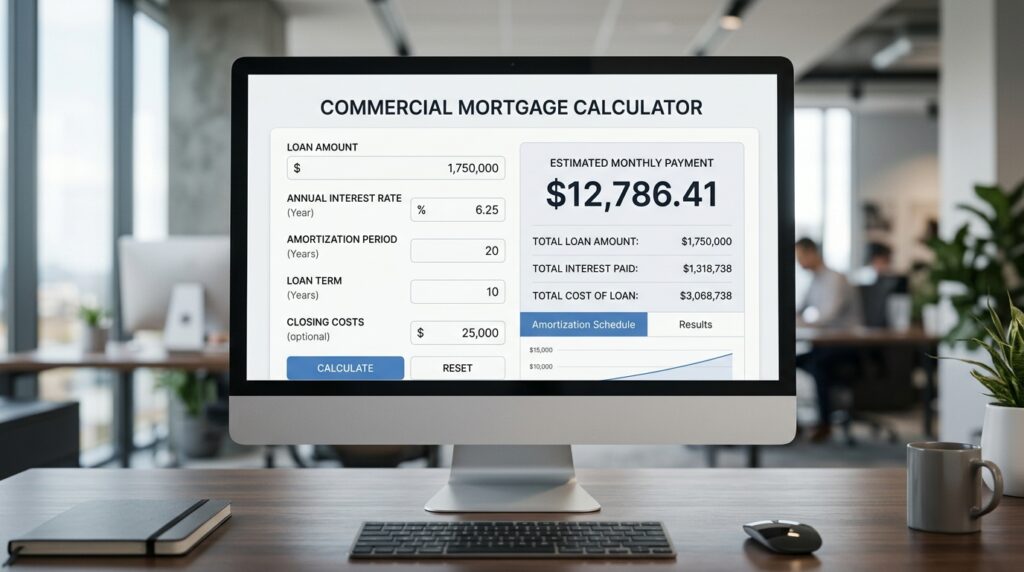
Commercial Mortgage Calculator
Evaluating a potential commercial real estate acquisition or refinancing an existing property requires fast, reliable financial modeling. Unlike residential mortgages, commercial real estate (CRE) loans involve distinct lending structures, shorter loan terms, balloon payments, and specialized underwriting requirements.
Using an interactive commercial mortgage calculator allows investors, brokers, and business owners to model monthly principal and interest costs, estimate balloon payments at maturity, and evaluate overall loan feasibility before making critical investment decisions.
1. Calculate Your Commercial Mortgage Monthly Payment
The interactive tool above is designed specifically for commercial real estate properties, including industrial warehouses, retail centers, office buildings, multi-family complexes, and owner-occupied business locations.
To run an accurate estimate using our commercial loan payment calculator, simply enter your key deal parameters:
- Purchase Price / Property Value: The total agreed acquisition price or appraised value of the commercial asset.
- Down Payment Amount ($ or %): The capital contribution provided by the buyer (typically ranging between 20% and 35% for conventional CRE financing).
- Loan Amount (Principal): The total debt financed by the commercial lender.
- Interest Rate (%): The fixed or initial variable interest rate quoted by your lender. You can check current commercial mortgage rates to test realistic market benchmarks for 2026.
- Amortization Period (Years): The timeline over which monthly payments are calculated (typically 20, 25, or 30 years).
- Loan Term (Years): The actual duration of the loan contract before the remaining balance becomes due (common terms are 5, 7, or 10 years).
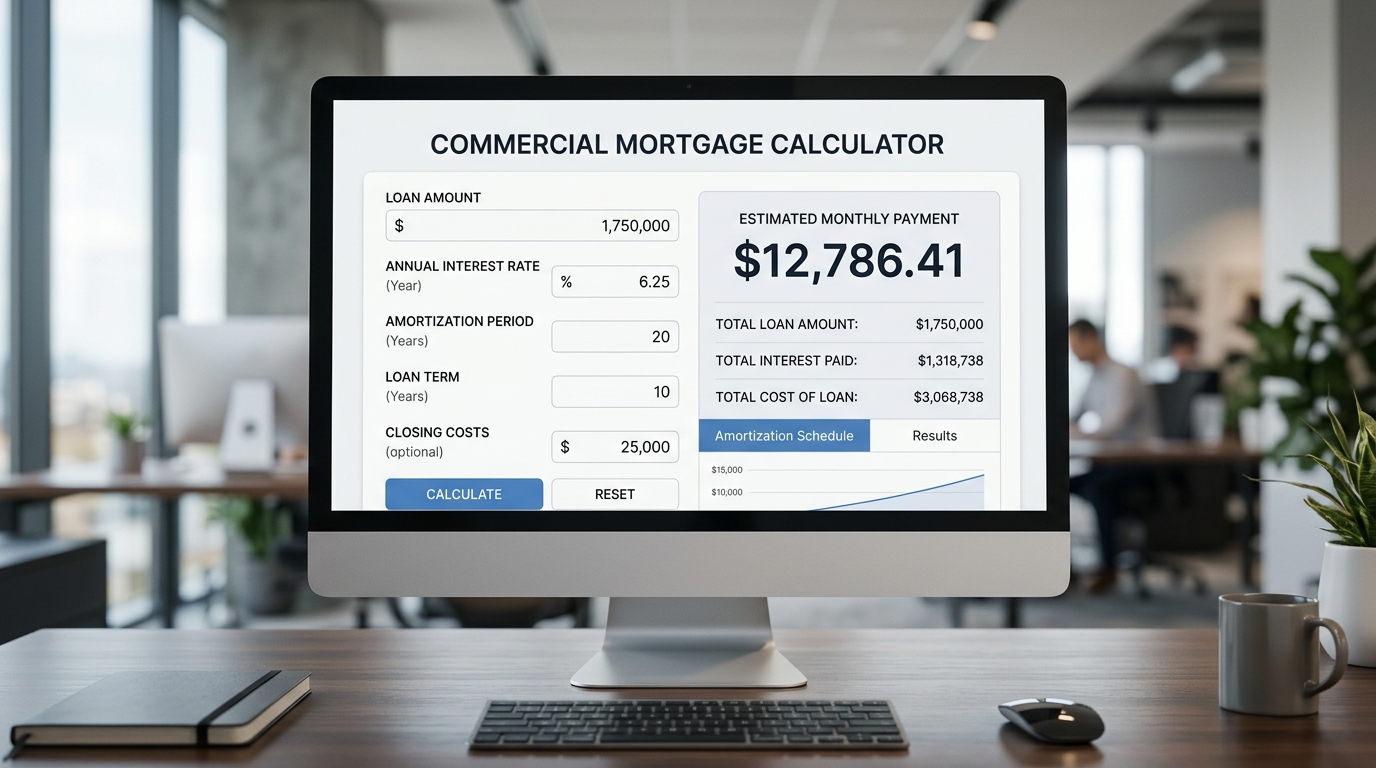
Use an interactive commercial mortgage calculator to quickly estimate monthly payments and balloon balances for various commercial property types.
Once entered, the calculator provides instant feedback on your debt service metrics, allowing you to stress-test your financing options under various interest rate and leverage scenarios.
2. Key Metrics Summary: Principal, Interest, and Balloon Balance
Understanding the core financial outputs of a commercial loan is critical for structuring debt effectively. Commercial loans differ fundamentally from standard 30-year residential mortgages because the loan term is usually much shorter than the amortization period.
Understanding the Amortization vs. Term Gap
For example, a common structure is a 10-year term with a 25-year amortization. During the 10-year term, you make 120 regular monthly principal and interest payments based on a 25-year payoff scale. However, because the loan matures after 10 years, a substantial remaining balance—known as the balloon payment—must be paid in full, refinanced, or settled through the sale of the property.
| Metric | Description | Commercial Real Estate Impact |
|---|---|---|
| Monthly Payment (P&I) | The regular monthly payment consisting of principal reduction and interest charges. | Directly impacts monthly Net Operating Income (NOI) and cash flow. |
| Total Principal Paid | The portion of debt equity built over the duration of the loan term. | Increases your equity position prior to loan maturity. |
| Total Interest Paid | The cumulative cost of borrowing paid to the commercial lender. | Represents a major operating tax deduction for commercial property owners. |
| Balloon Payment Balance | The outstanding principal balance due at loan maturity. | Requires refinancing, sale, or payoff before the term expires. To review your full multi-year payment schedule, view our commercial loan amortization schedule. |

Visualizing the amortization schedule helps understand how principal, interest, and the final balloon payment are structured in a commercial real estate loan.
3. How Commercial Mortgage Payments Are Calculated
Commercial mortgage payments are calculated using standard compounding interest formulas modified for monthly payment intervals. Lenders calculate the periodic payment ($PMT$) necessary to amortize the loan balance ($P$) over $n$ total monthly payments at a monthly interest rate ($r$).
The mathematical formula applied by a commercial property mortgage calculator is:
$$PMT = P \times \frac{r(1 + r)^n}{(1 + r)^n – 1}$$
Where:
* $PMT$ = Monthly commercial mortgage payment
* $P$ = Principal loan amount
* $r$ = Monthly interest rate (Annual Rate divided by 12)
* $n$ = Total number of amortizing monthly payments (Amortization Years $\times 12$)
Practical Calculation Example
Consider a commercial investor purchasing a retail building with the following terms in 2026:
* Property Purchase Price: $2,000,000
* Down Payment (25%): $500,000
* Loan Principal ($P$): $1,500,000
* Annual Interest Rate: 6.50% ($r = 0.065 / 12 = 0.0054167$)
* Amortization Period: 25 Years ($n = 25 \times 12 = 300\text{ months}$)
* Loan Term: 10 Years (120 months)
Applying the formula:
$$PMT = 1,500,000 \times \frac{0.0054167(1 + 0.0054167)^{300}}{(1 + 0.0054167)^{300} – 1} \approx \$10,128.14$$
The monthly principal and interest payment is $10,128.14. After 10 years of monthly payments (120 payments), the investor will have paid approximately $364,500 in principal reduction, leaving an estimated balloon payment balance of $1,135,500 due at year 10.
Before committing to terms, prudent investors should also evaluate investment feasibility to ensure property net cash flow comfortably covers this monthly debt obligation.
4. Commercial Real Estate Loan Requirements
Commercial lenders evaluate both the financial strength of the borrower and the cash-generating potential of the underlying property. Because commercial loans represent higher capital risks than residential home loans, underwriting standards are rigorous.
Down Payment Guidelines
Standard conventional commercial mortgages require down payments ranging from 20% to 35% of the property value (corresponding to an LTV ratio of 65% to 80%). Government-backed programs offer lower equity entry points:
* SBA 504 Loans: Require as little as 10% down for owner-occupied commercial buildings. (SBA 504 Loans)
* SBA 7(a) Loans: Typically require 10% to 15% down depending on business cash flow. (SBA 7(a) Loans)
* Conventional Commercial Bank Loans: Expect 25% to 30% down for standard retail, office, or industrial acquisitions.
Credit Score Thresholds
Commercial lenders evaluate both personal credit history and business credit reports:
* Conventional Bank Loans: Minimum personal FICO score of 660 to 700+. (FICO score)
* SBA Financing: Minimum FICO score typically around 680+.
* Institutional / Life Insurance Debt: Prefers strong credit scores above 720+ with significant liquid net worth.
* Private Debt / Bridge Lenders: Can accommodate credit scores under 620, but charge higher interest rates and origination fees.
LTV & Borrowing Limits
Loan-to-Value (LTV) measures the loan principal relative to the property’s appraised value. While maximum LTV limits typically cap at 75% to 80%, commercial lenders heavily prioritize the Debt Service Coverage Ratio (DSCR) when determining maximum borrowing limits. Even if a property qualifies for an 80% LTV on paper, weak net operating income may restrict maximum borrowing power to 65% LTV to maintain required lender coverage ratios.
5. Frequently Asked Questions
How is a commercial mortgage calculated?
A commercial mortgage is calculated using standard financial compounding formulas based on loan principal, annual interest rate, and total amortization schedule (typically 20 to 25 years). Monthly debt service ($PMT$) covers interest charges and principal reduction. Because commercial loan terms (e.g., 5 or 10 years) are shorter than the amortization window, the remaining principal balance must be paid as a balloon payment at maturity.
How much down payment is required for a commercial real estate loan?
Most commercial lenders require a down payment between 20% and 35% of the property’s purchase price or appraised value. However, government-backed Small Business Administration (SBA) loan programs, such as SBA 504 or SBA 7(a) loans for owner-occupied properties, permit down payments as low as 10% to 15%.
How much can you borrow with a commercial real estate loan?
Commercial borrowing limits depend on the property’s appraised market value, Loan-to-Value (LTV) caps (typically 65% to 80%), and property net operating income (NOI). Lenders enforce a Debt Service Coverage Ratio (DSCR) benchmark—usually 1.20x to 1.25x—ensuring the property generates at least 20% to 25% more income than necessary to pay total principal and interest obligations.
What closing costs and fees are associated with a commercial mortgage?
Commercial loan closing costs typically total 2% to 5% of the loan principal. Standard closing fees include lender origination fees (0.5% to 1.5%), commercial property appraisal fees ($3,000 to $10,000+), environmental site assessments (Phase I ESA), title search and insurance, legal fees, and engineering structural reports.
How to calculate monthly payments on a commercial loan?
To calculate monthly commercial payments, use a commercial loan monthly payment calculator by inputting the total loan amount, interest rate, and amortization period. The basic formula is $PMT = P \times [r(1 + r)^n] / [(1 + r)^n – 1]$, where $P$ is principal, $r$ is monthly interest rate, and $n$ is total months in the amortization window.
What is Loan-to-Value (LTV) ratio in commercial real estate financing?
Loan-to-Value (LTV) ratio is an underwriting metric representing the proportion of loan debt relative to the property’s appraised value. For example, a $1,500,000 mortgage on a $2,000,000 commercial building reflects a 75% LTV ratio ($1,500,000 / $2,000,000$). Higher LTV ratios represent greater risk to lenders and may require higher interest rates.