
Commercial Real Estate Investment Calculator
Evaluating commercial property acquisitions requires looking beyond simple purchase price and monthly mortgage estimates. Commercial real estate (CRE) underwriting focuses on property cash flow, risk management, capital returns, and lender debt coverage standards.
Our commercial real estate investment calculator provides brokers, investors, and business property owners with an integrated framework to analyze asset profitability, evaluate Debt Service Coverage Ratios (DSCR), calculate Net Operating Income (NOI), and assess overall property deal feasibility.
1. Analyze Your Real Estate Investment
Whether you are evaluating a multi-tenant retail building, industrial warehouse, office complex, or owner-occupied business location, commercial financial modeling rests on income and expense verification.
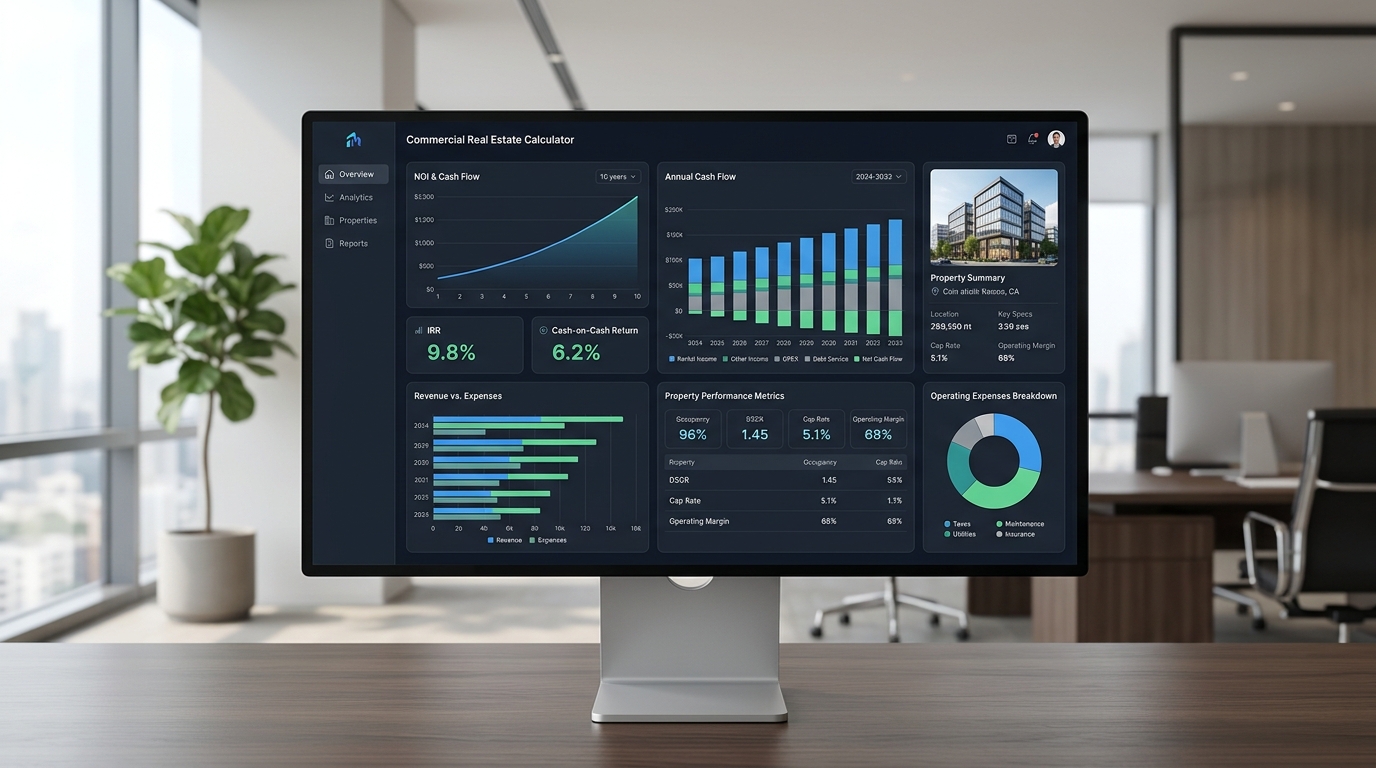
Utilize an interactive dashboard to analyze the cash flow and profitability of commercial real estate investments.
To use our interactive investment tool, enter the primary operating metrics of your target commercial property:
- Gross Potential Rent (GPR): Total gross rental income assuming 100% tenant occupancy at market rental rates.
- Vacancy & Collection Loss (%): Expected income deduction accounting for unit turnover or uncollected rent (typically budgeted between 3% and 10%).
- Operating Expenses (OpEx): Annual recurring costs required to operate the asset (property taxes, insurance, utilities, maintenance, management fees).
- Purchase Price & Acquisition Costs: Total capital required to purchase and close the deal.
- Debt Financing Inputs: Loan amount, interest rate, and amortization schedule. To model your exact financing terms, you can estimate commercial mortgage financing in our core loan calculator.
2. Key Commercial Real Estate Metrics Explained
Underwriters and equity investors analyze specific ratios to verify if a property produces adequate income to cover debt payments while delivering target investment returns.
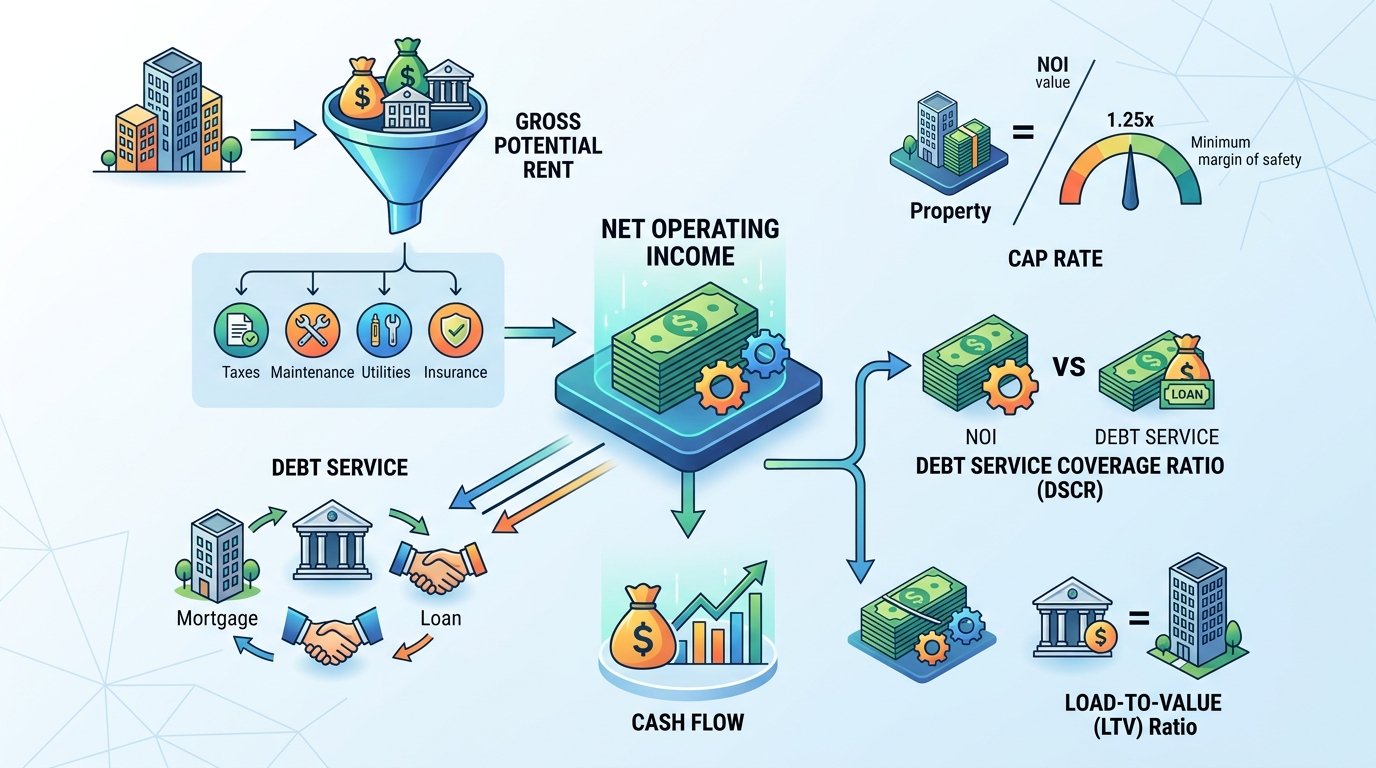
Understand essential commercial real estate metrics like DSCR and NOI to evaluate property performance.
Debt Service Coverage Ratio (DSCR)
The Debt Service Coverage Ratio (DSCR) is the single most critical risk metric evaluated by commercial lenders. DSCR measures a property’s annual Net Operating Income relative to its annual total principal and interest payments.
$$\text{DSCR} = \frac{\text{Net Operating Income (NOI)}}{\text{Annual Debt Service}}$$
- DSCR < 1.00x: Negative cash flow. The property does not generate sufficient income to cover mortgage payments.
- DSCR = 1.00x: Break-even cash flow. Zero safety margin for unforeseen operating expenses or vacancies.
- DSCR = 1.25x (Lender Benchmark): Standard institutional underwriting baseline. Net income exceeds mortgage payments by 25%.
Net Operating Income (NOI)
Net Operating Income (NOI) measures the total annual revenue generated by a commercial property after deducting all necessary operating expenses, but before accounting for debt service payments and income taxes.
$$\text{NOI} = (\text{Gross Potential Rent} + \text{Other Income} – \text{Vacancy Loss}) – \text{Operating Expenses}$$
Operating expenses included in NOI:
* Property taxes & special assessments
* Property & casualty insurance
* Property management fees
* Repairs, maintenance, and janitorial service
* Utilities paid by property owner
Note: Debt service (mortgage principal/interest), capital expenditures (CapEx reserves), and depreciation are excluded from NOI calculations.
Cap Rate & Cash-on-Cash Return
To gauge asset valuation and equity yields, CRE professionals utilize Capitalization Rates and Cash-on-Cash Return metrics:
| Financial Metric | Formula | Strategic Significance |
|---|---|---|
| Capitalization Rate (Cap Rate) | $\frac{\text{Net Operating Income}}{\text{Purchase Price}}$ | Measures unleveraged annual rate of return based on property asset value. |
| Cash-on-Cash Return | $\frac{\text{Annual Pre-Tax Cash Flow}}{\text{Total Initial Cash Invested}}$ | Measures equity yield generated relative to out-of-pocket cash invested down. |
| Debt Yield | $\frac{\text{Net Operating Income}}{\text{Total Loan Amount}}$ | Evaluates lender risk independent of interest rates and amortization periods. |
Before finalizing your return expectations, compare rates across market lenders by checking our guide to check average commercial real estate interest rates for 2026.
3. Evaluating Cash Flow and Profitability
To illustrate commercial investment underwriting in practice, let’s examine a step-by-step financial evaluation of a multi-tenant commercial building priced at $3,000,000.
Acquisition & Underwriting Assumptions
- Purchase Price: $3,000,000
- Down Payment (25%): $750,000
- Commercial Mortgage (75% LTV): $2,250,000
- Mortgage Terms: 6.75% Interest Rate, 25-Year Amortization
- Monthly Payment (P&I): $15,556 ($186,672 annually)
Property Operating Pro Forma
Gross Potential Rental Income:                  $360,000 / year
Less Vacancy & Collection Allowance (5%):      -$18,000 / year
------------------------------------------------------------------
Effective Gross Income (EGI):                   $342,000 / year
Less Annual Operating Expenses (Taxes, Ins, Mgmt): -$112,000 / year
------------------------------------------------------------------
Net Operating Income (NOI):                     $230,000 / year

Less Annual Debt Service (Principal & Interest):-$186,672 / year
------------------------------------------------------------------
Net Pre-Tax Cash Flow (Annual Cash-Flow):        $43,328 / year
Financial Metric Analysis
- Cap Rate Calculation:
$$\text{Cap Rate} = \frac{\$230,000\text{ NOI}}{\$3,000,000\text{ Purchase Price}} = 7.67\%$$ - Debt Service Coverage Ratio (DSCR):
$$\text{DSCR} = \frac{\$230,000\text{ NOI}}{\$186,672\text{ Debt Service}} = 1.23x$$
Verdict: The 1.23x DSCR satisfies standard commercial lender thresholds (1.20x–1.25x minimum). - Cash-on-Cash Return:
$$\text{Cash-on-Cash Return} = \frac{\$43,328\text{ Pre-Tax Cash Flow}}{\$750,000\text{ Cash Down Payment}} = 5.78\%$$
In addition to annual cash flow, the owner builds equity through monthly principal reduction. To map out your long-term equity growth, you can project your mortgage amortization timeline over your full investment horizon.
4. Frequently Asked Questions
What is a good Debt Service Coverage Ratio (DSCR) for a commercial loan?
Most commercial mortgage lenders require a minimum Debt Service Coverage Ratio (DSCR) of 1.20x to 1.25x. A DSCR of 1.25x means the property’s Net Operating Income (NOI) is 25% higher than the annual principal and interest mortgage obligations, providing a comfortable buffer against tenant vacancies or unexpected operating expense increases. Premier institutional lenders may require 1.35x+ for higher-risk asset classes.
What documents are needed to apply for a commercial real estate loan?
Applying for a commercial real estate loan requires documentation for both the borrower and the property:
* Property Documentation: Year-to-date income and expense statements (profit & loss), rent roll with lease terms, past 2–3 years of property tax returns, and property condition/environmental reports.
* Borrower Documentation: Past 3 years of personal and business tax returns, personal financial statements (PFS) detailing liquid assets and net worth, business bank statements, and borrowing entity documents (LLC Operating Agreement or Articles of Incorporation).