Current Multifamily Loan Rates & Market Overview
Navigating commercial real estate financing in 2026 requires a thorough understanding of benchmark interest rates, debt structures, and lender requirements. Whether acquiring a 5-unit apartment building or refinancing a large multi-tenant complex, securing competitive commercial real estate multifamily rates is vital to maximizing net operating income (NOI) and overall return on investment.
Multifamily lending rates today fluctuate based on macroeconomic indicators, federal monetary policy, and specific property performance metrics. Real estate syndicators, private investors, and mortgage brokers must continuously evaluate loan pricing across multiple capital sources—including agency lenders (Fannie Mae and Freddie Mac), conventional commercial banks, life insurance companies, and private debt funds.
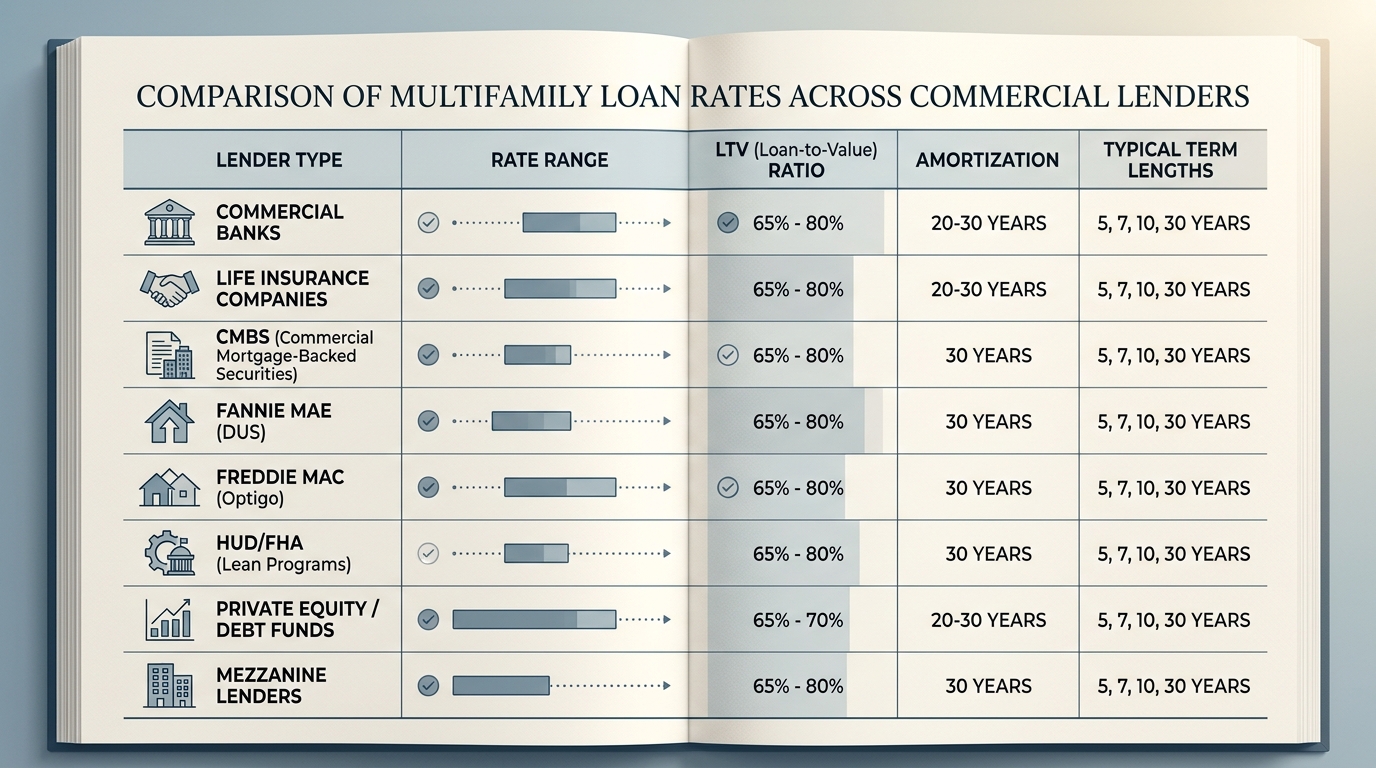
A benchmark table outlining current multifamily loan rates and key terms across various lender types in the commercial real estate market.
Current Multifamily Loan Rate Benchmarks by Lender Type
Commercial mortgage interest rates vary significantly depending on the capital provider, loan structure, loan-to-value (LTV) ratio, and debt service coverage ratio (DSCR). Below is an overview of standard benchmark pricing and structures across primary capital sources in 2026:
1. Agency Lenders (Fannie Mae & Freddie Mac)
Agency loans remain the gold standard for stabilized, 5+ unit apartment properties. They offer non-recourse execution, competitive fixed rates, long-term amortization, and flexible terms.
* Pricing Structure: Treasuries plus a spread (typically 130 to 220 basis points depending on tier and leverage).
* LTV Limit: Up to 75% – 80%.
* Minimum DSCR: 1.25x (1.35x for small balance programs in secondary markets).
* Term Options: 5, 7, 10, 12, or 15-year fixed-rate terms.
To evaluate specific government-sponsored enterprise options, investors can compare Fannie Mae and Freddie Mac agency rates against traditional debt capital.
2. Commercial Banks & Community Institutions
Local, regional, and national banks provide flexible financing for stabilized and moderate value-add acquisitions. Bank loans are typically recourse, though non-recourse options exist for low-leverage, strong-sponsor transactions.
* Pricing Structure: Prime Rate or SOFR plus a margin, or fixed rates based on bank cost of funds.
* LTV Limit: 65% – 75%.
* Minimum DSCR: 1.20x – 1.30x.
* Term Options: 3 to 10-year fixed terms, often with 5-year rate resets and full recourse guarantees.
3. Life Insurance Companies
Life insurance lenders cater to institutional-grade, high-quality, stabilized assets in primary metro areas. They offer the lowest interest rates in exchange for conservative leverage.
* Pricing Structure: Low Treasury spreads with tight rate floors.
* LTV Limit: 55% – 65%.
* Minimum DSCR: 1.35x – 1.50x.
* Term Options: 10 to 30-year long-term fixed financing with non-recourse terms.
4. Private Debt Funds & Bridge Lenders
Bridge lenders specialize in short-term, opportunistic, and heavy value-add transactions where property cash flows are currently insufficient for permanent debt.
* Pricing Structure: SOFR plus 350 to 650 basis points (floating rate).
* LTV / LTC Limit: Up to 75% LTV / 85% Loan-to-Cost (LTC).
* Minimum DSCR: Often lower initial DSCR (or interest reserve structures).
* Term Options: 1 to 3-year short-term non-recourse execution with extension options.
What is the average interest rate on an apartment building loan?
The average interest rate on an apartment building loan is determined by several factors, including property location, asset grade, debt type, leverage level, and borrower liquidity. Broadly speaking, average multifamily loan rates range from competitive agency floor rates for primary-market assets up to higher floating rates for short-term value-add debt.
To calculate accurate debt service for a specific asset, investors can use our multifamily interest rate calculator to test different interest rate, LTV, and amortization inputs against projected property cash flow.
How are multifamily interest rates calculated?
Lenders use a formulaic approach to price multifamily commercial mortgages. Understanding these underlying mechanics allows borrowers to negotiate better pricing and terms:
- Benchmark Base Rate: Fixed-rate multifamily commercial mortgage rates are benchmarked against US Treasury yields (typically 5-year, 7-year, or 10-year Treasury notes). (US Treasury yields) Floating-rate loans are pegged to the Secured Overnight Financing Rate (SOFR). (Secured Overnight Financing Rate (SOFR))
- Lender Spread (Margin): The lender adds a spread to the base rate to cover credit risk, operating overhead, and profit margin. Spreads widen for higher risk assets (e.g., lower DSCR, smaller population markets) and narrow for institutional assets.
- Property Tiering & Location: Agency programs categorize properties into tiers based on market size and population density. Top-tier markets (Tier 1 metros) receive lower rate spreads than Tier 3 or Tier 4 small-town markets.
- Loan-to-Value (LTV) Adjustments: Lower LTV ratios (e.g., 65% LTV vs 80% LTV) reduce lender risk, which often yields a 10 to 30 basis point reduction in interest rate.
- Debt Service Coverage Ratio (DSCR): Assets generating strong cash flows comfortably exceeding debt obligations earn lower interest rates and reduced fee structures.
Historical Multifamily Mortgage Rate Trends
Commercial mortgage rates move dynamically with overall economic expansion, inflation metrics, and Federal Reserve policy. Over multi-decade cycles, multifamily rates have adjusted through distinct macroeconomic shifts:
- Low-Interest Rate Era: Historical lows provided record-low borrowing costs, enabling cap rate compression across nearly all major markets.
- Rate Adjustment Cycles: Increases in benchmark indices led to expanding credit spreads, shifts in lender underwriting, and adjustments in asset pricing.
- Current Market Context (2026): Borrowers face a stabilized rate environment where disciplined underwriting, debt structuring, and cash-flow management dictate transaction success.
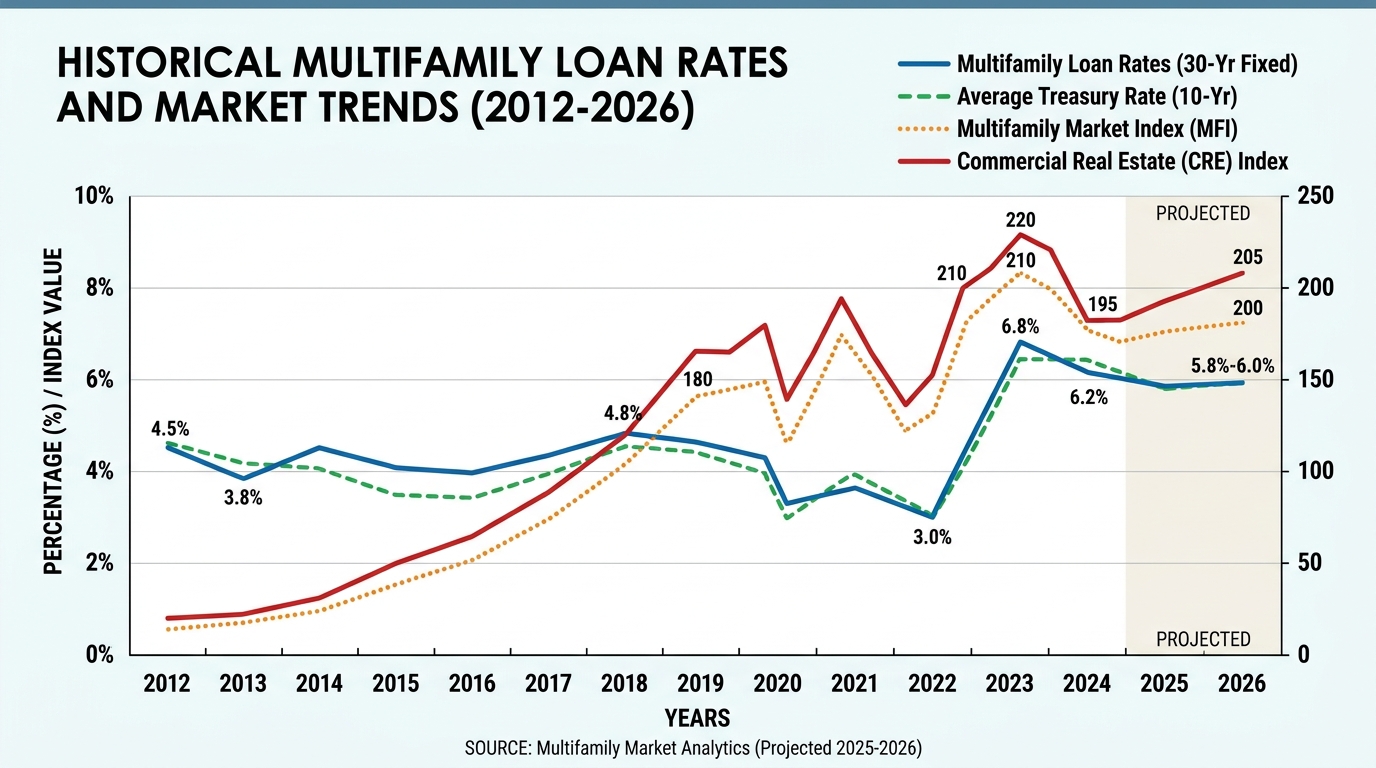
Historical chart illustrating the dynamic trends of multifamily mortgage rates and their correlation with broader market shifts.
How do interest rate increases affect multifamily property valuations and cap rates?
Interest rate changes directly impact commercial property values. As borrowing costs rise, capitalization rates (cap rates) generally adjust upward. When interest rates exceed cap rates (creating “negative leverage”), real estate investors face reduced cash-on-cash returns unless purchase prices decline or property Net Operating Income (NOI) increases through rent growth or expense optimization.
Furthermore, higher interest rates reduce the maximum debt amount a property can support under fixed minimum DSCR constraints (e.g., 1.25x), requiring buyers to contribute larger equity down payments to complete acquisitions.
Purchasing & Qualification Guide
Qualifying for the best multifamily loan rates requires meeting strict financial, operational, and experience benchmarks set by commercial underwriting guidelines.
What down payment percentage is required for an apartment building purchase?
For standard permanent multifamily loans (such as agency or bank financing), down payments typically range from 20% to 35% of the purchase price, corresponding to an maximum LTV of 65% to 80%.
- Agency Loans (Fannie/Freddie): Maximum LTV is generally 75% to 80%, requiring a 20% to 25% down payment.
- Conventional Bank Loans: Banks typically cap LTV at 70% to 75%, requiring a 25% to 30% down payment.
- Bridge Financing: While bridge loans may cover up to 80% or 85% of total project cost (including renovation budgets), equity requirements remain substantial based on total capitalization.
What credit score is needed for a commercial multifamily loan?
Most commercial multifamily lenders require key sponsors to have a minimum mid-FICO credit score of 680, with preferred rates available for sponsors scoring 720 or higher.
Beyond credit scores, lenders evaluate the overall balance sheet of the borrowing entity and key guarantors:
* Net Worth Requirement: Principal guarantors must typically possess a combined net worth equal to or exceeding 100% of the requested loan amount.
* Post-Closing Liquidity: Guarantors must hold liquid assets (cash, publicly traded securities) equal to 6 to 12 months of total principal, interest, tax, and insurance payments post-closing.
* Experience: Lenders expect sponsors to demonstrate a successful track record managing similar multifamily assets in size and scope.
Loan Terms & Closing Process
Choosing the right loan structure requires balancing initial interest rate pricing against prepayment flexibility, debt service risks, and hold periods. Investors can choose between fixed and variable rate financing depending on their value-add operational schedule and exit strategy.
Can I get an interest-only (I/O) period on a commercial apartment loan?
Yes, interest-only (I/O) periods are common on commercial apartment loans, particularly through agency programs, debt funds, and select bank offerings.
- Partial Interest-Only: Agency permanent loans frequently offer 1 to 5 years of interest-only payments at the start of a 10-year term, provided the property achieves high DSCR thresholds (e.g., 1.35x+).
- Full-Term Interest-Only: Low-leverage permanent loans (e.g., 55% – 60% LTV) or short-term bridge loans may feature full-term interest-only payments, maximizing short-term cash flow during lease-up or renovation.
How long does it take to close a commercial multifamily loan?
The closing timeline for a commercial multifamily loan typically ranges from 45 to 90 days from application signed to funding:
- Initial Review & Term Sheet (Days 1–10): Financial analysis of property NOI, rent rolls, sponsor balance sheets, and issuance of initial term sheet.
- Underwriting & Due Diligence (Days 10–40): Formal credit committee approval, ordering third-party reports including Appraisal, Property Condition Assessment (PCA), Phase I Environmental Site Assessment (ESA), and ALTA Survey.
- Legal Documentation & Title (Days 40–60): Loan agreement drafting, title commitment review, insurance compliance verification, and closing preparation.
- Funding (Days 60–75): Execution of final loan documents and disbursement of loan funds.
Frequently Asked Questions (FAQ)
What are current multifamily loan rates today?
Current multifamily loan rates range from competitive agency benchmark yields to higher bridge and bank rates, depending on lender type, asset quality, leverage level, and borrower creditworthiness. Agency fixed rates track benchmark Treasury yields plus standard credit spreads, while floating bridge rates track SOFR plus credit margins. Borrowers should request updated rate quotes based on specific property NOI, location, and DSCR.
Disclaimer: Real estate market dynamics and interest rates change frequently. All figures, guidelines, and pricing parameters provided in this guide serve as general market overviews and benchmark educational content. Borrowers should consult with qualified commercial mortgage professionals for current rate locks and tailored financing advice.