
The Best Commercial Mortgage Lenders & Banks for Investors
Selecting the right financial institution is one of the most critical steps when financing commercial real estate acquisitions, repositioning projects, or portfolio refinances. The commercial lending landscape encompasses a wide spectrum of capital providers—including traditional commercial banks, life insurance companies, government-sponsored enterprise (GSE) agency lenders, debt funds, and SBA lending specialists.
Choosing among the best commercial mortgage lenders requires matching your property asset class, target leverage, holding period, and credit profile with the capital provider best suited to execute your business plan. In this guide, we evaluate top commercial mortgage lenders, compare direct bank execution against commercial mortgage brokers, detail specialized financing channels, and break down essential commercial loan closing costs.
Which banks offer the best commercial real estate loans?
National commercial banks, regional institutions, and specialized credit unions offer the best commercial real estate loans based on borrower requirements. Top national banks provide competitive rates for large portfolio acquisitions, while regional banks excel in local market expertise and flexible underwriting.
When performing a commercial mortgage rate comparison across major banking institutions, lenders fall into three distinct tiers:
1. Major National Banks (Tier 1 Institutions)
Large national money-center banks (such as JPMorgan Chase, Bank of America, Wells Fargo, and Citi) are widely recognized as the best banks for commercial real estate loans exceeding $5 million to $10 million. (JPMorgan Chase)
- Best For: High-net-worth investors, institutional funds, and stabilized Class A properties.
- Key Advantages: Highly competitive fixed interest rates, extensive balance sheet capacity, and sophisticated cash management services.
- Considerations: Strict underwriting criteria, requiring strong borrower liquidity, high net worth minimums, and robust historical operating records.
2. Regional and Community Banks
Regional commercial banks (such as M&T Bank, PNC, Huntington Bank, and Flagstar) offer an ideal balance of competitive pricing and localized underwriting flexibility.
- Best For: Mid-market real estate investors, local commercial owner-occupiers, and value-add acquisition deals between $1 million and $10 million.
- Key Advantages: Relationship-driven lending, greater flexibility on property nuances, direct access to bank decision-makers, and customizable credit terms.
- Considerations: May require borrowers to establish primary business banking deposit relationships as a condition of loan approval.
3. Credit Unions and Mutual Banks
Credit unions and mutual savings banks have emerged as aggressive commercial real estate lenders, particularly for stabilized commercial assets in secondary markets.
- Best For: Small to mid-size commercial acquisitions and refinances up to $5 million.
- Key Advantages: Exemption from certain federal tax burdens often translates to lower origination fees, competitive fixed rates, and favorable prepayment options.
- Considerations: Lower maximum loan limits and geographic constraints based on credit union membership charters.
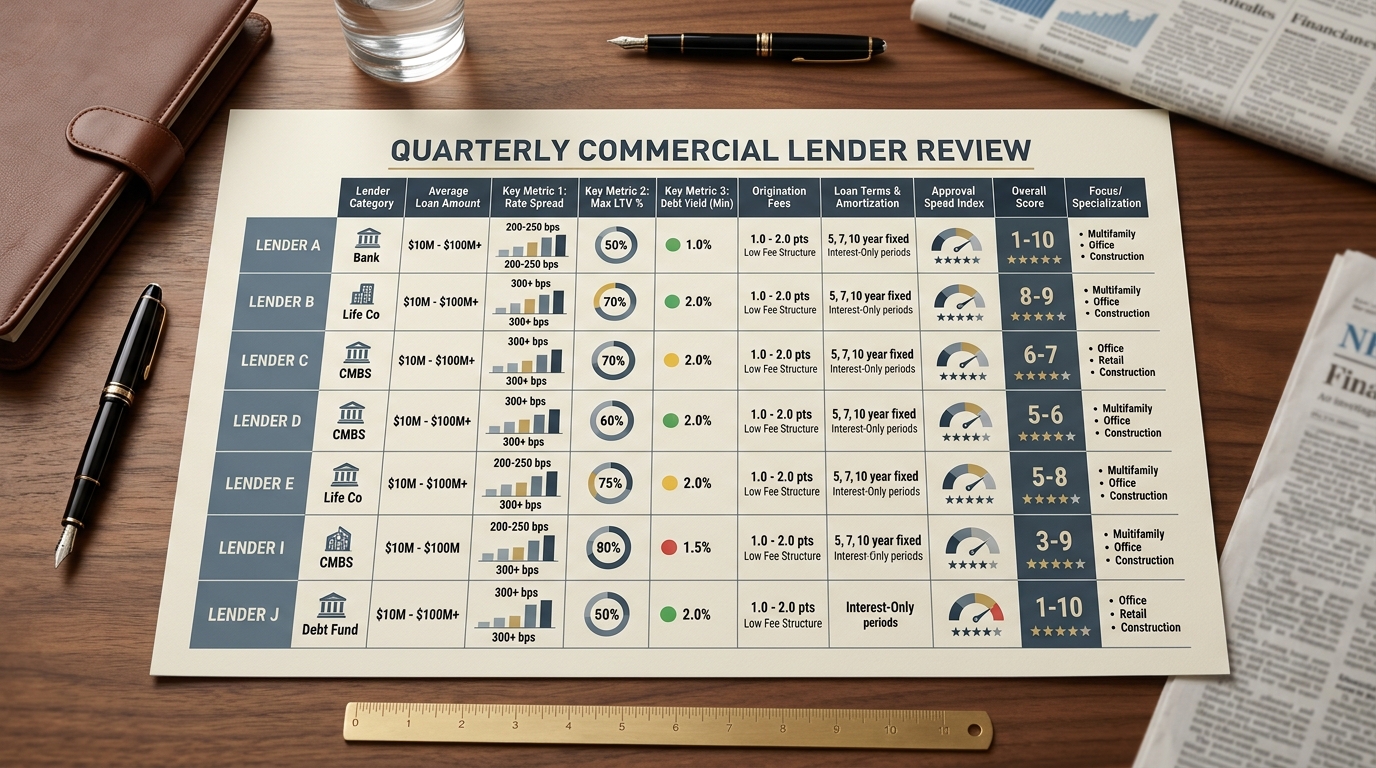
A comparative table illustrating the strengths and specializations of various commercial mortgage lenders for real estate investors.
To accurately project overall borrowing costs, investors should regularly track current benchmark interest rates across banking channels before locking in loan quotes.
Top Lenders by Asset Class (Multifamily, Retail, Office)
Different commercial lenders specialize in specific property types to manage portfolio risk and leverage focused asset management expertise.
       COMMERCIAL REAL ESTATE CAPITAL SOURCES BY ASSET CLASS
 ┌──────────────────────┬──────────────────────┬──────────────────────┐
 │     MULTIFAMILY      │ INDUSTRIAL & LOGISTICS│ RETAIL & OFFICE     │
 ├──────────────────────┼──────────────────────┼──────────────────────┤
 │ Agency (Fannie/Fred) │ Life Insurance Co.   │ Regional Banks       │
 │ HUD / FHA            │ Commercial Banks     │ Private Debt Funds   │
 │ Regional Banks       │ CMBS Conduit Lenders │ CMBS Conduit Lenders │
 └──────────────────────┴──────────────────────┴──────────────────────┘
Multifamily Property Lenders
Agency lenders backed by Fannie Mae and Freddie Mac dominate multifamily real estate financing. They offer non-recourse, long-term fixed rates (up to 30 years) with competitive loan-to-value limits up to 80%. For smaller multifamily deals ($1M to $7.5M), Agency Small Balance Loan (SBL) programs provide streamlined underwriting and lower closing costs.
Industrial & Logistics Property Lenders
Life insurance companies (such as MetLife, Prudential, and Northwestern Mutual) offer some of the lowest commercial real estate interest rates for prime industrial assets. Life companies seek conservative leverage (50%–65% LTV) backed by long-term leases with creditworthy corporate tenants, delivering predictable multi-decade yield returns.
Retail and Office Property Lenders
Given shifting structural demand in office and retail sectors, lenders evaluate these assets through stringent cash flow testing. Regional banks and CMBS (Commercial Mortgage-Backed Securities) conduit lenders lead financing for grocery-anchored retail centers and high-occupancy office assets, focusing heavily on lease rollover schedules, tenant credit ratings, and anchor tenant longevity.
Commercial Mortgage Brokers vs. Direct Banks
Navigating the commercial debt market requires choosing whether to work directly with a bank lender or engage an experienced commercial mortgage broker.
What is the difference between mortgage broker rates and bank rates?
The difference between mortgage broker rates and bank rates lies in market access and pricing structure. Direct banks offer single-institution rates with lower upfront fees, while mortgage brokers shop across dozens of lenders to secure wholesale rates and customized loan structures.

Visual comparison of commercial mortgage rates and terms offered by direct banks versus those secured through mortgage brokers.
Direct Bank Execution
Approaching direct bank lenders eliminates third-party brokerage fees. This approach works exceptionally well for experienced investors who maintain existing banking relationships, possess pristine balance sheets, and require standard, straightforward financing for stabilized properties.
Commercial Mortgage Broker Advantages
Commercial mortgage brokers act as independent financial advisors who represent the borrower. Key benefits of utilizing a broker include:
- Extensive Capital Network: Brokers distribute loan packages across nationwide networks of banks, debt funds, life companies, and private syndicates to solicit competing quotes.
- Complex Deal Structuring: Ideal for transactions requiring specialized capital stacks, mezzanine debt, preferred equity, or non-recourse execution.
- Negotiation Leverage: By creating competitive bidding environments, brokers force lenders to compress pricing margins, waive covenants, or improve loan terms.
Investors seeking to maximize their borrowing leverage should learn how to effectively negotiate term sheets and rates to secure optimal pricing regardless of whether they execute directly or through a broker.
Specialized Lenders: SBA 7(a), 504, and Bridge Financing
For specialized use cases, alternative commercial lending platforms provide tailored structural solutions that conventional bank loans cannot match.
1. SBA 7(a) Loan Program
Administered by approved commercial banks and guaranteed by the U.S. Small Business Administration, the SBA 7(a) program provides owner-occupied business owners with funding up to $5 million. (SBA 7(a) program)
- Best For: Small business owner-occupiers acquiring commercial real estate with low down payments (10%).
- Key Terms: Up to 25-year fully amortizing terms, floating rates tied to Prime, and flexible working capital allocations.
2. SBA 504 Loan Program
The SBA 504 program pairs a private commercial bank loan (50% LTV) with a certified development company (CDC) debenture backed by the SBA (40% LTV), requiring only a 10% borrower equity contribution.
- Best For: Long-term fixed-rate financing for major owner-occupied real estate acquisitions and equipment expansion.
- Key Terms: Below-market, 10-, 20-, or 25-year fixed interest rates on the CDC debenture portion.
3. Private Bridge & Debt Fund Lenders
When properties require heavy renovation, lease-up stabilization, or rapid closing execution within 15 to 30 days, non-bank private debt funds step in.
- Best For: Value-add acquisitions, opportunistic property turnarounds, and short-term debt coverage.
- Key Terms: Interest-only payments, 1- to 3-year loan terms, flexible exit structures, higher interest rates (8.50% to 12.00%+), and higher origination fees (1% to 2%).
Commercial Loan Fee Breakdown (Origination, Appraisal, Legal)
Evaluating total financing expenses requires accounting for third-party closing costs and lender administrative fees beyond headline interest rates.
What closing costs and fees are associated with commercial real estate loans?
Closing costs for commercial real estate loans typically total 1% to 3% of the total loan amount. Standard fees include lender origination fees (0.5%–1%), commercial property appraisals ($3,000–$7,000+), Phase I environmental reviews ($2,000–$4,000), legal fees, and title insurance.
Here is a breakdown of standard commercial loan closing fees:
- Lender Origination Fee: Charged by the bank or lender for processing and underwriting the loan. Typically ranges from 0.50% to 1.00% of the total loan amount.
- Commercial Property Appraisal Fee: Independent valuation ordered by the lender to verify property value. Commercial appraisals cost between $3,000 and $8,000+, depending on asset complexity and square footage.
- Phase I Environmental Site Assessment (ESA): Evaluates environmental liability and historical land use. Costs range from $2,000 to $4,500.
- Property Condition Assessment (PCA): Engineering inspection evaluating structural, HVAC, roofing, and mechanical systems. Costs range from $2,500 to $5,000.
- Lender Legal Counsel Fee: Borrowers are responsible for paying the legal fees incurred by the lender’s counsel to draft loan documents. Fees range from $3,500 to $10,000+.
- Title Insurance & Escrow Fees: Variable expenses based on total purchase price and state title rate schedules.
Understanding these fee categories helps borrowers prepare their cash reserves and meet core lender qualifying criteria during underwriting.
Frequently Asked Questions
Which bank is best for commercial real estate loans?
The best bank depends on deal size and property type. Major national banks like Chase and Wells Fargo excel at large institutional loans, while regional institutions like PNC and M&T Bank offer greater flexibility and better terms for mid-market local investments.
What is the difference between direct commercial lenders and mortgage brokers?
Direct commercial lenders fund loans from their own balance sheets or capital reserves. Commercial mortgage brokers act as intermediaries who package loan applications and submit them to multiple institutional lenders to secure the best rates and terms for borrowers.
Do commercial mortgage brokers charge fees to the borrower?
Yes, commercial mortgage brokers typically charge a brokerage fee of 0.50% to 1.00% of the loan amount, paid at closing. In some instances, lenders pay the broker fee directly out of the loan yield spread.
How do SBA commercial real estate loans differ from conventional bank loans?
SBA loans require significantly lower down payments (10% vs. 25%–35% for conventional loans) and offer longer fully amortizing terms (25 years without balloon payments), making them ideal for small business owner-occupiers.
Disclaimer: Lender terms, pricing schedules, and loan product availability are subject to underwriting approval and macroeconomic conditions. Consult with a qualified commercial mortgage advisor to determine the optimal lender for your portfolio.