
Free Commercial Loan Amortization Calculator
Analyzing commercial real estate debt demands quick, reliable calculations. Use our free commercial loan amortization calculator below to estimate your monthly principal and interest payments, evaluate debt service obligations, and project remaining balances across various loan terms and amortization periods.
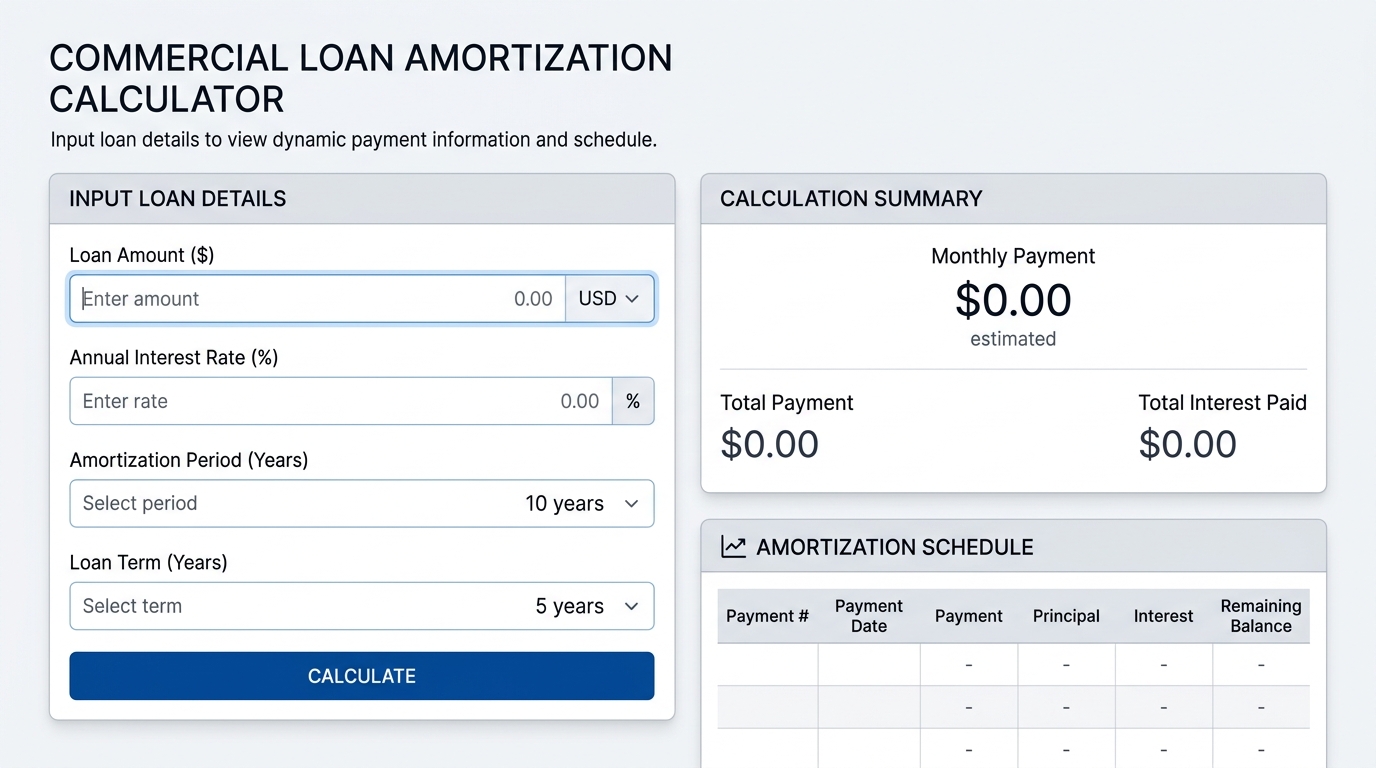
Our free commercial loan amortization calculator provides quick estimates for monthly payments and remaining balances.
How to Calculate Commercial Loan Amortization Step-by-Step
Understanding how to calculate commercial loan amortization allows deal underwriters and real estate investors to manually verify debt schedules and model customized loan terms.
To calculate monthly principal and interest payments for a commercial mortgage, follow these three steps:
-
Determine the Monthly Interest Rate ($r$): Divide the annual interest rate by 12 months.
$$r = \frac{\text{Annual Interest Rate}}{12}$$ -
Determine the Total Number of Payments ($n$): Multiply the amortization period in years by 12 months.
$$n = \text{Amortization Period (Years)} \times 12$$ -
Calculate the Monthly Debt Payment ($M$): Apply the standard loan amortization payment formula using loan principal ($P$):
$$M = P \times \left[ \frac{r(1 + r)^n}{(1 + r)^n – 1} \right]$$
How Do You Use a Commercial Loan Calculator to Project DSCR?
A commercial real estate loan payment calculator is an essential tool for evaluating the Debt Service Coverage Ratio (DSCR) of an income-producing asset. Lenders require a minimum DSCR—typically between 1.25x and 1.35x—to ensure property revenue easily covers debt obligations.
Step-by-Step DSCR Projection Process
- Calculate Net Operating Income (NOI): Determine the property’s gross revenue minus operating expenses (excluding debt service and income taxes).
- Calculate Annual Debt Service: Enter your loan amount, interest rate, and amortization period into the commercial loan amortization calculator to find the monthly payment ($M$). Multiply $M$ by 12 to establish annual debt service.
- Divide NOI by Annual Debt Service:
$$\text{DSCR} = \frac{\text{Net Operating Income}}{\text{Annual Debt Service}}$$
Practical DSCR Example
Suppose an industrial building generates $180,000 in Net Operating Income. You plan to secure a $1,500,000 mortgage at 6.00% interest amortized over 25 years.
- Monthly Payment ($M$): $9,664.52
- Annual Debt Service ($9,664.52 \times 12$): $115,974.24
- DSCR Calculation:
$$\text{DSCR} = \frac{\$180,000}{\$115,974.24} = 1.55\text{x}$$
Because 1.55x comfortably exceeds standard lender requirements (1.25x), this deal structure presents low financial risk to potential lenders. To gain a deeper foundational understanding of broader underwriting guidelines and debt structures, read our complete guide on commercial real estate loan amortization.
Commercial Loan Amortization Formula Explained
The mathematical engine behind any commercial loan amortization calculator relies on compound interest payment mechanics.
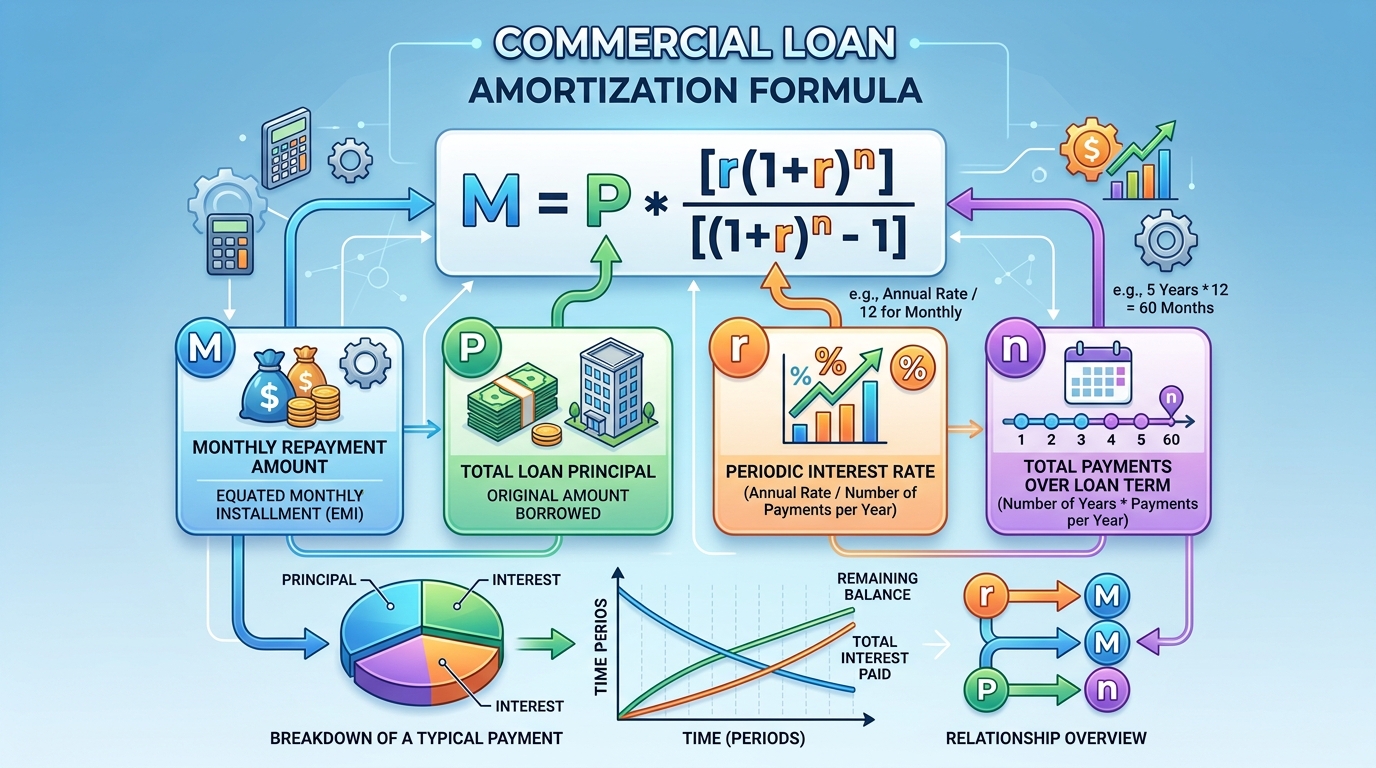
The commercial loan amortization formula breaks down monthly payments into principal and interest components.
Components of the Amortization Formula
- $M$ (Total Monthly Payment): The constant dollar amount paid each month.
- $P$ (Principal Loan Amount): The starting borrowed amount.
- $r$ (Periodic Interest Rate): The annual rate expressed as a decimal divided by 12.
- $n$ (Total Amortization Months): Total months required for complete principal paydown.
Breaking Down the Principal & Interest Allocation
Each monthly payment consists of two parts:
$$\text{Interest Portion} = \text{Current Principal Balance} \times r$$
$$\text{Principal Portion} = M – \text{Interest Portion}$$
As the loan balance is gradually reduced, the monthly interest portion decreases, accelerating the principal reduction.
When a commercial mortgage has a short maturity term (e.g., a 5-year or 10-year loan term), the remaining principal at maturity must be paid off. Our calculator calculates this balance automatically, making calculating a balloon payment simple and immediate. Furthermore, for deals featuring initial debt relief periods, you can run an interest-only payment calculation to evaluate short-term liquidity benefits.
Frequently Asked Questions (FAQ)
Can I calculate commercial loan amortization in Excel?
Yes. You can use Excel’s builtin =PMT(rate/12, nper, -pv) function to calculate monthly payments, or =PPMT() and =IPMT() to calculate principal and interest distributions for any specific payment period.
Why does a longer amortization schedule lower my monthly loan payment?
Extending the amortization period (e.g., from 20 years to 25 years) spreads principal repayment across 60 additional monthly payments ($n = 300$ vs $n = 240$), reducing the principal component required in each monthly installment.
How do I calculate a balloon payment using an amortization schedule?
To determine the balloon payment, generate a standard monthly amortization schedule up to the maturity month (e.g., Month 60 for a 5-year loan term). The remaining principal balance listed at that specific month represents the exact balloon payment due.