

The Complete Guide to Commercial Property Loan Rates
Navigating commercial real estate (CRE) financing can feel significantly more complex than securing a residential mortgage. While residential loans are largely standardized around consumer credit scores and government-backed guarantees, commercial mortgage rates are driven by custom risk assessments, underlying financial market benchmarks, and bespoke lender pricing models.
Whether you are acquiring an industrial facility, refinancing a multi-tenant retail strip, or stabilizing a multifamily property, understanding how commercial lenders price their capital is essential for minimizing your overall cost of capital. In this guide, we break down the mechanics of commercial loan rate determination, explain how lenders calculate risk spreads, and highlight actionable steps you can take to position your deal for optimal pricing.
What Determines Commercial Mortgage Rates?
Commercial mortgage rates are determined by combining a benchmark market rate index (such as U.S. Treasury yields or the Secured Overnight Financing Rate) with a lender-defined risk premium. Key factors influencing this risk spread include property Loan-to-Value (LTV), Debt Service Coverage Ratio (DSCR), borrower creditworthiness and liquidity, asset location, and physical property class.

A visual breakdown of the components that influence commercial mortgage rates, from market benchmarks to property-specific risk factors.
Unlike residential loans, which rely heavily on standardized underwriting software, commercial lenders evaluate each transaction as an independent business venture. The base interest rate acts as the lender’s baseline cost of funds, while the risk premium reflects the perceived likelihood of default or loss given default. Lenders also adjust rates based on current economic cycles, liquidity within capital markets, and their internal portfolio concentration limits for specific property types.
How Are Commercial Loan Rates Calculated?
To understand how your final interest rate is established, it helps to review the step-by-step formula lenders use during term sheet drafting and underwriting:
- Establish the Base Benchmark Index: The lender selects an appropriate reference index corresponding to the loan structure. Fixed-rate commercial loans typically reference 5-year, 7-year, or 10-year U.S. Treasury yields, while floating-rate loans use 30-day SOFR (Secured Overnight Financing Rate). (Secured Overnight Financing Rate (SOFR)) (U.S. Treasury yields)
- Calculate the Baseline Lender Margin: The lender adds an initial credit spread (often ranging between 150 and 350 basis points) to cover administrative overhead, capital allocation costs, and baseline profit margins.
- Adjust for Property Risk & Asset Class: The spread is adjusted based on property quality, tenant creditworthiness, and lease duration. Core assets in primary markets receive tighter spreads, whereas value-add properties or special-purpose assets incur a rate premium.
- Evaluate Leverage and Cash Flow Coverage: High Loan-to-Value ratios (above 70%) increase financial leverage, prompting lenders to widen the spread. Conversely, robust Debt Service Coverage Ratios (above 1.35x) provide cushion against revenue shortfalls and reduce the interest rate. To evaluate how these specific leverage metrics impact your loan quote, explore key factors affecting commercial real estate rates.
- Factor in Borrower Experience & Liquidity: Sponsors with proven track records, high net worth, and substantial post-closing liquidity reserves are rewarded with spread discounts.
- Sum the Index and Total Risk Spread: The final coupon rate equals the reference benchmark index rate plus the total calculated risk spread.
Commercial Loan Pricing Models Explained
Commercial lenders utilize structured pricing models to maintain risk-adjusted returns across their loan portfolios. These models convert qualitative asset assessments and quantitative financial ratios into a precise interest rate.
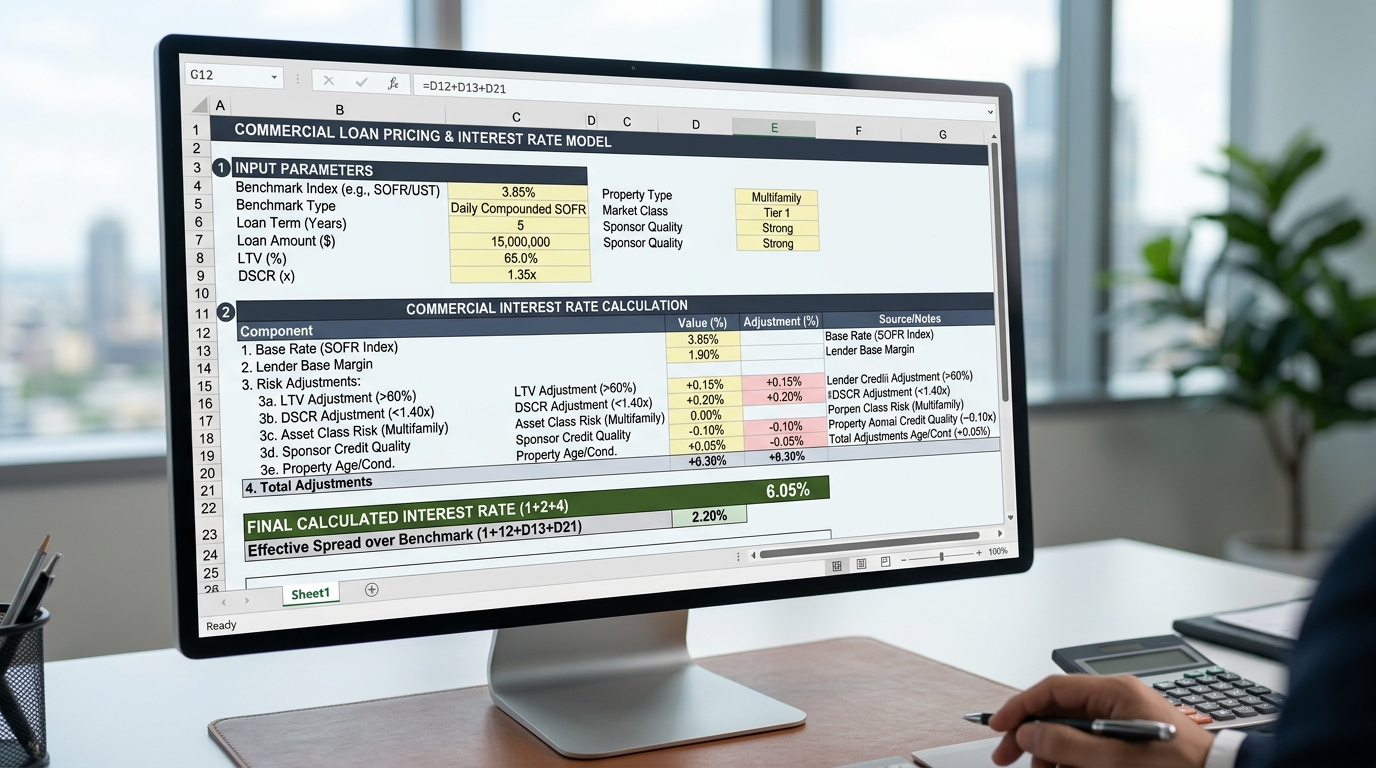
An example of a commercial lender’s internal spreadsheet model used to calculate and price commercial real estate loans.
Understanding the Commercial Real Estate Risk Premium
The commercial real estate risk premium represents the additional yield a lender demands above a risk-free benchmark (such as U.S. Treasuries) to compensate for illiquidity, operational risk, and market volatility.
Lenders divide the risk premium into distinct components:
- Default Risk Premium: Reflects the probability that the borrower will fail to meet debt service obligations. This is evaluated primarily through property NOI stability and tenant lease creditworthiness.
- Term Risk Premium: Longer loan terms (such as 10-year fixed terms compared to 3-year floating bridge loans) carry interest rate risk and inflation exposure, requiring higher spreads.
- Liquidity Premium: Commercial properties cannot be liquidated instantly. Lenders charge a premium for holding illiquid real estate collateral compared to publicly traded securities.
- Prepayment & Extension Risk: Lenders model early loan payoff risks and potential extension options, adjusting loan spreads or imposing yield maintenance clauses accordingly.
Commercial Lender Interest Rate Calculation Formulas
While individual lending institutions maintain proprietary pricing algorithms, most commercial loan risk calculations follow a standardized mathematical framework:
$$\text{Commercial Loan Rate} = \text{Benchmark Index Yield} + \text{Base Margin} + \Delta\text{LTV Risk} + \Delta\text{DSCR Risk} + \Delta\text{Asset Class Risk}$$
Where:
* Benchmark Index Yield: The prevailing rate for Treasuries or SOFR. You can compare benchmark rate indices to see how base yields shift over different economic cycles.
* Base Margin: The bank or institutional lender’s base operational margin.
* $\Delta$ Financial Modifiers: Incremental basis point adjustments added or subtracted based on underwriting metrics.
For example, if the 10-Year U.S. Treasury yield is 4.00%, the lender’s base margin is 2.00% (200 basis points), an LTV under 65% grants a 0.20% (20 bps) discount, and a retail asset class carries a 0.35% (35 bps) surcharge, the final commercial mortgage rate would be calculated as:
$$4.00\% + 2.00\% – 0.20\% + 0.35\% = 6.15\%$$
By analyzing each variable in this equation, borrowers can intentionally structure their financing requests to target specific pricing discounts before submitting loan applications.
Frequently Asked Questions (FAQ)
What is the difference between commercial and residential mortgage pricing?
Residential mortgages rely heavily on personal credit scores, standardized debt-to-income (DTI) ratios, and secondary market liquidity (Fannie Mae / Freddie Mac). Commercial mortgage pricing focuses primarily on the income generated by the underlying commercial property, its cash flow coverage (DSCR), property type risk, and market dynamics.
Why do commercial lenders charge higher interest rates on secondary property types?
Secondary and tertiary property types (such as specialized industrial facilities, hotels, or self-storage) face higher vacancy volatility and longer re-tenanting periods compared to core multifamily or grocer-anchored retail. Lenders add a higher risk spread to compensate for potential loss exposure.
How can borrowers lower their commercial loan pricing spread?
Borrowers can lower their interest rate spread by lowering the requested LTV (e.g., contributing more equity), demonstrating stronger property cash flows to boost DSCR, offering personal guarantees, or working with specialized capital advisors to execute actionable strategies to get the best commercial mortgage rate.
Do fixed-rate and floating-rate commercial loans use the same benchmark index?
No. Fixed-rate commercial mortgages generally benchmark against U.S. Treasury yields with matching maturities (5, 7, or 10 years). Floating-rate commercial loans typically reference short-term benchmark indices, most commonly the 30-day Secured Overnight Financing Rate (SOFR).