What are SBA commercial mortgage rates?
Small Business Administration (SBA) commercial mortgages represent a highly attractive financing avenue for small and mid-sized business owners purchasing, constructing, or refinancing owner-occupied commercial real estate. Because SBA loans carry government guarantees, lenders can extend financing with down payments as low as 10%—significantly lower than standard commercial bank guidelines.
SBA commercial mortgage rates are regulated interest rate structures governed by maximum rate caps tied to benchmark indices like the Prime Rate or U.S. Treasury yields. (U.S. Treasury yields) Understanding how SBA 504 and SBA 7(a) interest rates are calculated enables business owners to secure long-term capital while preserving operating liquidity.
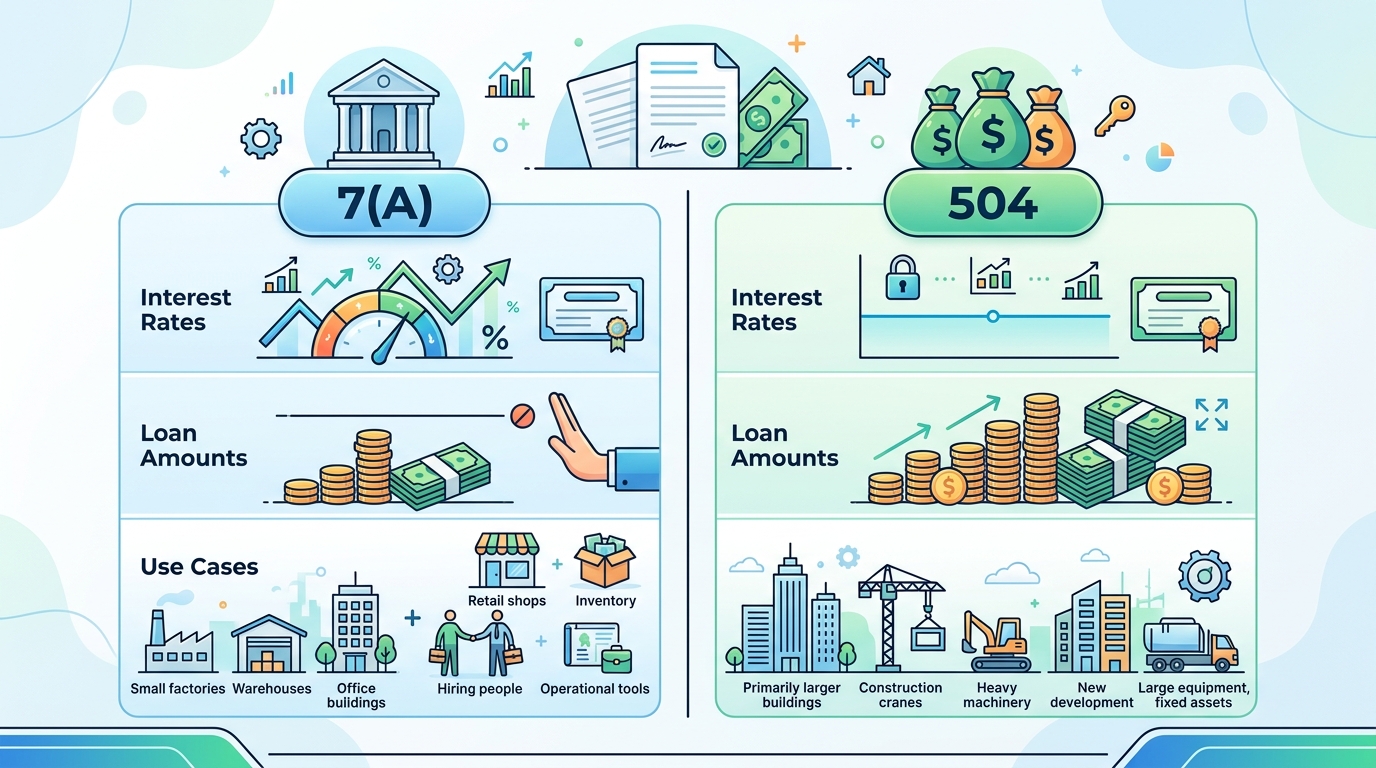
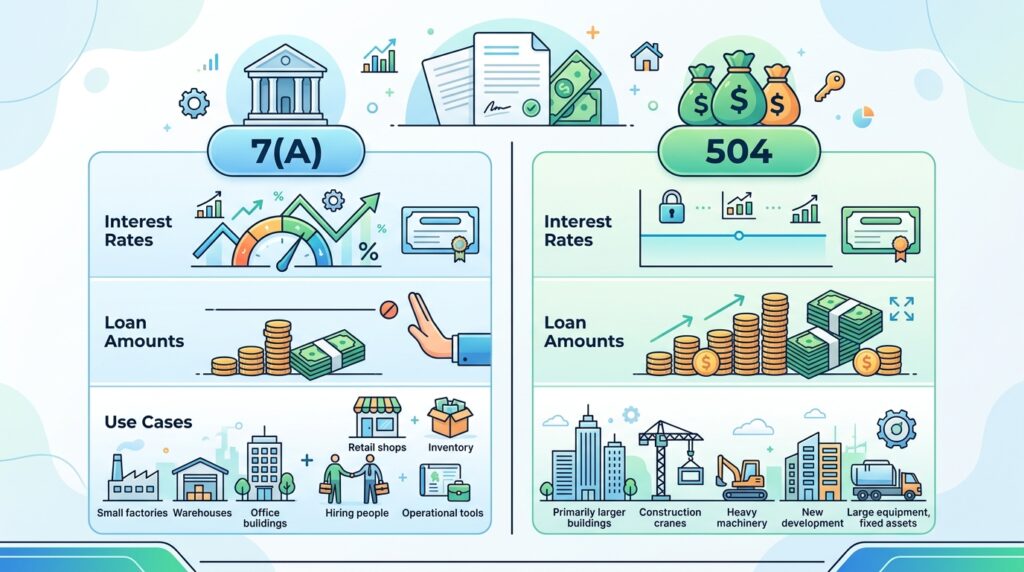
A visual comparison of the SBA 504 and 7(a) loan programs highlights their distinct features and rate structures.
What are the current interest rates for SBA 504 and 7(a) loans?
Summary: Current SBA commercial mortgage rates depend on whether you utilize the SBA 504 Program (fixed-rate financing split between a bank senior loan and a Certified Development Company debenture) or the SBA 7(a) Program (flexible, variable or fixed financing backed directly by an SBA-approved lender). (SBA 7(a) Program) (SBA 504 Program)
Program Structure & Rate Comparison Matrix
| Program Metric | SBA 504 Loan Program | SBA 7(a) Loan Program |
|---|---|---|
| Primary Use Case | Owner-occupied real estate & heavy equipment acquisitions | Real estate, working capital, business acquisitions |
| Maximum Loan Amount | Up to $5.0M – $5.5M (CDC debenture portion) | Up to $5,000,000 total loan size |
| Down Payment Requirement | 10% minimum for standard owner-occupied assets | 10% minimum for commercial real estate |
| Interest Rate Structure | 100% Fixed rates on CDC portion (pegged to 10-Yr Treasury) | Variable or Fixed rates (pegged to Prime Rate + spread) |
| Maximum Lender Spread | Regulated low market spreads | Max Prime + 2.25% to 2.75% (for loans > $50k) |
| Loan Term / Amortization | 20 or 25-year fully amortizing terms | Up to 25 years fully amortizing for real estate |
| Owner-Occupancy Rule | 51%+ for existing buildings; 60%+ for new ground-up | 51%+ for existing buildings; 60%+ for new ground-up |
SBA 504 Loan Rates Breakdown
The SBA 504 loan program is designed specifically for major fixed-asset purchases, such as owner-occupied commercial properties or industrial facilities. The 504 loan uses a unique three-tier structure:
- Bank / Private Lender Portion (50% of total deal): A senior lien provided by a commercial bank or credit union at competitive fixed or variable market rates.
- CDC / SBA Debenture Portion (40% of total deal): A junior lien provided through a Certified Development Company (CDC) backed by a 100% government guarantee. The CDC portion carries a 20- or 25-year fixed interest rate pegged to 10-Year U.S. Treasury yields plus a small administrative fee spread.
- Borrower Equity Contribution (10% of total deal): The business owner contributes a low 10% down payment (15% for single-purpose properties or startup businesses).
Because 40% of the capital stack is locked into long-term fixed rates via the CDC debenture, SBA 504 loan interest rates provide outstanding long-term rate predictability.

Understanding the fixed-rate structure of SBA 504 loans is crucial for long-term financial planning.
SBA 7(a) Loan Rates Breakdown
The SBA 7(a) program is the SBA’s flagship general business loan vehicle. While 7(a) funds can be used for working capital and equipment, loans backed by commercial real estate qualify for 25-year fully amortizing repayment schedules.
- Variable Rate Pricing: Most SBA 7a commercial real estate rates adjust quarterly based on the U.S. Prime Rate plus a lender spread regulated by SBA maximum caps.
- SBA Rate Cap Structure: For real estate loans exceeding $50,000 with terms over 7 years, lenders cannot exceed Prime + 2.25% to 2.75%.
- Fixed Rate Options: Lenders may offer fixed-rate 7(a) loans, priced using the SBA Peg Rate or Prime Rate plus an agreed fixed margin.
How to Qualify for SBA Commercial Real Estate Loans
Qualifying for SBA commercial real estate financing requires meeting both SBA eligibility requirements and individual lender underwriting criteria.
Primary SBA Qualification Criteria
- Owner-Occupancy Mandate: The borrowing business must physically occupy at least 51% of the rentable square footage of an existing commercial building (or 60% for new ground-up construction). Pure investment properties do not qualify.
- For-Profit Small Business Status: The company must operate as a for-profit entity, satisfy SBA size standards (net worth and income thresholds), and operate legally within the United States.
- Cash Flow & Debt Service Coverage: The operating business must demonstrate historical cash flow sufficient to achieve a minimum 1.15x to 1.25x Debt Service Coverage Ratio (DSCR) on proposed loan payments.
- Creditworthiness & Character: Business owners holding 20% or greater equity ownership must provide personal guarantees and satisfy borrower credit score requirements.
SBA Loans vs. Conventional Commercial Mortgages
Deciding between an SBA loan and a standard conventional bank mortgage depends on your business priorities, available equity capital, and timeline requirements.
Strategic Selection Considerations
- Equity Preservation vs. Rate Spreads: SBA loans require only 10% down, allowing business owners to conserve operating cash. Conventional loans typically require 20% to 35% down.
- Prepayment Penalties: SBA 504 loans feature a 10-year step-down prepayment structure on the CDC debenture, while SBA 7(a) loans carry a mild 3-year step-down penalty (5%, 3%, 1%). Conventional bank loans often utilize yield maintenance or defeasance.
- Fee Comparison: SBA loans include an upfront SBA Guarantee Fee (typically 3.0% to 3.75% of the guaranteed portion, which can be rolled into the loan balance). Borrowers should compare SBA guarantee fees vs standard costs when analyzing total capital expenditure.
- Market Rate Comparison: To select the ideal financing channel for your business property, owners should compare against conventional commercial rates across major lending institutions.