The Commercial Loan Underwriting Process & Committee Guide
Commercial real estate underwriting represents the core analytical engine of commercial lending. Before a bank or private credit institutional lender risks capital on an asset, commercial underwriters perform comprehensive credit, financial, and market audits to quantify risk. Demystifying how underwriters analyze deals and how credit committees make funding decisions provides borrowers with a distinct advantage when securing capital.
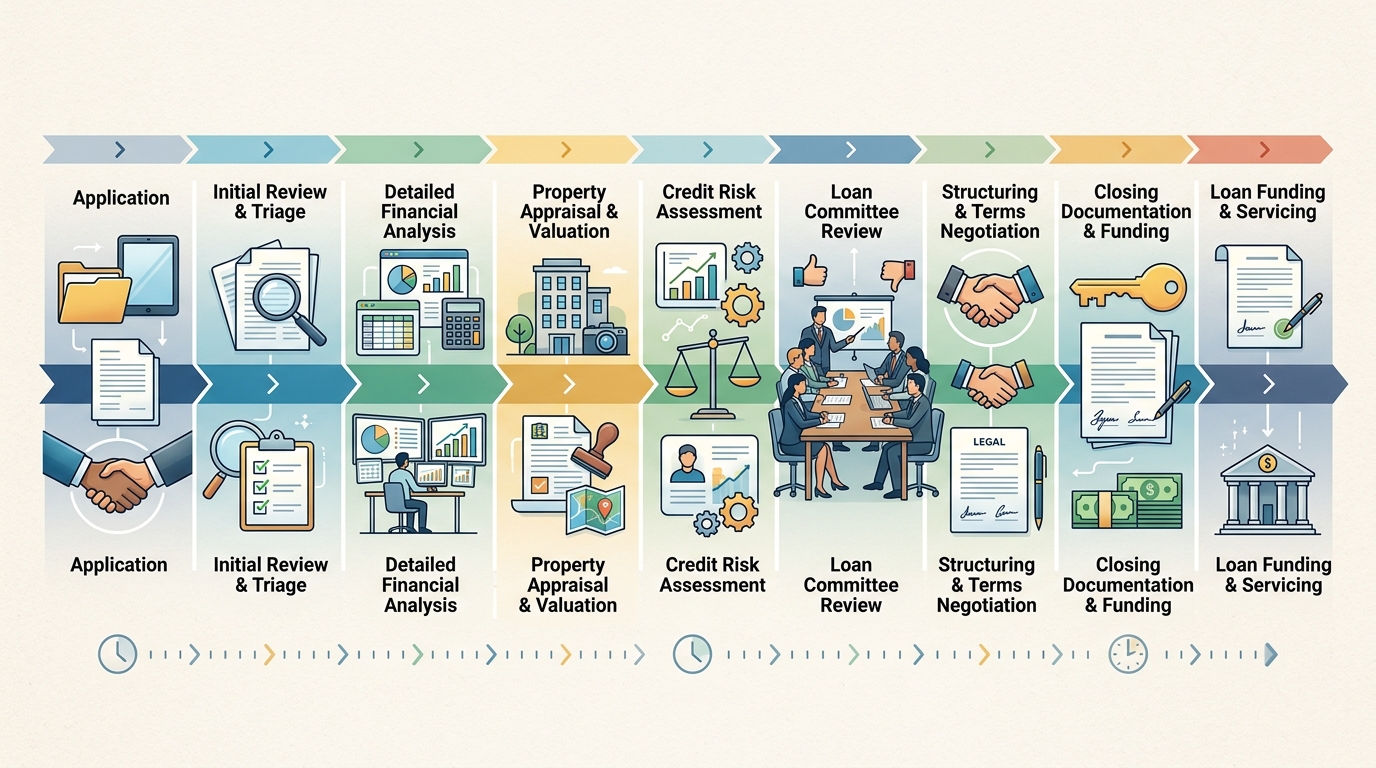
A visual representation of the typical commercial loan underwriting process and its associated timeline.
What is the Commercial Loan Underwriting Process?
The commercial loan underwriting process is an in-depth financial, physical, and legal audit conducted by a commercial lender to evaluate loan repayment capability. Underwriters analyze property cash flows, sponsor creditworthiness, market fundamentals, valuation reports, and environmental risk factors to determine whether proposed loan terms satisfy credit policy benchmarks.
Unlike residential underwriting, which relies heavily on automated scoring and personal income statements, commercial mortgage underwriting requires tailored financial modeling, property cash flow stress testing, and subjective risk assessment.
Commercial Mortgage Underwriting Timeline: How Long Is It?
The commercial mortgage underwriting timeline typically spans 14 to 30 days, operating concurrently with property due diligence and third-party report production.
The underwriting phase begins once a complete loan package and initial appraisal deposits are received. The timeline is divided into distinct operational milestones:
- Days 1–5: Financial modeling, tax return reconciliation, historical rent roll auditing, and sponsor background checks.
- Days 6–15: Review of incoming third-party appraisal reports, Phase I Environmental Site Assessments (ESA), and Property Condition Assessments (PCA).
- Days 16–22: Underwriter credit memo compilation, sensitivity analysis, and preliminary submission to credit risk management.
- Days 23–30: Formal presentation to the institutional commercial real estate loan committee, voting, and issuance of conditional loan terms.
Understanding this sequence alongside the broader commercial real estate financing timeline helps borrowers align closing deadlines accurately.
Key Ratios in CRE Loan Underwriting
Commercial underwriters evaluate loan requests through core financial metrics designed to test cash flow durability and loss severity in economic downturns.
Debt Service Coverage Ratio (DSCR) Requirements
The Debt Service Coverage Ratio (DSCR) measures a property’s annual cash flow relative to its annual debt service obligations (principal and interest). It represents the primary metric commercial lenders use to verify cash flow safety margins.
DSCR Formula:
DSCR = Net Operating Income (NOI) / Total Annual Debt Service
DSCR Benchmarks
- 1.20x to 1.25x: Standard minimum baseline for stabilized multifamily and commercial assets.
- 1.30x to 1.35x: Required threshold for riskier commercial property classes (e.g., hospitality, specialized retail, single-tenant assets).
- Below 1.15x: Generally considered unbankable by traditional institutional lenders, requiring debt restructuring or higher sponsor equity contributions.
For example, if a commercial office building generates $125,000 in annual Net Operating Income and has $100,000 in proposed annual principal and interest payments, its DSCR is 1.25x—satisfying standard underwriting requirements.
Loan-to-Value (LTV) and Debt Yield
In addition to cash flow coverage ratios, underwriters utilize asset protection benchmarks to limit downside capital risk:
- Loan-to-Value (LTV) Ratio: Calculates loan amount relative to appraised property value (
LTV = Loan Amount / Appraised Value). Conventional commercial lenders limit LTV to between 65% and 75%, ensuring substantial borrower equity cushion. - Debt Yield: Evaluates lender risk independent of interest rate fluctuations or loan amortization periods (
Debt Yield = Net Operating Income / Total Loan Amount). Lenders typically seek a minimum debt yield of 9% to 11%.
Understanding these core financial metrics is integral to navigating the entire commercial real estate loan approval process.
What Happens During a Commercial Real Estate Loan Committee Review?
The commercial real estate loan committee serves as the ultimate credit approval authority within a lending institution. Composed of senior credit officers, executive management, and chief risk officers, the committee reviews underwriter findings to sanction or decline capital commitments.

The structured environment of a commercial real estate loan committee review meeting, where senior credit officers evaluate loan proposals.
Preparing the Credit Memo
Before the committee convenes, the underwriter authors a comprehensive document known as the Credit Memorandum (or Loan Committee Package). This detailed dossier includes:
- Executive Summary & Deal Structure: Loan request details, interest rates, term lengths, and proposed recourse terms.
- Sponsor & Guarantor Analysis: Liquidity reserves, net worth, historical real estate experience, and credit background.
- Property Performance & Rent Roll Audit: Historical income trends, tenant lease expiration schedules, tenant creditworthiness, and local market absorption rates.
- Third-Party Summary: Key takeaways from independent appraisal valuations, Phase I ESA findings, and engineering assessments.
- Sensitivity & Stress Testing: Scenarios testing how occupancy drops, interest rate spikes, or operating expense increases impact DSCR performance.
Loan Committee Voting and Conditional Approvals
During the committee session, the underwriter presents the deal, highlighting potential risks and mitigation factors. Committee members cross-examine the presentation, evaluating portfolio concentration limits, economic trends, and credit policy alignment.
The committee renders one of three decisions:
* Approved as Presented: The loan is approved under the proposed terms.
* Approved Subject to Conditions (Conditional Approval): The loan is approved provided specific criteria are met (e.g., lowering loan amount to achieve a 1.30x DSCR, requiring additional interest reserves, or requiring personal guarantees).
* Declined: The loan request is rejected due to unmitigated risk factors.
Upon conditional approval, the lender prepares a formal commercial loan commitment letter outlining binding terms and closing obligations.
Common CRE Loan Underwriting Red Flags
Underwriters are trained to identify hidden risks that could endanger loan performance. Common red flags that can disrupt credit reviews include:
- Unrealistic Expense Ratio Assumptions: Reporting property operating expenses below realistic market norms (e.g., projecting expenses at 20% of gross revenue when industry averages run 35%–45%).
- Upcoming Lease Expirations: Large lease rollover concentrations where major tenants have lease expirations within 12–24 months of loan closing.
- Unverified One-Time Income Inclusions: Including temporary, non-recurring fees or capital infusions into baseline Net Operating Income calculations.
- Sponsor Cash-Out Excessive Leverage: Transactions where sponsors seek substantial cash-out distributions without sufficient capital reinvestment into property maintenance.
- Environmental or Deferred Maintenance Liabilities: Adverse Phase I ESA findings or engineering reports detailing major immediate capital expenditure requirements.
FAQ
What DSCR ratio is needed for commercial loan approval?
Most commercial lenders require a minimum Debt Service Coverage Ratio (DSCR) of 1.20x to 1.25x for stabilized commercial properties. Higher-risk property types, such as hotels or single-tenant retail buildings, may require DSCR thresholds of 1.30x to 1.35x.
What is a credit memo in commercial real estate underwriting?
A credit memo is a comprehensive narrative document prepared by a commercial underwriter for the loan committee. It details property cash flows, sponsor financial strength, market comparisons, appraisal valuations, environmental reports, risk factors, and stress-testing analysis.
How long does a commercial real estate loan committee review take?
Loan committees typically meet weekly or bi-weekly. Once an underwriter completes the credit memo, formal loan committee review and voting usually takes 3 to 7 days.
What happens if a commercial loan is approved with conditions?
A conditional approval means the credit committee has approved funding provided specific requirements are satisfied prior to closing. Common conditions include adding interest reserves, providing additional tax documentation, securing tenant estoppel certificates, or adjusting the loan amount to meet LTV/DSCR requirements.