The Complete Commercial Real Estate Loan Approval Process
Navigating the commercial real estate loan approval process can seem daunting to investors, business owners, and developers alike. Unlike residential mortgages, which rely primarily on personal income and credit scores, commercial property financing evaluates both the creditworthiness of the borrower and the cash-generating potential of the underlying property. Understanding each stage of this journey enables applicants to assemble competitive packages, minimize delays, and secure favorable financing terms in 2026.
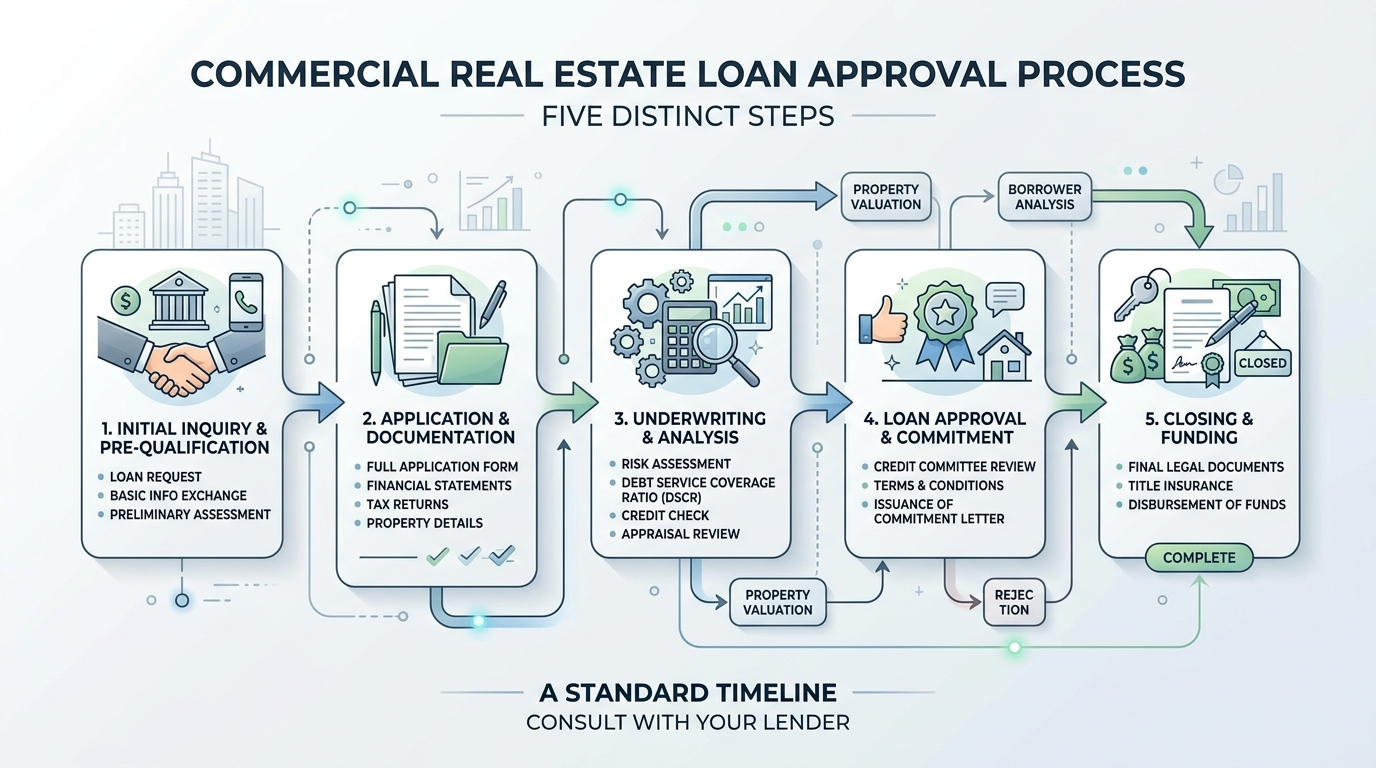
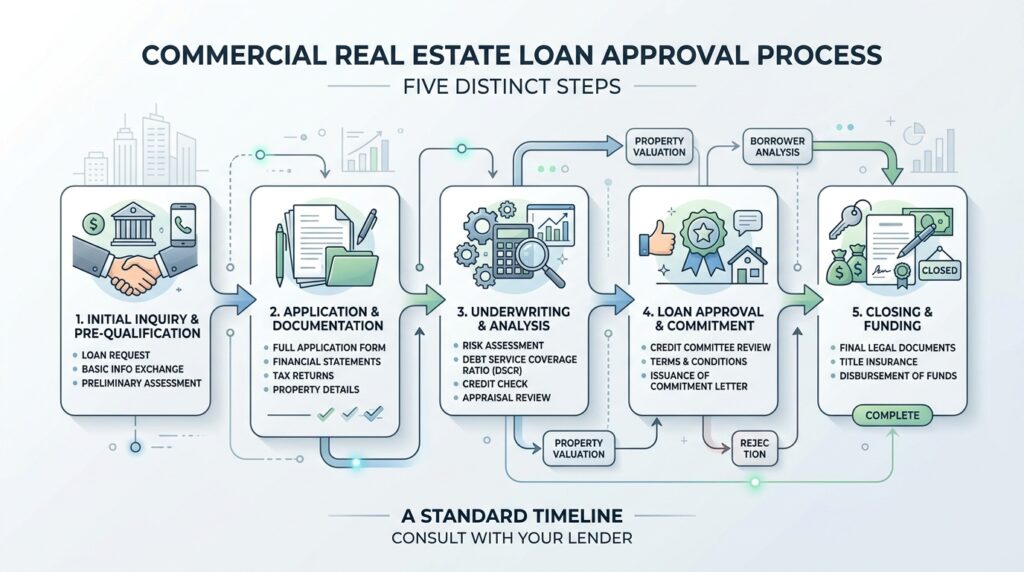
The commercial real estate loan approval process typically involves five key steps, guiding borrowers from initial inquiry to final funding.
What is the Commercial Real Estate Loan Approval Process?
The commercial real estate loan approval process is a comprehensive evaluation performed by commercial lenders—including commercial banks, credit unions, life insurance companies, CMBS (Commercial Mortgage-Backed Securities) lenders, and private debt funds—to determine whether to fund a commercial property transaction.
During this multi-stage evaluation, lenders analyze property financial performance, market conditions, borrower creditworthiness, historical cash flow, and environmental risks. The overarching goal is to verify that the property generates sufficient income to service debt obligations while maintaining adequate risk buffers for both borrower and lender.
How to Get Approved for a Commercial Real Estate Loan
Securing commercial property financing requires rigorous preparation and financial transparency. Lenders evaluate applications through two primary lenses: borrower strength and property cash flow. Knowing how to get approved for a commercial real estate loan starts with meeting foundational underwriting thresholds long before submitting a formal application.
Key Approval Requirements & Criteria
To qualify for commercial real estate financing, applicants typically need to satisfy the following industry-standard benchmarks:
- Debt Service Coverage Ratio (DSCR): Lenders require a minimum DSCR of 1.20x to 1.35x. A DSCR of 1.25x indicates that net operating income (NOI) covers debt payments by 125%.
- Loan-to-Value (LTV) Ratio: Standard commercial LTV limits range between 65% and 75% for conventional loans, requiring borrowers to contribute 25% to 35% in equity down payment.
- Credit Score: Principal sponsors generally need a minimum personal credit score of 680 to 720, though non-recourse lenders focus more heavily on asset performance.
- Global Cash Flow & Net Worth: Lenders often look for a borrower net worth equal to or exceeding the total loan amount, along with liquid liquidity reserves equal to 6 to 12 months of principal and interest payments.
Understanding these foundational criteria helps you prepare your financial statements and property reports to meet lender expectations seamlessly.
Commercial Real Estate Pre-Approval vs. Approval
Borrowers frequently confuse early stage lender indications with formal loan decisions. Distinguishing between pre-approval and full loan approval is critical when submitting purchase offers:
- Letter of Intent (LOI) / Pre-Qualification: A non-binding preliminary assessment outlining potential loan terms, pricing, and structure based on unverified information provided by the applicant.
- Pre-Approval / Term Sheet: An initial underwriting review that indicates a lender’s willingness to proceed subject to formal verification, appraisal, and loan committee sanction.
- Formal Loan Approval (Commitment Letter): A legally binding document issued after full credit underwriting, property valuation, and loan committee review detailing final interest rates, covenants, and closing conditions.
Reviewing the entire commercial mortgage approval timeline provides further clarity on how pre-approval transitions into full underwriting.
The 5 Steps of Commercial Property Loan Approval
The journey from initial loan inquiry to wire transfer follows a structured five-step lifecycle. Each step requires specific documentation and active collaboration between the borrower, loan broker, underwriter, and third-party vendors.
Step 1: Pre-Qualification and LOI
The process begins with initial discussions where the lender reviews executive summaries, property rent rolls, and historical financial statements. If the deal meets the lender’s preliminary credit guidelines, the lender issues a Letter of Intent (LOI) or Term Sheet detailing proposed interest rates, loan terms, amortizations, and estimated third-party fees.
Step 2: Documentation and Application
Once the borrower countersigns the LOI and remits the initial expense deposit, formal application processing commences. The applicant submits a full documentation package including:
* Three years of personal and corporate tax returns
* Year-to-date income statements (Profit & Loss) and balance sheets
* Current rent roll, lease agreements, and operating statements for the property
* Personal Financial Statement (PFS) for all principals holding 20% or more ownership
Reviewing a comprehensive commercial loan approval checklist ensures that no critical documents are missed during this phase.
Step 3: Third-Party Reports (Appraisal, Environmental)
Lenders commission independent third-party assessments to verify property valuation and identify structural or environmental liabilities:
* Commercial Appraisal: Establishes fair market value using income capitalization, sales comparison, and cost approaches.
* Phase I Environmental Site Assessment (ESA): Identifies potential environmental contamination or liabilities under CERCLA guidelines.
* Property Condition Assessment (PCA): Evaluates physical building systems, structural integrity, deferred maintenance, and immediate capital reserve needs.
Step 4: Underwriting and Committee Review
During this crucial stage, commercial underwriters conduct rigorous stress-testing on property income and expenses. The underwriter builds a credit memo summarizing property performance, borrower credit history, market comps, and exit strategies. This memo is presented to the bank or institutional credit committee for formal review and voting.
Gain deeper insight into this evaluation stage by reading our guide on the commercial loan underwriting process.
Step 5: Commitment Letter and Closing
Upon credit committee approval, the lender issues a formal Commercial Loan Commitment Letter outlining binding terms, covenants, and conditions precedent to funding. Once signed, lender legal counsel drafts loan documentation, completes title work, verifies insurance policies, and prepares for loan closing and escrow disbursement.
Bank vs. Non-Bank Commercial Lender Approval Process
Different commercial mortgage lenders maintain distinct underwriting standards, review schedules, and risk tolerances. Selecting the right lender category depends on your transaction timeline, property type, and execution requirements.
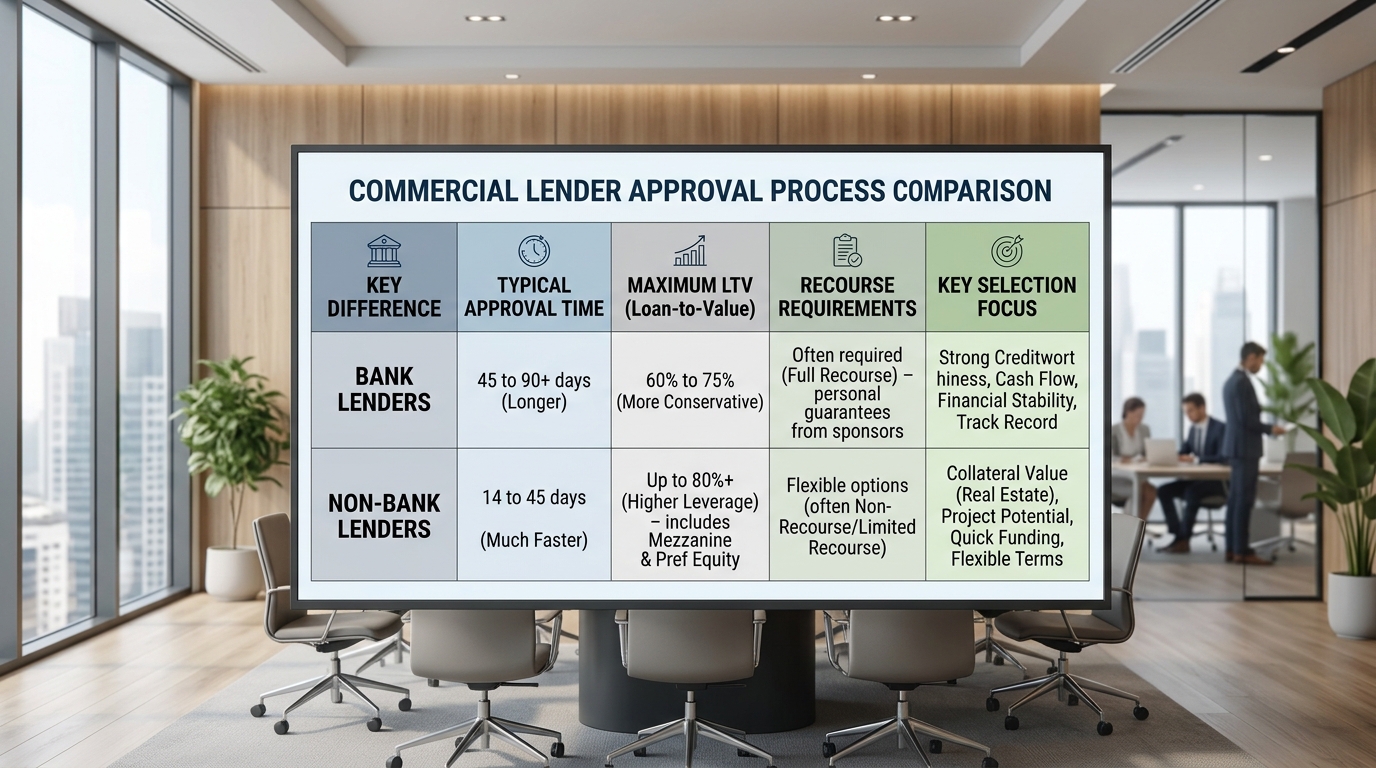
Understanding the distinctions between bank and non-bank commercial lenders is crucial for selecting the right financing partner based on your project’s needs.
| Lender Type | Typical Approval Time | Max LTV | Recourse Requirement | Key Selection Focus |
|---|---|---|---|---|
| Commercial Banks / Credit Unions | 45–75 Days | 65%–75% | Full Recourse | Strong historical cash flow, global liquidity, lower interest rates |
| CMBS (Conduit Lenders) | 45–60 Days | 70%–75% | Non-Recourse | Stabilized income-producing assets, secondary/tertiary markets |
| Life Insurance Companies | 60–90 Days | 55%–65% | Non-Recourse | Top-tier low-risk assets, institutional sponsors, ultra-low rates |
| Bridge / Private Debt Funds | 14–30 Days | 75%–80% | Non-Recourse Option | Value-add properties, opportunistic acquisitions, speed of execution |
While traditional banking institutions offer lower interest rates, non-bank private debt funds deliver accelerated timelines and flexible structuring for value-add deals.
Commercial Loan Approval Odds: What Causes Rejection?
Understanding why lenders decline applications empowers borrowers to proactively address red flags before formal review. Primary causes of commercial loan rejection include:
- Insufficient Net Operating Income (NOI): Inadequate income to meet minimum DSCR guidelines (e.g., DSCR dropping below 1.20x during underwriting stress tests).
- Tenant Concentration Risk: Over-reliance on a single anchor tenant whose lease expires prior to loan maturity.
- Deferred Maintenance & Structural Issues: Property Condition Assessments revealing major capital expenditure needs without identified funding sources.
- Unresolved Environmental Liabilities: Phase I ESA findings indicating historical contamination or hazardous materials requiring expensive remediation.
- Inadequate Liquidity or Credit Issues: Sponsor credit blemishes, active litigation, or insufficient cash reserves following closing.
Addressing these friction points ahead of application submission significantly increases commercial property financing approval odds.
Frequently Asked Questions
What are the odds of getting approved for a commercial real estate loan?
Commercial real estate loan approval odds depend heavily on property net operating income, sponsor liquidity, and loan-to-value structure. Stabilized properties with strong DSCR (1.25x+) and experienced sponsors enjoying clean credit histories typically see high approval rates (70%–80%+). Conversely, speculative value-add projects with weak sponsor liquidity or unverified income suffer significantly lower traditional approval rates unless paired with private debt or bridge financing solutions.
What is the difference between commercial real estate pre-approval and final approval?
Pre-approval is an initial, non-binding assessment based on preliminary sponsor and property financials (summarized in an LOI or Term Sheet). Final approval is a legally binding loan commitment granted only after underwriters verify all documents, third-party reports (appraisal, Phase I ESA, PCA) are completed, and the credit committee votes to fund the loan.
What financial documents are required for a commercial real estate loan application?
Lenders typically require three years of personal and corporate tax returns, year-to-date profit and loss statements, current property rent rolls, historical operating statements, personal financial statements (PFS) for all major sponsors, and corporate organizational documents (LLC operating agreements, articles of organization).
How long does the commercial property financing approval process take?
The average commercial property financing approval process takes between 45 and 90 days from LOI sign-off to loan funding. Private debt lenders and bridge funds can expedite approvals in 14 to 30 days, whereas SBA, CMBS, or life insurance loans may require up to 90 days due to stringent third-party reviews and documentation requirements.