Commercial Real Estate Loan Calculator
Navigating commercial property financing requires precision, clear projections, and a comprehensive understanding of total debt obligations. Whether you are acquiring an industrial warehouse, purchasing an owner-occupied retail space, or refinancing an existing office asset in 2026, using an interactive commercial real estate loan calculator is an essential first step.
Unlike residential mortgages—which typically offer standardized 30-year fixed terms—commercial real estate (CRE) loans feature diverse structures, variable amortization horizons, balloon maturity dates, and specific lender underwriting metrics. This guide explains how to calculate monthly commercial debt payments, structure loan parameters accurately, evaluate total transaction costs, and prepare your deal for lender approval.
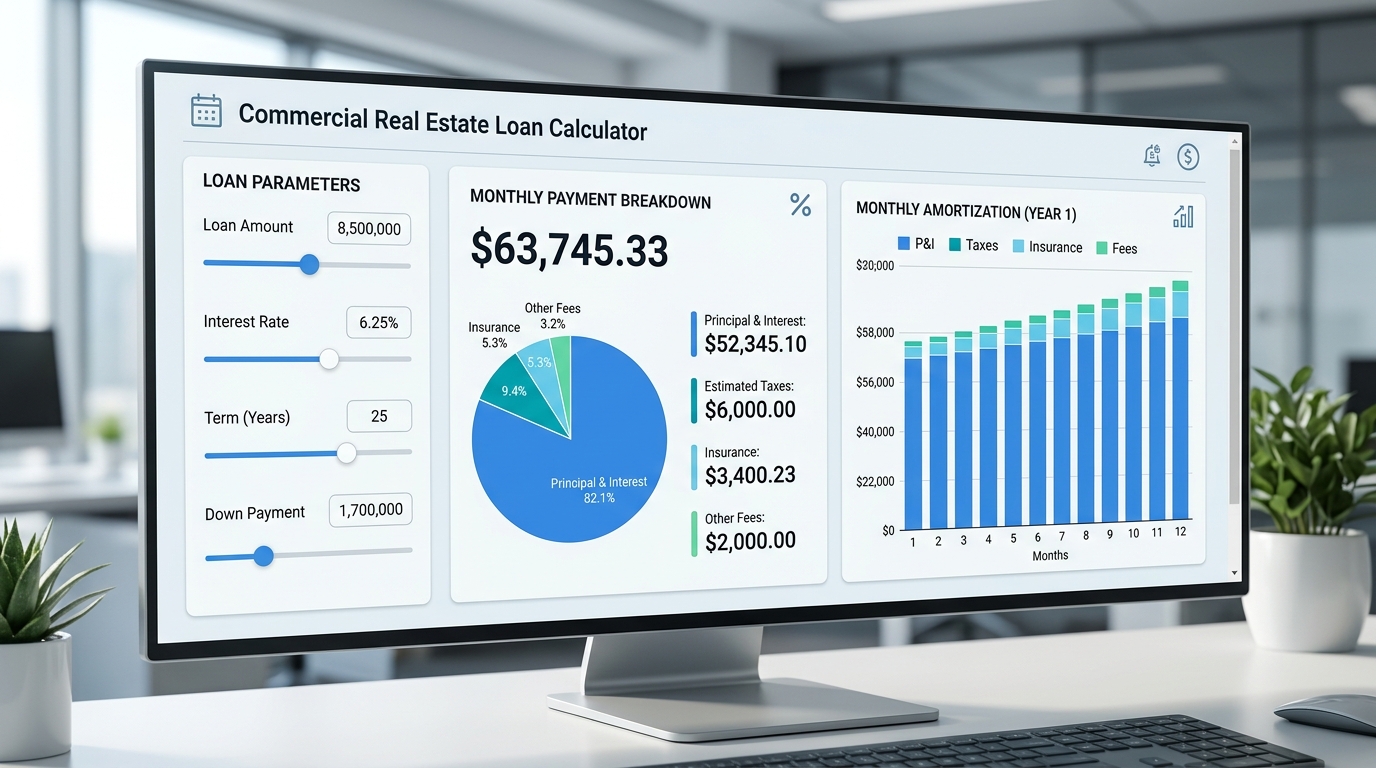
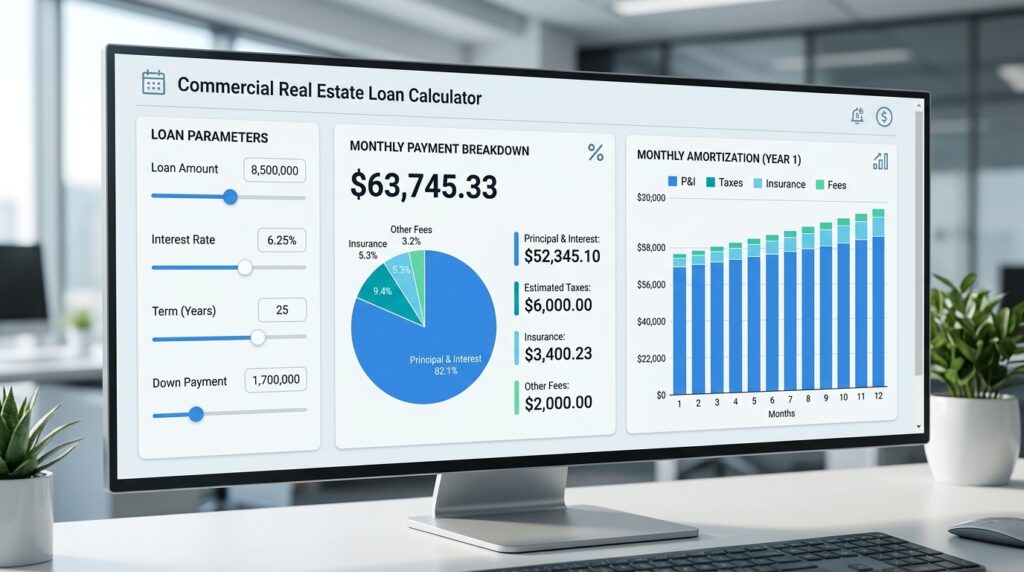
Visualize your commercial real estate loan obligations with a clear breakdown of monthly payments and total costs.
How to Use Our Commercial Mortgage Calculator
Our commercial property loan calculator provides immediate clarity on monthly principal and interest payments, overall interest expense, and total debt service costs. By inputting baseline terms, borrowers can run sensitivity scenarios before submitting formal application packages to commercial lenders.
Step-by-Step Instructions & Inputs
To generate an accurate payment estimate using the commercial real estate loan calculator, gather the following loan parameters:
- Purchase Price / Property Value: Enter the total acquisition cost or appraised value of the commercial real estate asset.
- Down Payment Amount or Loan-to-Value (LTV) Ratio: Input your equity contribution. Commercial lenders generally mandate down payments ranging from 20% to 35% of the property value, corresponding to 65% to 80% LTV maximum limits.
- Loan Term (Maturity): Specify the duration of the loan agreement before the remaining principal balance must be repaid or refinanced. Common commercial loan terms span 5, 7, or 10 years.
- Amortization Period: Indicate the total timeline over which monthly payments are calculated (typically 20 to 25 years for commercial property).
- Interest Rate: Enter the annual interest rate quoted by your commercial bank, private credit lender, or SBA loan provider.
- Payment Frequency: Select monthly payments (the standard model across commercial lending institutions).
After entering these values, the tool calculates your total monthly principal and interest (P&I) obligation, total interest payable across the loan term, and expected balance due at term maturity. To compare your baseline projections against dynamic market benchmarks, explore current commercial loan rates to test floating vs. fixed financing scenarios.
How is a commercial mortgage payment calculated?
A commercial mortgage payment is calculated using the standard amortization formula for fixed-rate debt service, which accounts for the principal loan amount, monthly interest rate, and total number of amortizing compounding periods:
$$\text{Monthly Payment } (M) = P \times \frac{r(1 + r)^n}{(1 + r)^n – 1}$$
Where:
– $P$ = Total principal loan amount (Loan Amount = Purchase Price minus Down Payment)
– $r$ = Monthly interest rate (Annual Interest Rate divided by 12 months)
– $n$ = Total number of monthly payments in the amortization schedule (Amortization Years multiplied by 12)
Illustrative Commercial Calculation Example
Consider a borrower acquiring a light industrial facility for $2,000,000 in 2026:
– Loan Amount ($P$): $1,500,000 (75% LTV, requiring a $500,000 down payment)
– Interest Rate: 6.50% per annum ($r = 0.065 / 12 = 0.0054167$ per month)
– Amortization Period ($n$): 25 years (300 monthly payments)
– Loan Term: 10 years (120 actual monthly payments prior to balloon payment)
Applying the formula:
$$M = 1,500,000 \times \frac{0.0054167(1 + 0.0054167)^{300}}{(1 + 0.0054167)^{300} – 1} \approx \$10,128.14 \text{ per month}$$
Over the 10-year term, the borrower makes 120 monthly debt service payments totaling $1,215,376.80. At the end of Year 10, because the loan amortizes over 25 years, a remaining principal balance of approximately $1,148,500 remains due. To review full month-by-month debt reduction tables, you can generate a commercial amortization schedule for detailed reporting.
Understanding Total Loan Costs & Fees
Calculating monthly debt service covers principal and interest, but evaluating total commercial property loan costs requires accounting for upfront closing expenses, third-party due diligence, and ongoing reserve requirements.
Third-Party Closing Costs and Underwriting Fees
- Loan Origination Fees: Typically 0.50% to 1.50% of the total loan amount, charged by the lender to cover underwriting and processing.
- Commercial Appraisal: $3,000 to $7,500+ depending on property complexity, size, and location.
- Phase I Environmental Site Assessment (ESA): $2,000 to $5,000 to assess environmental liability risks.
- Property Condition Assessment (PCA): $2,500 to $6,000 to evaluate structural integrity and major building systems (HVAC, roof, plumbing).
- Title Search and Insurance: 0.50% to 1.0% of the purchase price.
- Lender Legal Fees: $3,000 to $10,000+ for commercial loan documentation and legal review.
How much down payment is required for a commercial real estate loan?
A standard commercial real estate loan requires a down payment of 20% to 35% of the total purchase price, depending on the asset class, borrower liquidity, and lender requirements. Conventional commercial bank loans typically cap Loan-to-Value (LTV) ratios at 75%, requiring a 25% equity contribution. SBA 504 and SBA 7(a) owner-occupied commercial property loans permit down payments as low as 10% for qualifying small businesses.
To ensure your business or investment firm meets equity and liquidity benchmarks, review our commercial real estate loan requirements before initiating formal loan applications.
Fixed vs. Variable Interest Rates Overview
Choosing between fixed and variable (floating) interest rate structures directly affects long-term payment stability and borrowing costs.
| Metric / Feature | Fixed-Rate Commercial Loans | Variable-Rate Commercial Loans |
|---|---|---|
| Interest Rate Stability | Locked for term (e.g., 5, 7, or 10 years) | Adjusts periodically based on SOFR or Prime Rate |
| Initial Rate Level | Slightly higher initial benchmark rate | Lower initial starting interest rate |
| Cash Flow Predictability | High; debt service remains constant | Moderate-Low; exposed to interest rate spikes |
| Prepayment Flexibility | Often includes yield maintenance or defeasance | Typically lower or zero prepayment penalties |
| Best Suited For | Long-term hold strategies & stable income assets | Short-term repositioning or value-add projects |
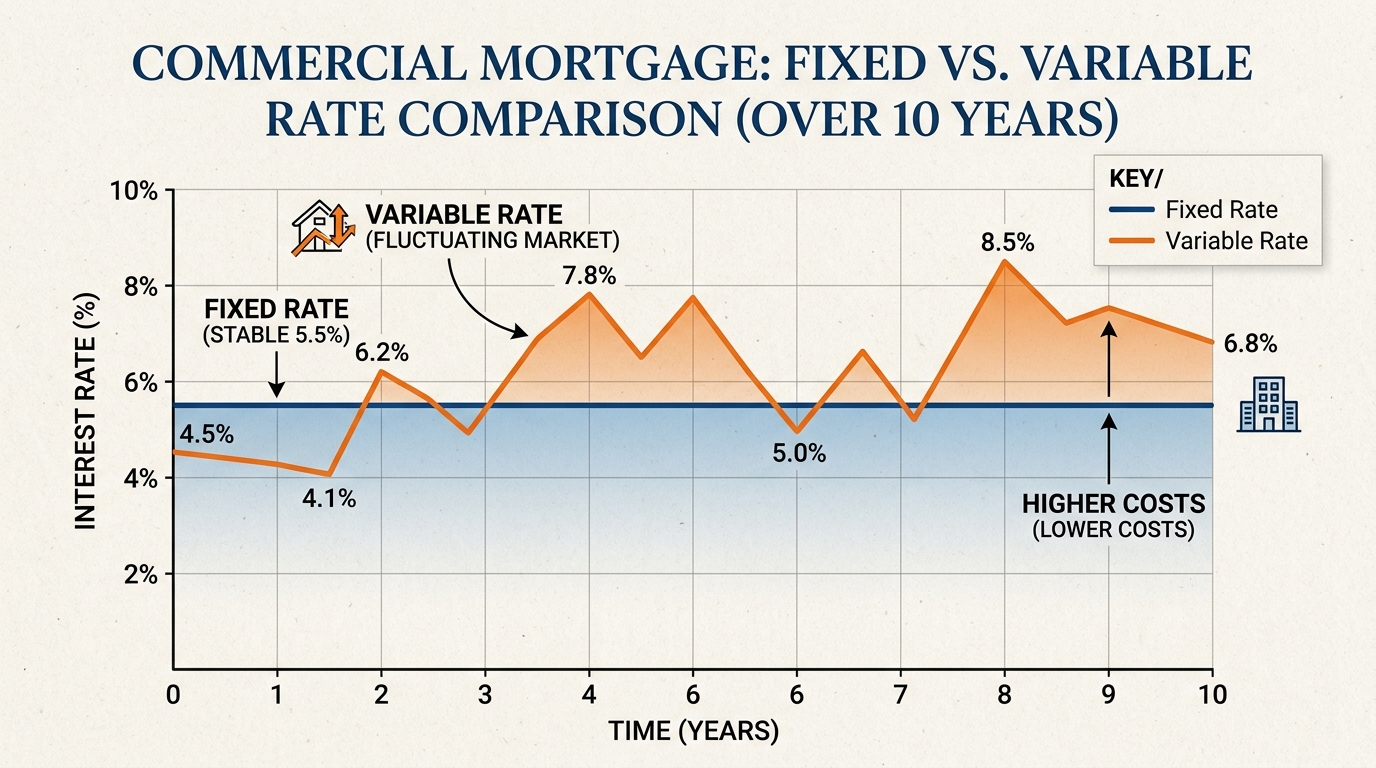
Understand the trade-offs between fixed and variable interest rates for commercial mortgages with this comparative chart.
Fixed-rate structures protect borrowers against inflation and central bank monetary tightening, locking in predictable debt obligations. Conversely, variable-rate loans provide flexibility for short-term holds or properties undergoing renovations, allowing early refinancing without severe yield maintenance penalties.
Frequently Asked Questions (FAQ)
How does a commercial real estate loan calculator work?
A commercial real estate loan calculator uses user-provided inputs—including purchase price, down payment percentage, annual interest rate, loan term, and amortization period—to compute monthly debt service obligations using standard compounding formulas. It breaks down principal reduction, total interest cost, and remaining balloon balances at term maturity.
What credit score is needed to qualify for a commercial real estate loan?
Most conventional commercial lenders require a minimum personal credit score of 680 to 700 for principal sponsors. SBA loans typically require scores of 680 or higher. For institutional commercial property financing, lenders focus heavily on corporate balance sheets, liquid cash reserves (net worth equal to loan size), and property Debt Service Coverage Ratio (DSCR) exceeding 1.25x.
What is the difference between loan term and amortization period?
The loan term is the actual duration during which the loan contract remains active before full repayment or refinancing is required (e.g., 5 or 10 years). The amortization period is the timeline used to calculate monthly payment amounts (e.g., 25 years). Because the term is shorter than the amortization period, commercial loans usually conclude with a lump-sum balloon payment.
Are commercial loan rates higher than residential mortgage rates?
Yes, commercial loan interest rates are typically 0.50% to 2.00% higher than standard 30-year residential mortgage rates. Commercial real estate financing carries higher underwriting complexity, lower asset liquidity, and shorter loan terms, reflecting higher perceived credit risk for lenders.