

Commercial Real Estate Bridge Financing Costs & Fees
Evaluating commercial real estate debt requires looking beyond stated interest rates. While interest payments represent the ongoing price of capital, total overall commercial real estate bridge financing costs include origination points, third-party due diligence fees, extension charges, and exit fees.
Because bridge loans are short-term financial instruments (typically 12 to 36 months), upfront closing fees and exit structures represent a larger percentage of total borrowing costs than on a 10-year permanent loan.
This guide provides a transparent itemized breakdown of bridge loan fee schedules, closing expenses, exit structures, and effective APR calculations.
Typical Origination Fees for Commercial Bridge Loans
Origination fees (often referred to as points) represent administrative and underwriting fees charged by the lender to process, structure, and fund the debt facility. One point equals 1% of the gross loan amount.
What are typical origination fees for commercial bridge loans?
Typical commercial bridge loan origination fees range from 1.0% to 2.5% of total committed debt.
- Institutional Debt Funds: 1.0% to 1.5% of total loan commitment.
- Private Non-Bank Lenders: 1.5% to 2.0% of total loan commitment.
- Hard Money Lenders: 2.0% to 3.5%+ of total loan commitment.
In addition to direct lender points, mortgage broker fees (if an intermediary structures the loan) typically add 0.50% to 1.0% to upfront transaction costs.

A visual breakdown of the typical costs involved in commercial real estate bridge financing.
Commercial Bridge Loan Closing Cost Breakdown
Closing costs encompass third-party due diligence, administrative processing, legal fees, and title charges required to execute the transaction.
How much are total closing costs on a commercial real estate bridge loan?
Total closing costs on commercial bridge loans typically add 1.5% to 3.0% of the total loan amount on top of regular interest payments.
Below is an itemized breakdown detailing standard third-party expenses associated with commercial bridge debt closing:
| Fee Category | Typical Cost Range | Responsible Party | Description / Scope |
|---|---|---|---|
| Lender Origination Fee | 1.0% – 2.5% of loan | Lender | Fee for capital underwriting and loan structuring |
| Lender Legal Counsel | $10,000 – $25,000+ | Outside Counsel | Drafting loan documents, intercreditor agreements, legal review |
| Commercial Appraisal | $4,000 – $8,000 | Independent Appraiser | Full FIRREA commercial property valuation |
| Phase I Environmental (ESA) | $2,500 – $4,500 | Environmental Firm | Assessment of property contamination risk (ASTM E1527-21) |
| Property Condition Assessment (PCA) | $3,000 – $6,000 | Engineering Firm | Structural, mechanical, roof, and capital expenditure evaluation |
| Title Insurance & Escrow | 0.2% – 0.5% of loan | Title Company | Lender title policy coverage and closing escrow administration |
| Lender Processing / Admin | $1,500 – $3,500 | Lender | Internal administrative and document handling fee |
Before executing term sheets, real estate investors should view average commercial bridge loan rates to assess how base interest pricing interacts with upfront fee structures.
Understanding Exit Fees and Prepayment Penalties
Exit fees and prepayment provisions govern how financial obligations are settled when the loan is paid off at refinancing, sale, or maturity.
What exit fees and extension fees do commercial bridge lenders charge?
- Exit Fees: Many commercial bridge lenders charge an exit fee of 0.50% to 1.0% of the principal loan balance upon repayment. In some structures, lenders waive exit fees if the borrower refinances into permanent debt provided by the same financial institution.
- Extension Fees: If a sponsor requires extra time beyond the initial maturity date to complete property stabilization, lenders charge an extension fee of 0.25% to 0.50% per 12-month extension option.
- Minimum Interest Guarantees: Unlike permanent mortgages that utilize complex yield maintenance or defeasance formulas, bridge loans usually feature flexible prepayment terms. However, lenders often include a minimum interest guarantee (e.g., 6 to 12 months of guaranteed interest), ensuring the lender earns a baseline yield if the loan is paid off early.
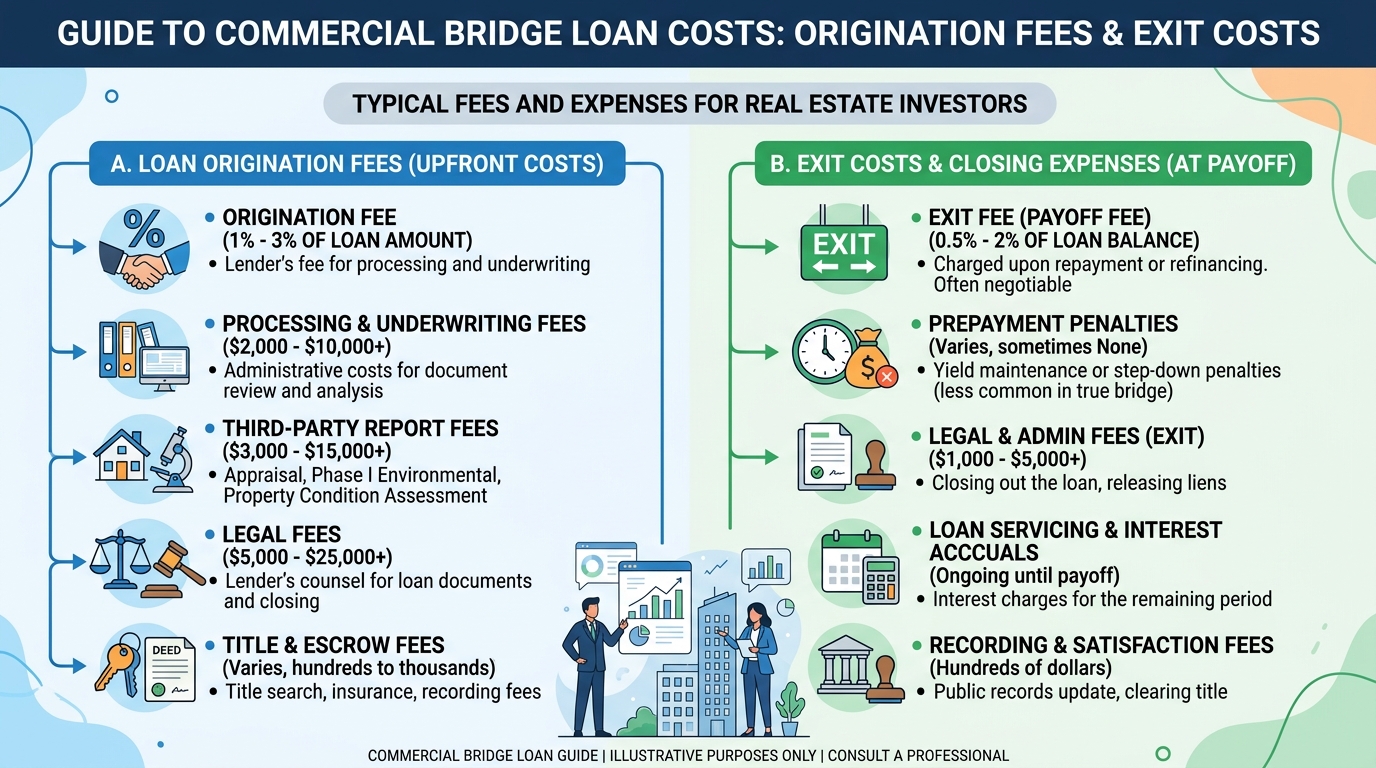
A detailed overview of common origination and exit fees associated with commercial bridge loans.
Understanding how commercial bridge loan terms affect costs empowers sponsors to negotiate exit fee waivers or minimum interest clauses during initial term sheet discussions.
Calculating Effective APR & Total Bridge Costs
Because bridge debt involves upfront points, interest payments, ongoing fees, and exit costs over a compressed timeframe, comparing loans based strictly on interest rates can be misleading. Sponsors calculate the Effective Annual Percentage Rate (APR) to understand the total annualized cost of debt.
Effective APR Formula
The effective cost of a bridge loan is calculated by combining total interest paid, origination points, exit fees, and third-party closing costs over the exact duration the debt remains outstanding:
$$\text{Effective Annualized Cost} = \frac{\text{Total Interest Paid} + \text{Origination Points} + \text{Closing Costs} + \text{Exit Fee}}{\text{Average Outstanding Balance} \times \text{Loan Term in Years}}$$
Sample Calculation (12-Month Bridge Loan):
- Loan Commitment: $5,000,000
- Interest Rate: 9.50% Interest-Only ($475,000 annual interest)
- Origination Fee (1.5%): $75,000
- Third-Party Closing Costs: $25,000
- Exit Fee (0.50%): $25,000
- Total Annual Outflow: $475,000 + $75,000 + $25,000 + $25,000 = $600,000
- Effective APR: 12.00%
Notice that while the nominal interest rate was 9.50%, the true effective APR over a 12-month term is 12.00%.
To quickly run custom scenario calculations for your property deals, you can calculate your total financing costs using our financial calculator tool.
Frequently Asked Questions (FAQ)
What are loan origination points on a commercial bridge loan?
Origination points are upfront fees paid to the lender at closing to cover underwriting and capital allocation costs. One point equals 1% of the total loan amount ($10,000 per $1,000,000 borrowed).
Are bridge loan fees tax-deductible?
Commercial bridge loan origination fees and interest expenses are generally tax-deductible business expenses, but they must be amortized over the life of the loan under IRS regulations. Real estate investors should consult a certified CPA for specific tax guidance.
Do commercial bridge loans have prepayment penalties?
Most commercial bridge loans do not have severe prepayment penalties like yield maintenance or defeasance. Instead, they may feature a minimum interest clause (guaranteeing 6 to 12 months of interest yield to the lender).
Who pays for the property appraisal and environmental report?
The borrower is responsible for paying all third-party due diligence expenses, including commercial appraisals, Phase I environmental site assessments, and structural property condition reports, regardless of whether the loan successfully closes.