
Financing Guide: Loans for Commercial Real Estate Investors
For commercial real estate investors, debt capital is not merely a funding source—it is the engine that drives portfolio yield, return on equity (ROE), and tax-efficient wealth building. In 2026, finding the best commercial property loans requires a strategic understanding of how lenders analyze risk across income-producing asset classes, structure cash flow coverage, and evaluate investment syndicates or single-purpose entities.
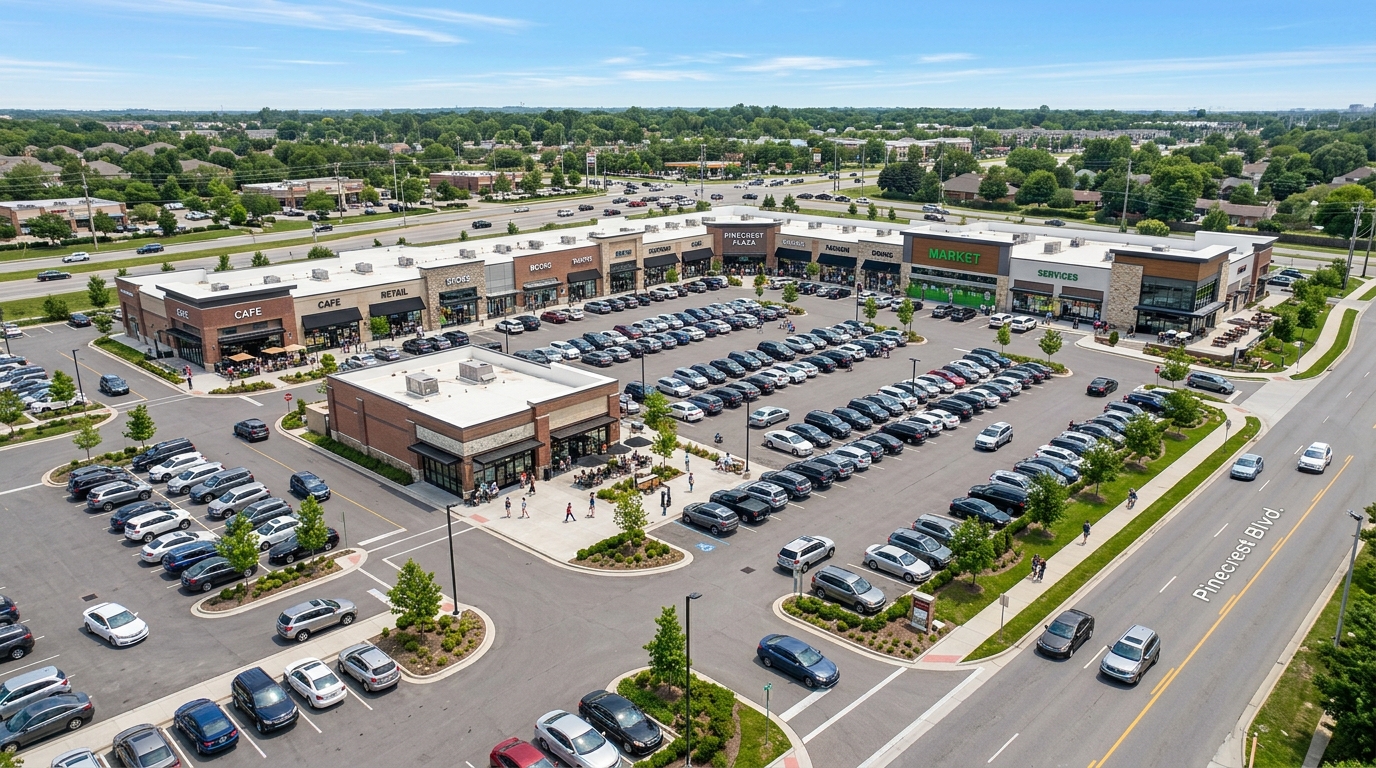
Retail properties, such as strip centers, are common assets financed with loans for commercial real estate investors.
Whether you are scaling from multi-family residential into retail strip centers, industrial distribution hubs, or medical office buildings, securing tailor-made debt is essential. To build a solid underwriting strategy, investors should view strict commercial property loan requirements while comparing capital sources across the debt capital markets.
Financing Income-Producing Assets
When securing loans for commercial real estate investors, capital sources view non-owner-occupied properties primarily as stand-alone cash-flow businesses. Unlike owner-occupied loans where business operational income services debt, investment properties depend entirely on lease income generated from commercial tenants.
Retail, Multifamily, Industrial, and Office Sector Nuances
Underwriting criteria and loan pricing vary significantly based on property sector dynamics:
- Multifamily Properties (5+ Units):
- Risk Profile: Lowest perceived default risk due to diversified tenant bases across multiple residential leases.
-
Financing Terms: Excellent access to agency debt (Fannie Mae, Freddie Mac) with non-recourse terms, long fixed-rate periods, and aggressive LTV ratios up to 75%–80%.
-
Industrial & Logistics Warehouses:
- Risk Profile: Highly favorable sector driven by e-commerce, third-party logistics, and manufacturing demand.
-
Financing Terms: Lenders offer long amortization periods and competitive pricing for multi-tenant or single-tenant triple-net (NNN) distribution assets.
-
Retail Strip Centers & Power Centers:
- Risk Profile: Dependent on tenant mix, anchor tenant creditworthiness (e.g., grocery store anchors), and location foot traffic.
-
Financing Terms: Lenders carefully scrutinize lease rollover schedules, co-tenancy clauses, and sales performance before committing capital.
-
Medical & Professional Office Assets:
- Risk Profile: Higher capital expenditure obligations (tenant improvements and leasing commissions) upon lease expirations.
- Financing Terms: Medical office assets leased to regional healthcare networks command premium non-recourse pricing, whereas general suburban office requires lower LTV leverage (60%–65%).
What Lenders Look for in Debt Applications
Commercial underwriters evaluate commercial real estate investment loans through a dual lens: analyzing both the strength of the real estate asset and the track record of the sponsor or borrowing entity.

Lenders meticulously evaluate various factors when considering applications for commercial real estate investment loans.
How do lenders evaluate commercial real estate investment property loans?
When reviewing an application for commercial investment property loans, lenders execute a comprehensive underwriting audit covering five core areas:
-
Property Net Operating Income (NOI):
Lenders perform a historical analysis of trailing 12-month (T12) operating statements, verifying gross rental income, subtracting vacancy allowances (typically 5%–10% market minimums), and subtracting operating expenses (taxes, insurance, management fees, maintenance reserves). -
Tenant Lease Structure & Creditworthiness:
Underwriters examine rent rolls, lease start and expiration dates, tenant renewal options, and tenant credit ratings. Single-tenant assets leased to corporate-grade triple-net tenants receive lower interest rates than multi-tenant properties with expiring short-term leases. -
Debt Service Coverage Ratio (DSCR):
The property’s NOI must comfortably cover proposed annual principal and interest debt payments, with most lenders mandating a 1.25x to 1.35x safety buffer. -
Sponsor Experience & REO Schedule:
Borrowers must present a detailed Schedule of Real Estate Owned (REO) demonstrating prior success acquiring, managing, and stabilizing comparable commercial properties. -
Borrower Liquidity and Net Worth:
Lenders typically require the sponsor (or group of guarantors) to possess a combined net worth equal to or exceeding the total loan amount, along with post-closing liquid assets equal to 6–12 months of principal and interest payments.
Before finalizing return projections, investors should compare commercial property loan rates across fixed and floating options to accurately project long-term leverage costs.
How Property Cash Flow (DSCR) Drives Approval
In commercial real estate investor debt, Debt Service Coverage Ratio (DSCR) is the single most important metric dictating loan size and interest rate margins.
$$\text{DSCR} = \frac{\text{Net Operating Income (NOI)}}{\text{Annual Debt Service}}$$
- 1.00x DSCR: Property income exactly equals debt service costs (zero cash flow margin).
- 1.25x DSCR (Standard Benchmark): Net Operating Income exceeds debt payments by 25%. This represents the standard baseline required by commercial banks and private lenders.
- 1.40x+ DSCR (Premium Cash Flow): Strongly cash-flowing assets qualify for lower interest rates, reduced reserve requirements, or higher maximum loan proceeds.
If a property’s projected NOI fails to satisfy the lender’s minimum DSCR threshold at a 75% LTV ratio, the lender will “size down” the loan amount until the debt service aligns with the required coverage ratio. The investor must then contribute a larger equity down payment to close the transaction.
+-------------------------------------------------------------------------+
|                  HOW DSCR IMPACTS LOAN PROCEEDS SIZING                  |
|                                                                         |
|   Target Purchase Price: $4,000,000                                    |
|   Net Operating Income (NOI): $250,000                                  |
|                                                                         |
|   Scenario A: Lender Requires 1.25x DSCR                                |
|   --> Max Allowable Debt Service: $200,000                              |
|   --> Max Loan Proceeds Approved: ~$2,850,000 (71% LTV)                 |
|                                                                         |
|   Scenario B: Lender Requires 1.40x DSCR                                |
|   --> Max Allowable Debt Service: $178,571                              |
|   --> Max Loan Proceeds Approved: ~$2,540,000 (63.5% LTV)               |
+-------------------------------------------------------------------------+
Evaluating the Best Loans for Portfolio Expansion
To rapidly scale a commercial property portfolio, investors must match specific debt structures to their acquisition phases and holding goals. You can explore commercial real estate financing options across various bank and non-bank categories.
What is the best commercial property loan for first-time investors?
For first-time commercial real estate investors, the best commercial property loan is typically a conventional commercial mortgage from a regional or community bank, or a local credit union loan.
- Why Community Banks & Credit Unions Excel for First-Timers:
- Lower Minimum Loan Amounts: Institutional lenders often ignore transactions below $2,000,000, whereas local banks eagerly fund $500,000 to $2,500,000 acquisitions.
- Holistic Underwriting: Community lenders consider full relationship banking balances (business deposits, personal accounts) to offset minor gaps in commercial real estate experience.
- Flexibility: Local bank loan committees offer higher tolerance for customized loan structures or step-down prepayment penalties compared to rigid securitized CMBS products.
For investors acquiring multi-family properties (5+ units) as their entry point into commercial real estate, agency small-balance loans (Fannie Mae Small Commercial / Freddie Mac SBL) offer outstanding 5-to-10-year non-recourse debt with up to 30-year amortization schedules.
Frequently Asked Questions for Investors
Can an LLC get a commercial real estate property loan?
Yes. Commercial lenders prefer—and often mandate—that real estate investors close transactions using a Special Purpose Entity (SPE), typically organized as a limited liability company (LLC). Holding properties in an LLC isolates legal liability, simplifies multi-member partner distributions, and matches standard commercial debt servicing protocols.
What is the typical down payment required for investor commercial property loans?
Most investor loans require a down payment between 20% and 30% of the property’s purchase price (70% to 80% LTV). Properties with lower occupancy or riskier tenant structures may require 35% down.
Do commercial investment property loans require personal guarantees?
It depends on the lender type and loan size. Loans below $2,000,000 from commercial banks generally require full recourse personal guarantees from all individuals owning 20% or more of the borrowing LLC. CMBS conduit loans, agency loans, and larger life insurance company debt are typically non-recourse, requiring guarantees only for fraudulent acts (“bad-boy” carve-outs).
Can I use rental income from a newly acquired commercial building to qualify?
Yes. Underwriters base loan qualification primarily on the existing, documented leases and historical operating income of the target property, rather than your personal employment salary.