

How Long Does Commercial Loan Approval Take? A Timeline Guide
Timing is everything in commercial real estate acquisitions and refinances. Closing delays can endanger earnest money deposits, delay property developments, or even cause contract cancellations. Understanding realistic closing windows helps borrowers, investors, and brokers plan transactions accurately.
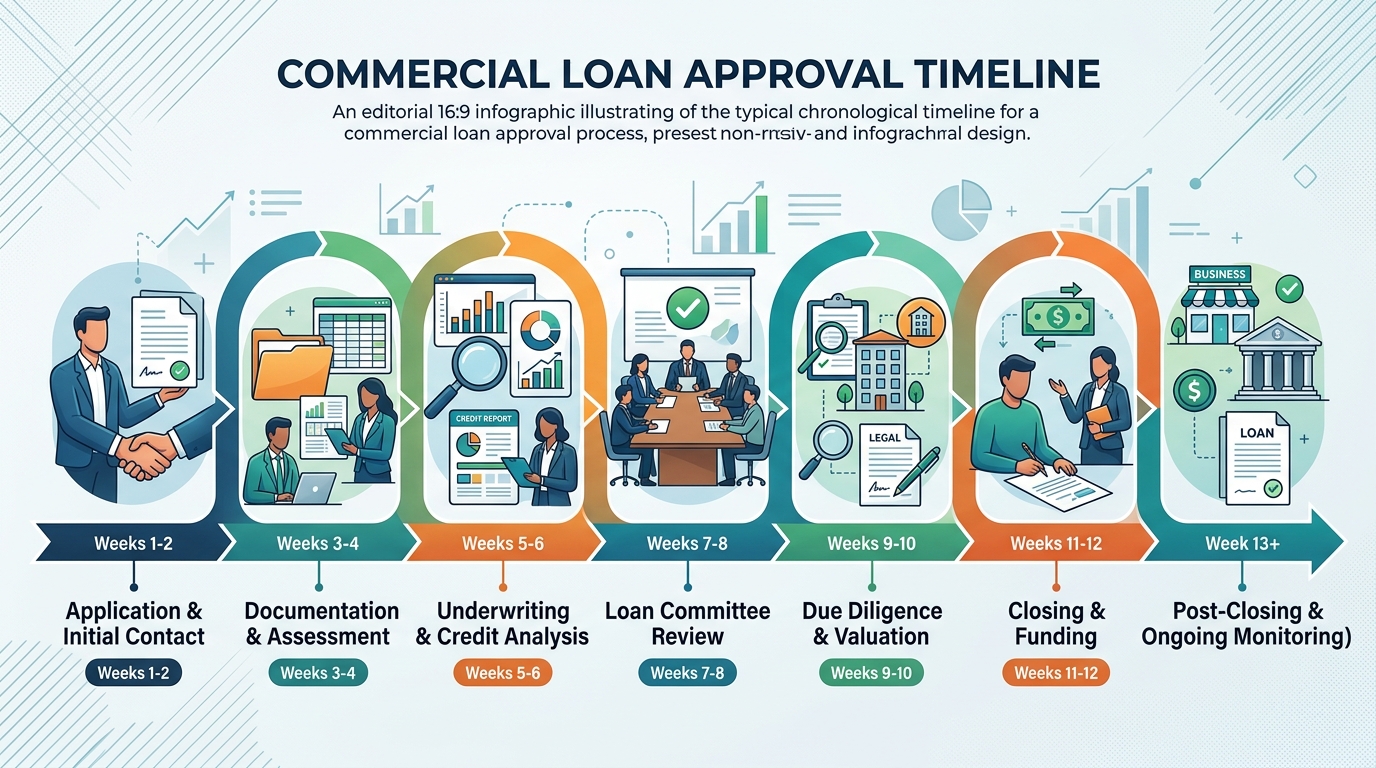
A visual guide to the commercial loan approval timeline, from application to closing.
How Long Does Commercial Loan Approval Take?
Commercial loan approval typically takes between 45 and 90 days from initial document submission to loan closing. Traditional bank loans and SBA financing usually require 60 to 90 days, while non-bank lenders and bridge funds can close transactions in 14 to 30 days depending on transaction complexity.
The overarching timeline depends on lender category, borrower document readiness, appraisal turn times, and property third-party inspection schedules.
The Average Commercial Mortgage Approval Timeline
While individual closing schedules vary based on deal structure, standard commercial property acquisitions follow a predictable 90-day multi-phase lifecycle.
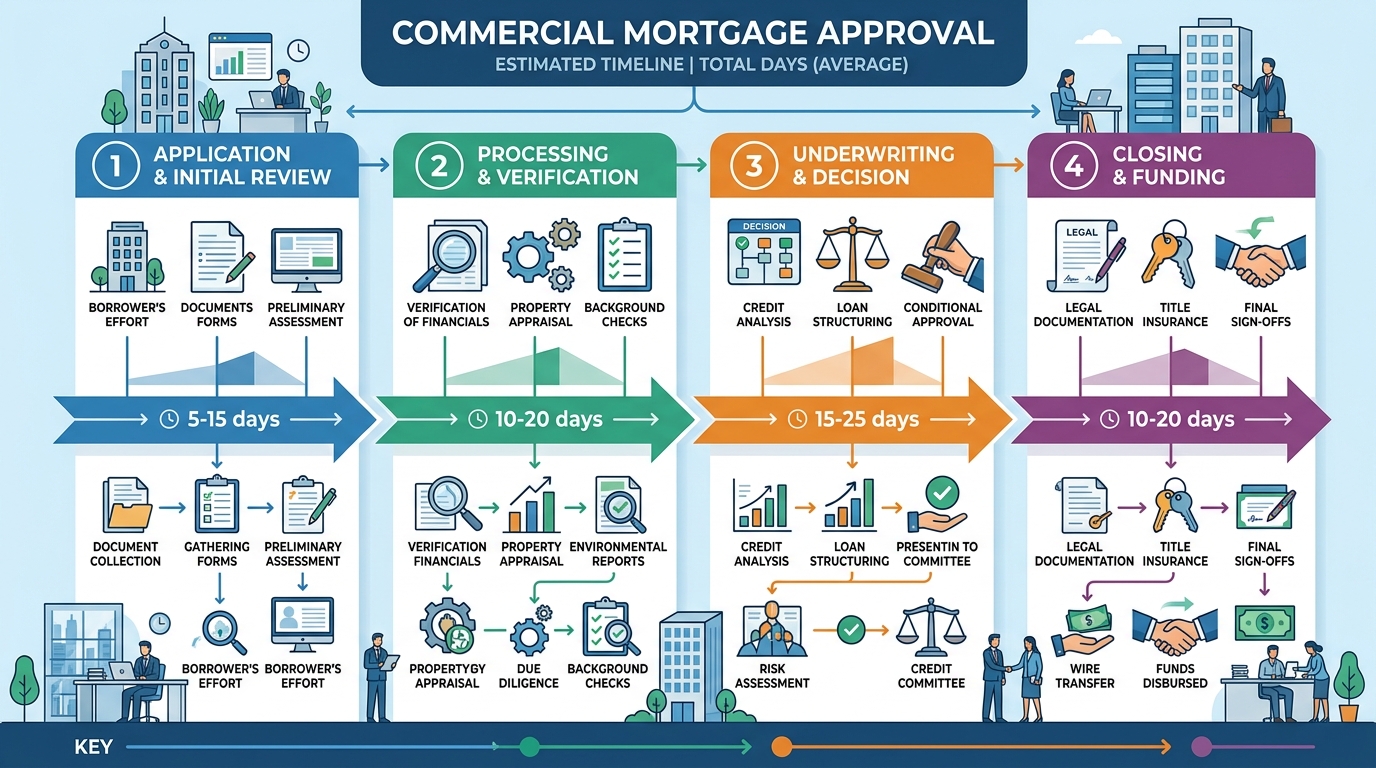
Breakdown of the average commercial mortgage approval timeline, highlighting key phases and their typical durations.
Days 1–15: Application and Initial Review
The initial phase focuses on agreement setup and preliminary document collation.
* LOI Issuance & Acceptance: The borrower negotiates terms with the lender, signs the Letter of Intent (LOI), and submits the required initial deposit for third-party fees.
* Document Intake: The borrower submits personal tax returns, entity organization documents, financial statements, current rent rolls, and property operating history.
* Initial Credit Assessment: The loan officer verifies baseline eligibility metrics including credit history and property cash flow alignment.
Before submitting your package, review the step-by-step commercial real estate loan approval steps to ensure your financial materials are fully organized.
Days 16–30: Processing and Third-Party Reports
Once formal processing begins, third-party professionals are engaged to evaluate property physical, financial, and legal risk profile.
* Third-Party Bidding & Engagement: Lenders order the commercial appraisal, Phase I Environmental Site Assessment (ESA), and Property Condition Assessment (PCA).
* Title Search & Legal Review: Title companies begin preliminary title searches to identify existing liens, easements, or municipal encumbrances.
* Verification of Financials: Loan processors verify lease contracts, bank statements, tenant estoppels, and operating accounts.
Days 31–60: Underwriting and Loan Committee
During this central stage, the property undergoes intensive financial analysis and credit verification.
* Financial Modeling & Stress Testing: Underwriters stress test net operating income (NOI), Debt Service Coverage Ratio (DSCR), and Exit LTV assumptions.
* Credit Memo Drafting: The underwriter synthesizes deal risks, valuation metrics, and sponsor experience into a formal credit presentation.
* Loan Committee Review: The institutional credit committee reviews the package, votes, and issues conditional loan approval.
To better prepare for this evaluation window, explore our detailed breakdown of the commercial mortgage underwriting timeline.
Days 61–90: Commitment and Closing
The final milestone transforms conditional approval into loan execution and cash funding.
* Commitment Letter Sign-Off: The lender issues a formal Commercial Loan Commitment Letter detailing final pricing, legal covenants, and closing conditions.
* Closing Legal Documentation: Lender attorneys prepare final promissory notes, mortgages/deeds of trust, personal guarantees, and loan agreements.
* Funding & Settlement: Title policies are finalized, final closing statements are executed, escrow collects borrower equity, and loan funds are wired.
To ensure all closing prerequisites are met without delay, verify your file against standard cre loan approval requirements.
Steps in Commercial Real Estate Loan Processing
Commercial real estate loan processing represents the engine that drives an application from initial intake to formal credit committee evaluation. Loan processors act as the central operational hub, coordinating communications between borrowers, lenders, appraisers, environmental engineers, title officers, and legal counsel.
Primary processing milestones include:
- File Structuring & Complete Intake Assembly: Gathering corporate governance documents, three years of tax returns, operating statements, and personal financial profiles.
- Third-Party Vendor Management: Ordering and monitoring long-lead vendor reports, specifically commercial appraisals, environmental site assessments, and physical property inspections.
- Property Income Verification: Cross-referencing rent rolls against historical lease agreements, utility statements, tax bills, and schedule E filings.
- Clearing Preliminary Title & Environmental Conditions: Resolving preliminary title exceptions, encroachment issues, and environmental red flags before formal underwriting submission.
What Causes Delays in the CRE Financing Timeline?
Even seasoned borrowers experience unexpected financing delays. Identifying primary friction points allows borrowers to manage risk proactively.
Appraisal and Third-Party Delays
Commercial appraisals represent the single most common cause of processing bottlenecks. Unlike residential appraisals, commercial property valuations require extensive market comparability research, cap rate verification, and income projections.
During periods of high transaction volume or in specialized commercial property niches, certified commercial appraisers can take 3 to 6 weeks to complete detailed reports. Furthermore, if a Phase I Environmental Site Assessment reveals potential environmental concerns, ordering a Phase II ESA can add an additional 30 to 45 days to the timeline.
Incomplete Tax and Financial Documentation
Submitting piecemeal, unorganized, or outdated financial records halts file processing immediately. Lenders cannot submit loan packages for underwriting or committee review without fully executed tax returns, current year-to-date income statements, and complete lease documentation. Discrepancies between reported tax income and property operating ledgers require manual reconciliations that add weeks to credit reviews.
How to Speed Up the Commercial Real Estate Financing Timeline
Borrowers can significantly accelerate loan closing schedules by adopting systematic preparation habits:
- Assemble an Application Binder in Advance: Gather complete tax returns, Personal Financial Statements (PFS), operating ledgers, and entity organizational records before signing an purchase agreement or LOI.
- Engage Pre-Qualified Lenders Early: Discuss deal dynamics with lenders during property due diligence rather than waiting for formal contract execution.
- Promptly Pay Third-Party Report Deposits: Remit appraisal and environmental study deposit funds immediately upon LOI execution to avoid vendor delay.
- Maintain Open Communication with Existing Tenants: Ensure tenants sign required Tenant Estoppel Certificates promptly to satisfy closing conditions.
- Consider Bridge or Private Debt Financing: For time-sensitive acquisitions requiring 14-to-30-day execution, private debt or bridge financing provides immediate capital while permanent financing is arranged.
FAQ
What steps are involved in commercial real estate loan processing?
Commercial real estate loan processing involves collecting applicant financial records, ordering third-party reports (commercial appraisal, Phase I ESA, Property Condition Assessment), verifying property rent rolls and lease contracts, clearing title encumbrances, and compiling the formal package for underwriting review.
How long does a commercial mortgage appraisal take?
A commercial mortgage appraisal typically takes between 3 and 5 weeks from the date fee deposits are remitted and physical site inspections are scheduled. Turn times vary depending on property complexity, geographic location, and appraiser availability.
Can you fast-track a commercial real estate loan approval?
Yes. Borrowers can fast-track approvals by providing complete, well-organized documentation upfront, paying third-party fees immediately, and opting for private debt or bridge loan structures, which can close in 14 to 30 days compared to traditional 60-to-90-day bank timelines.
What is the primary cause of commercial real estate financing delays?
The top causes of financing delays are incomplete financial or tax documentation submitted by the borrower, extended commercial appraisal turn times, title encumbrance issues, and required Phase II environmental investigations.